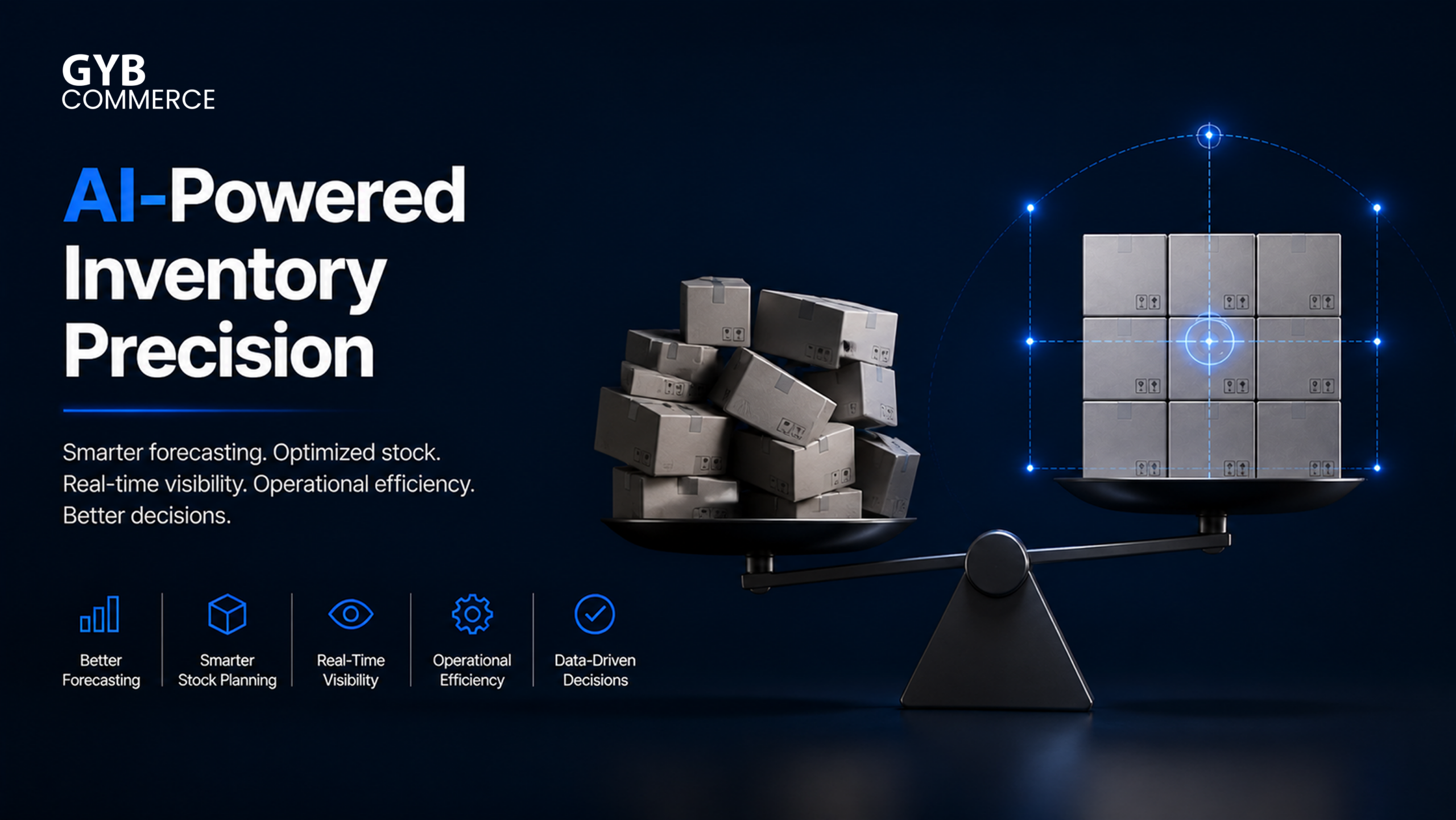
Inventory management has become more complex as demand patterns shift and supply chains grow unpredictable. Businesses often struggle with stockouts, overstocking, and inaccurate forecasts. These issues directly impact revenue, costs, and customer satisfaction. This is where artificial intelligence begins to play a practical role in improving how inventory decisions are made.
AI does not replace inventory management. Instead, it enhances how data is used to plan, predict, and respond to demand changes. By analyzing large volumes of data, AI helps businesses move from reactive decisions to proactive planning. As a result, inventory becomes more aligned with real-world demand.
Role of AI in Modern Inventory Management
At its core, AI helps businesses make better inventory decisions using data. Traditional systems rely heavily on historical records and manual inputs. However, these methods often fail when demand patterns change quickly. AI addresses this gap by continuously analyzing both past and real-time data.
AI uses machine learning to process data. This shows how technology is changing inventory management practices today by replacing manual tracking
Moreover, AI systems improve visibility across the supply chain. Instead of relying on periodic updates, businesses can monitor stock levels continuously. This shift enables more accurate planning and reduces the risk of costly inventory mistakes.
AI-Driven Decision Making in Inventory Systems
AI systems process large volumes of structured and unstructured data. They identify trends that are difficult to detect manually. As a result, businesses can make more informed decisions about stock levels and replenishment.
Improving Operational Efficiency with AI
By automating routine inventory tasks, AI reduces the need for manual intervention. This improves efficiency and allows teams to focus on higher-value activities such as planning and optimization.
Learn more about AI Inventory Forecasting Solutions by GYB Commerce
AI Improves Demand Forecasting and Planning
Demand forecasting is one of the most critical parts of inventory management. Without accurate forecasts, businesses either overstock or run out of products. Traditional forecasting methods often rely on static historical data, which limits their accuracy. In contrast, AI introduces a dynamic approach to forecasting.
AI models analyze multiple data sources at once. These include historical sales, seasonal trends, market conditions, and customer behavior. By combining these inputs, AI creates more accurate demand predictions. As a result, businesses can plan inventory levels with greater confidence.
How AI Forecasting Works in Practice
AI-driven forecasting systems rely on machine learning models that continuously learn from new data. Instead of fixed assumptions, these models adapt to changing patterns. This makes forecasting more responsive to real-world conditions.
For example, AI can detect subtle demand shifts caused by promotions, weather changes, or external events. It then adjusts forecasts in real time. This level of adaptability is difficult to achieve with manual methods.
Key Benefits of AI in Demand Forecasting
-
- More accurate demand predictions based on real-time data
-
- Reduced risk of stockouts and excess inventory
-
- Better alignment between supply and customer demand
-
- Improved planning across supply chain operations
A major benefit is seeing how AI helps companies avoid stockouts and overstocking during seasonal shifts.
As forecasting becomes more accurate, inventory decisions also improve. Businesses can reduce uncertainty and operate with greater efficiency.
AI Helps Optimize Inventory Levels
Maintaining the right inventory levels is a constant challenge. Holding too much stock increases storage costs, while too little leads to missed sales. AI helps solve this problem by continuously optimizing inventory based on demand signals.
AI adjusts stock levels based on real-time data. You can learn how to automate inventory calculations using AI to maintain balance. They consider factors such as lead times, demand variability, and supplier performance. This allows businesses to maintain optimal inventory without overcompensating.
In addition, AI supports automated replenishment decisions. When stock levels fall below a calculated threshold, the system can trigger restocking actions. This reduces manual intervention and ensures consistency in inventory control.
Common Use Cases of AI in Inventory Optimization
-
- Automated stock replenishment based on demand forecasts
-
- Safety stock adjustments using real-time data
-
- SKU-level optimization for better product mix
-
- Inventory allocation across multiple locations
These capabilities help businesses reduce waste while improving product availability. Over time, this leads to better cost control and higher operational efficiency.
AI Enables Real-Time Inventory Visibility
Another important advantage of AI is real-time visibility. Traditional inventory systems often rely on periodic updates, which creates delays in decision-making. However, AI systems process data continuously, allowing businesses to track inventory in real time.
This is often supported by technologies such as IoT sensors and RFID tracking. These tools collect data from warehouses, stores, and supply chain networks. AI then analyzes this data to provide accurate and up-to-date inventory insights.
As a result, businesses gain a clearer view of stock movements and supply chain conditions. This visibility helps identify potential issues early, such as delays or demand spikes. It also improves coordination across different parts of the supply chain.
Impact of Real-Time Visibility on Inventory Decisions
With continuous data access, businesses can react faster to inventory changes. This reduces the chances of stock imbalances and improves overall supply chain responsiveness.
Role of Connected Technologies in Inventory Tracking
Technologies like IoT and RFID enable constant tracking of inventory across locations. When combined with AI, they provide deeper insights into stock behavior and operational performance.
Data Requirements for AI Inventory Systems
AI systems depend on data quality and consistency to deliver accurate results. Without reliable data, predictions and recommendations can quickly become misleading. Therefore, before implementing AI, businesses must ensure their data infrastructure is well-structured and accessible.
In most cases, AI combines data from multiple sources across the supply chain. These include sales transactions, inventory records, supplier data, and external signals such as market trends. By bringing these inputs together, AI creates a unified view of inventory operations.
Equally important, data must be updated continuously. Static datasets limit the effectiveness of predictive models. Real-time data allows AI systems to adjust forecasts and recommendations as conditions change.
Key Data Inputs for AI Inventory Systems
-
- Historical sales data and demand patterns
-
- Real-time inventory levels across locations
-
- Supplier lead times and delivery performance
-
- SKU-level product data and turnover rates
-
- External factors such as seasonality and trends
When these data sources are properly integrated, AI systems can generate more reliable insights. As a result, businesses gain better control over inventory planning and execution.
Limitations of Traditional Inventory Management Methods
Traditional inventory management methods often rely on spreadsheets or basic software tools. While these approaches can work at a small scale, they become less effective as operations grow. Manual updates introduce delays and increase the risk of human error.
Another limitation is the heavy dependence on historical data. Although past trends provide useful context, they do not capture sudden changes in demand or supply conditions. This makes it difficult to respond quickly to market shifts.
In addition, traditional systems lack real-time visibility. Inventory updates are usually periodic, which leads to outdated information. Consequently, businesses make decisions based on incomplete data, increasing the risk of stock imbalances.
Common Challenges in Traditional Inventory Management
-
- Inaccurate forecasting due to static data
-
- Slow decision-making caused by manual processes
-
- Limited visibility across supply chain operations
-
- Higher risk of stockouts and excess inventory
-
- Difficulty scaling inventory processes as complexity increases
As these challenges grow, businesses begin to experience operational inefficiencies and rising costs. At this stage, more advanced approaches become necessary.
Explore AI inventory forecasting systems to improve planning accuracy
When Businesses Should Adopt AI in Inventory Management
AI adoption is not always immediate, but certain conditions signal the need for change. Businesses that experience frequent inventory issues often reach a point where traditional methods are no longer sufficient.
One common indicator is recurring stock imbalance. Frequent stockouts or overstocking suggest that forecasting methods are not accurate enough. Similarly, reliance on manual processes makes it difficult to maintain consistency as operations expand.
Another important factor is supply chain complexity. As businesses grow across multiple channels or regions, managing inventory manually becomes inefficient. AI helps handle this complexity by automating decisions and improving coordination.
Signs That Indicate the Need for AI
-
- Frequent stock shortages or excess inventory
-
- Increasing number of products and SKUs
-
- High variability in demand patterns
-
- Dependence on spreadsheets or manual tracking
-
- Limited real-time visibility across operations
When these conditions start affecting performance, AI becomes a practical step forward. It allows businesses to transition toward data-driven inventory management.
Frequently Asked Questions
How is AI used in inventory management in real-world systems?
AI is used in inventory management to analyze large datasets and predict demand patterns. It helps automate stock decisions and improve planning accuracy. Businesses use it to reduce errors and respond faster to changing conditions.
What are the main benefits of AI in inventory management?
AI improves forecasting accuracy, reduces operational costs, and enhances efficiency. It also helps maintain optimal stock levels and improves customer satisfaction. These improvements make inventory processes more reliable and scalable.
Can small businesses use AI for inventory management?
Small businesses can use AI through cloud-based tools and scalable platforms. Many solutions are designed to work without complex infrastructure. This makes AI accessible even for businesses with limited resources.
How does AI reduce stockouts and overstocking?
AI analyzes both historical and real-time data to predict demand more accurately. This allows businesses to maintain balanced inventory levels. As a result, the risk of shortages and excess stock is significantly reduced.
What data is needed for AI inventory systems?
AI systems require data such as sales history, stock levels, supplier performance, and external demand signals. Accurate and integrated data improves the quality of predictions and recommendations.
Is AI inventory management difficult to implement?
Implementation can be challenging if data systems are fragmented or inconsistent. However, modern tools simplify integration and deployment. Businesses can adopt AI gradually by starting with specific use cases.
How is AI different from traditional inventory management?
Traditional methods rely on manual inputs and static historical data. AI uses predictive models and real-time data to improve accuracy. This enables faster and more informed inventory decisions.
Hire Our AI Inventory Forecasting Engineers
Final Takeaways
AI is changing how inventory management operates by improving accuracy, efficiency, and responsiveness. Instead of relying on static data and manual processes, businesses can use AI to adapt to demand changes in real time. This shift helps reduce common problems such as stockouts, overstocking, and operational inefficiencies.
At the same time, successful adoption depends on strong data foundations and clear business objectives. When implemented correctly, AI enables more reliable forecasting and better inventory control.
As inventory operations become more complex, relying on traditional methods becomes increasingly difficult. AI provides a practical path toward building a more scalable and data-driven inventory system.