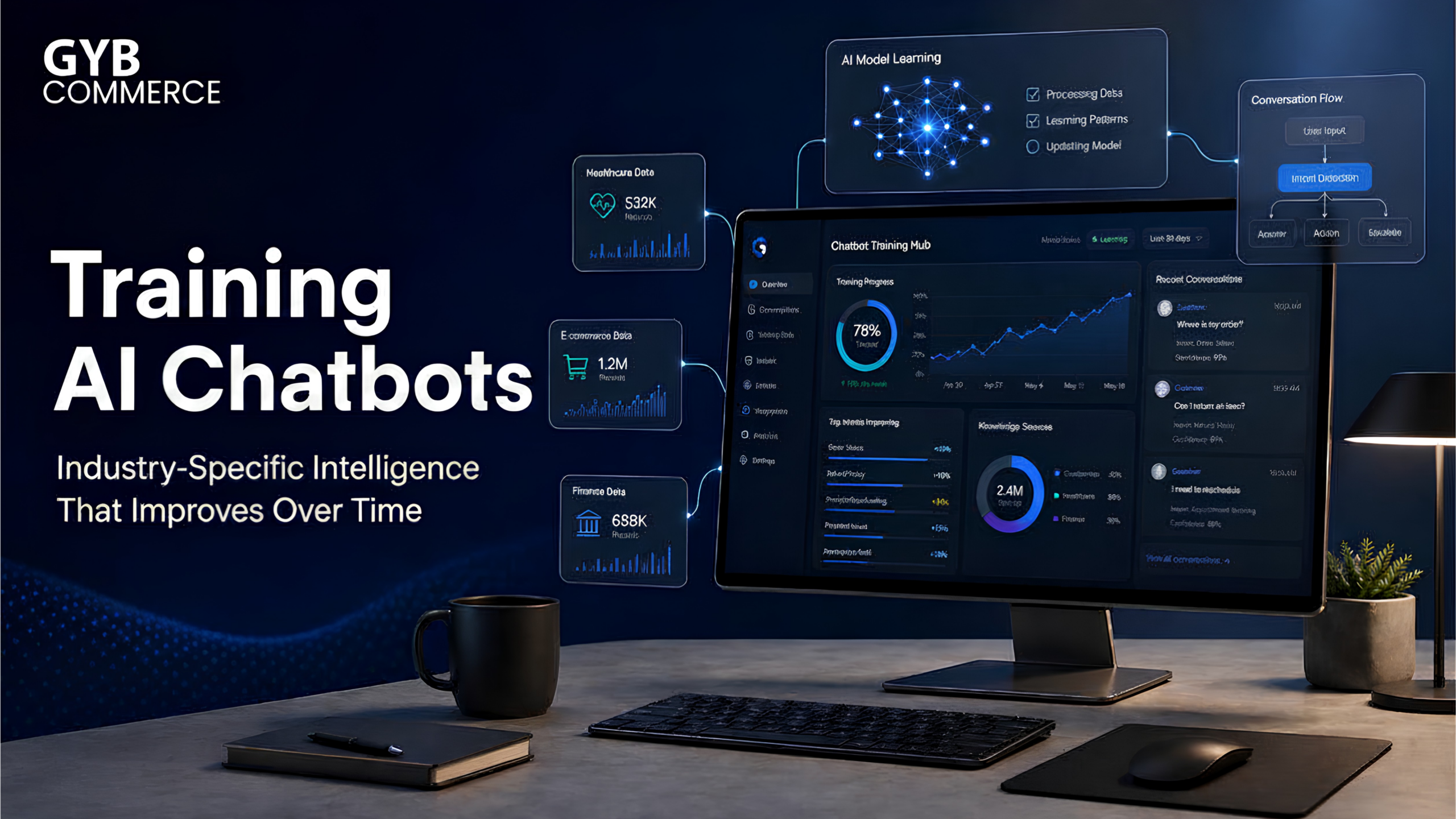
Training an AI chatbot is where most of the real work happens. Many chatbots look functional at launch, but they fail when users ask real questions. This usually happens because the chatbot was not trained properly on real data. Without training, it cannot understand context, intent, or industry-specific language.
This guide focuses on how to train a chatbot step by step using practical methods. Instead of generic advice, it explains how real businesses prepare data, improve accuracy, and adapt chatbots for specific industries. By the end, you will understand what actually makes a chatbot reliable.
Table of Contents
What Does Training an AI Chatbot Actually Mean
Training a chatbot is not just adding responses or writing scripts. It is the process of teaching the system how to understand and respond to user input. This is done using data, patterns, and continuous improvement.
Understanding How AI Chatbots Learn from Data
AI chatbots learn from examples, not fixed rules. They analyze patterns in conversations and use those patterns to predict responses. This is powered by technologies like Natural Language Processing and Machine Learning.
For example, when users ask similar questions in different ways, the chatbot learns to group them under the same intent. Over time, it becomes better at understanding variations. This is what makes AI chatbots more flexible than rule-based systems.
Difference Between Rule-Based Setup and AI Training
A rule-based chatbot works on predefined conditions. It responds only when the input matches specific keywords or phrases. This makes it predictable but limited.
An AI chatbot, on the other hand, learns from data and improves over time. It does not rely on exact matches. Instead, it understands intent and context. This allows it to handle more natural conversations.
Why Training Determines Chatbot Accuracy
The quality of training directly affects chatbot performance. If the training data is limited or poorly structured, the chatbot will struggle. It may give irrelevant answers or fail to respond correctly.
Accurate training improves response quality and reduces errors. It also makes interactions feel more natural. This is why training is the most critical part of chatbot development.
Let’s Talk About AI Chatbot Development
Why Industry-Specific Training Is Important
Not all chatbots are the same. A chatbot for ecommerce behaves differently from one used in healthcare or finance. Each industry has its own terminology, user expectations, and types of queries.
Handling Industry Terminology and Context
Different industries use different language. Customers in healthcare, for example, may use technical terms or describe symptoms. Ecommerce users may focus on products, orders, and delivery.
A generic chatbot cannot handle these variations effectively. Training it with industry-specific data helps it understand context better. This improves accuracy and relevance.
Improving Response Relevance for Users
Users expect precise answers, not generic responses. When a chatbot understands industry context, it can provide more useful information. This improves user satisfaction.
For example, a finance chatbot should understand terms related to payments, accounts, and transactions. Without proper training, it may misinterpret these queries.
Reducing Errors in Customer Interactions
Errors in chatbot responses can frustrate users. They may lose trust in the system and stop using it. Industry-specific training reduces these errors by improving understanding.
When the chatbot is trained properly, it handles queries more accurately. This leads to smoother interactions and better outcomes.
If you haven’t built the base chatbot yet, start with our guide on how to build an AI chatbot from scratch before moving into training and fine-tuning.
Types of Data Used to Train AI Chatbots
Data is the foundation of chatbot training. The quality and variety of data determine how well the chatbot performs. Using the right data sources is essential for building an effective system.
Customer Support Chats and Conversation Logs
Past conversations are one of the most valuable data sources. They show how customers actually communicate. This includes questions, complaints, and common issues.
Analyzing chat logs helps identify patterns and frequently asked questions. These insights can be used to train the chatbot more effectively. Real data always performs better than assumptions .
FAQs, Documents, and Knowledge Bases
Structured content like FAQs and documentation provides clear information. This helps the chatbot deliver accurate responses. It also ensures consistency across interactions.
These sources are especially useful for training chatbots on product or service details. They provide reliable information that can be reused in different scenarios.
CRM and Business Data
CRM systems contain valuable customer information. This includes past interactions, preferences, and purchase history. Integrating this data improves personalization.
When a chatbot has access to this information, it can provide more relevant responses. This enhances the overall user experience.
Synthetic vs Real Training Data
Synthetic data is created manually to simulate conversations. It is useful for initial setup and controlled scenarios. However, it lacks the complexity of real interactions.
Real data includes natural language, errors, and variations. It reflects how users actually communicate. Combining both types of data creates a more balanced training approach.
Training fits into a larger development workflow. Our step-by-step AI chatbot development process shows you exactly where training sits in the full project lifecycle.
Step-by-Step Process to Train an AI Chatbot
Training a chatbot requires a structured approach. Skipping steps can lead to poor performance. Following a clear process improves accuracy and reliability.
Defining Chatbot Goals and Use Cases
The first step is defining what the chatbot should do. This includes identifying use cases such as customer support, lead generation, or internal assistance.
Clear goals help shape the training process. They determine what data is needed and how the chatbot should respond. Without this clarity, training becomes unfocused.
Collecting and Preparing Training Data
Once goals are defined, the next step is collecting data. This includes gathering conversations, documents, and other relevant information. The data should be cleaned and organized.
Preparation is important because messy data can confuse the chatbot. Structured data improves learning and accuracy. This step lays the foundation for effective training.
The training approach you choose often depends on whether you’re working with a pre-built chatbot platform or a custom model. Our AI chatbot builder vs custom development comparison explains the tradeoffs.
Designing Intents and Entities
Intents represent what the user wants to achieve. Entities capture specific details within a query. Together, they help the chatbot understand both purpose and context.
For example, a user asking about order status has a clear intent. The order number or product name becomes the entity. Proper design improves understanding.
Building Conversation Flows
Conversation flow defines how interactions progress. It includes greetings, responses, and fallback options. A clear flow ensures that users are guided properly.
Planning different scenarios helps handle unexpected inputs. This improves the chatbot’s ability to manage real conversations. Consistency is key for a smooth experience.
Training the AI Model
At this stage, the chatbot is trained using the prepared data. The model learns patterns, identifies intents, and generates responses. This process may take time depending on complexity.
Training is not a one-time task. It requires adjustments and updates. Continuous learning improves performance over time.
Testing and Refining Responses
Testing helps identify errors and gaps in training. It involves simulating real user interactions and analyzing responses. This step is essential for improving accuracy.
Refinement includes updating data, adjusting intents, and improving responses. Regular testing ensures the chatbot remains effective.
Deploying and Monitoring Performance
Once the chatbot is ready, it is deployed for real use. However, training does not stop here. Monitoring performance helps identify areas for improvement.
Tracking interactions provides valuable insights. These insights can be used to refine the chatbot further. Continuous monitoring ensures long-term success.
How Natural Language Processing Improves Chatbot Training
Natural Language Processing plays a key role in chatbot training. It allows the chatbot to understand how people actually communicate. This includes handling variations, context, and tone.
Role of NLP in Understanding User Intent
NLP helps the chatbot identify the intent behind a message. It goes beyond keywords and focuses on meaning. This improves accuracy and relevance.
For example, different phrases with the same meaning are grouped together. This allows the chatbot to respond consistently.
Handling Variations, Slang, and Real Language
Users rarely follow perfect grammar when interacting with chatbots. They use slang, abbreviations, and incomplete sentences. NLP helps the chatbot handle these variations.
Training with diverse examples improves performance. It prepares the chatbot for real-world interactions. This makes conversations more natural.
Improving Contextual Understanding
Context is important in conversations. NLP allows the chatbot to remember previous interactions and respond accordingly. This improves flow and coherence.
Better context handling leads to more meaningful interactions. It also reduces confusion and repetition.
Best Practices to Train AI Chatbots Effectively
Training a chatbot is not just about feeding it data. The way you train it determines how well it performs in real situations. Following best practices helps improve accuracy and reduces common issues.
Using Real Conversation Data Instead of Assumptions
Many chatbots fail because they are trained on assumptions rather than real data. Businesses often guess what users might ask instead of analyzing actual conversations. This leads to gaps in understanding.
Using real chat logs and customer queries improves accuracy. It reflects how users actually communicate. This makes the chatbot more reliable in real scenarios.
Training with Diverse and Messy Inputs
Users do not follow structured language. They make typos, use slang, and ask incomplete questions. Training the chatbot with only clean data limits its ability to handle real interactions.
Including messy and varied inputs prepares the chatbot for real-world usage. It improves flexibility and reduces errors. This makes conversations feel more natural.
Continuously Updating Training Datasets
Training is an ongoing process, not a one-time task. New queries, products, and user behaviors emerge over time. Without updates, the chatbot becomes outdated.
Regularly updating training data keeps the chatbot relevant. It improves performance and adapts to changing needs. Continuous improvement is essential for long-term success.
Balancing Automation with Human Fallback
A chatbot should not try to handle every situation alone. Some queries require human intervention. Ignoring this can lead to frustration.
Providing a fallback option ensures users can reach human support when needed. This creates a better experience. It also builds trust in the system.
Common Mistakes in AI Chatbot Training
Even well-designed chatbots can fail due to training mistakes. Identifying these issues early helps prevent performance problems. Avoiding common mistakes improves reliability.
Using Limited or Poor-Quality Data
Low-quality data leads to inaccurate responses. If the chatbot is trained on incomplete or irrelevant data, it cannot perform well. This creates confusion for users.
High-quality data improves understanding and accuracy. It ensures the chatbot delivers meaningful responses. Investing in data quality is essential.
Ignoring User Intent Variations
Users ask the same question in many different ways. Failing to account for these variations limits the chatbot’s effectiveness. It may only respond to specific phrasing.
Training with multiple variations improves intent recognition. It helps the chatbot understand different ways of asking the same question. This increases accuracy.
Over-Relying on Scripts Instead of Learning
Some chatbots depend too much on predefined scripts. While scripts are useful, they limit flexibility. This makes the chatbot less adaptive.
AI chatbots should learn from data instead of relying only on scripts. This allows them to handle dynamic conversations. It improves overall performance.
Not Monitoring Chatbot Performance
Once deployed, many chatbots are left without proper monitoring. This leads to missed opportunities for improvement. Performance issues remain unresolved.
Tracking interactions helps identify gaps and errors. Continuous monitoring ensures the chatbot evolves over time. This is critical for maintaining effectiveness.
How to Train AI Chatbots for Different Industries
Training requirements vary across industries. Each sector has unique language, workflows, and user expectations. Adapting training to these differences improves performance.
Training Chatbots for Ecommerce Use Cases
Ecommerce chatbots focus on products, orders, and customer support. Training data includes product catalogs, FAQs, and order history. This helps the chatbot provide accurate information.
Personalization is important in ecommerce. Chatbots should recommend products and assist with purchases. This improves user experience and conversions.
Training Chatbots for Healthcare Queries
Healthcare chatbots require careful handling of sensitive information. Training data includes medical terminology, patient queries, and guidelines. Accuracy is critical in this field.
Compliance and privacy are also important. The chatbot must follow strict regulations. Proper training ensures safe and reliable interactions.
Training Chatbots for Finance and Services
Finance chatbots handle transactions, account information, and customer inquiries. Training involves financial terminology and structured data. Precision is essential to avoid errors.
These chatbots must also handle security concerns. Proper training helps maintain accuracy and trust. It ensures reliable performance.
Adapting Chatbot Tone and Responses per Industry
Tone plays a significant role in user experience. A healthcare chatbot should be formal and reassuring. An ecommerce chatbot can be more conversational and engaging.
Training the chatbot to match industry tone improves communication. It makes interactions more relevant and comfortable for users.
How to Measure and Improve Chatbot Performance
Measuring performance helps determine whether the chatbot is effective. Without proper metrics, it is difficult to identify areas for improvement. Tracking key indicators provides valuable insights.
Tracking Accuracy and Response Success Rate
Accuracy measures how often the chatbot provides correct responses. A high accuracy rate indicates effective training. Low accuracy highlights areas that need improvement.
Response success rate shows how often the chatbot resolves user queries. Monitoring these metrics helps refine performance.
Analyzing Chat Logs and User Feedback
Chat logs provide real insights into user interactions. They reveal common issues and patterns. Analyzing these logs helps improve training.
User feedback also plays an important role. It highlights areas where the chatbot falls short. This feedback can be used to refine responses.
Improving Chatbot Over Time with New Data
Continuous improvement is key to chatbot success. Adding new data helps the chatbot adapt to changing needs. This keeps it relevant and effective.
Regular updates improve accuracy and performance. Over time, the chatbot becomes more reliable.
Challenges in Training AI Chatbots
Training AI chatbots comes with several challenges. Understanding these challenges helps prepare for them. It also improves the overall development process.
Handling Complex and Unpredictable Queries
Users often ask unexpected or complex questions. These queries are difficult to handle without proper training. They require advanced understanding.
Improving training data helps address these challenges. It prepares the chatbot for diverse scenarios.
Maintaining Consistency Across Channels
Chatbots are often deployed across multiple platforms. Maintaining consistent responses across channels can be challenging. Differences in user behavior add complexity.
Standardizing training helps maintain consistency. It ensures uniform performance across platforms.
Scaling Training as Data Grows
As data increases, managing training becomes more complex. Larger datasets require better organization and processing. This adds to the effort required.
Using structured approaches helps manage scalability. It ensures the chatbot continues to perform well.
CTA: Get Started with GYB Commerce
Frequently Asked Questions
How to train AI chatbot for industry-specific questions effectively?
Training an AI chatbot for industry-specific questions requires using relevant data from that industry. This includes real conversations, documents, and customer queries. The chatbot should be trained to understand terminology, context, and user intent specific to that field.
Regular updates and continuous learning are essential. As new data becomes available, it should be added to improve accuracy. This ensures the chatbot remains effective over time.
What data is needed to train an AI chatbot?
Training data includes chat logs, FAQs, documents, and structured business data. These sources provide the information needed for accurate responses. High-quality data improves performance significantly.
Combining different data sources creates a more balanced training set. This helps the chatbot handle a wide range of queries.
How long does it take to train an AI chatbot?
The time required depends on complexity and data availability. A simple chatbot can be trained in a few days or weeks. More advanced systems may take several months.
Factors such as data preparation, testing, and refinement affect timelines. Proper planning helps manage this process.
Can I train a chatbot without coding?
Yes, it is possible to train a chatbot using no code platforms. These tools provide visual interfaces that simplify the process. They are suitable for beginners and small projects.
However, advanced customization may require coding. This provides greater control and flexibility.
How to improve chatbot accuracy over time?
Improving accuracy requires continuous updates to training data. Analyzing chat logs and user feedback helps identify gaps. Updating responses improves performance.
Regular testing and refinement ensure consistent improvement. This process is ongoing.
What are the biggest challenges in chatbot training?
Common challenges include handling complex queries, managing large datasets, and maintaining consistency. These issues can affect performance if not addressed properly.
Using structured approaches and continuous monitoring helps overcome these challenges. Proper planning is essential.
Is chatbot training different for each industry?
Yes, chatbot training varies across industries. Each sector has unique language, workflows, and user expectations. Training must reflect these differences.
Using industry-specific data improves accuracy and relevance. This ensures better performance.
Final Takeaways
Training an AI chatbot is the most critical step in making it effective. Without proper training, even advanced systems fail to deliver accurate responses. Focusing on data quality, structure, and continuous improvement leads to better results.
A well-trained chatbot adapts to user needs, handles real conversations, and improves over time. Businesses that invest in proper training achieve more reliable and scalable outcomes.