AI search is often treated as an upgrade. Many assume that adding machine learning or embeddings will instantly improve relevance and performance. However, in real-world systems, this assumption rarely holds.
In practice, AI search introduces new layers of complexity. If the underlying system is not designed correctly, performance can degrade instead of improving. This is why many implementations fail to deliver expected results.
Why Most AI Search Implementations Underperform
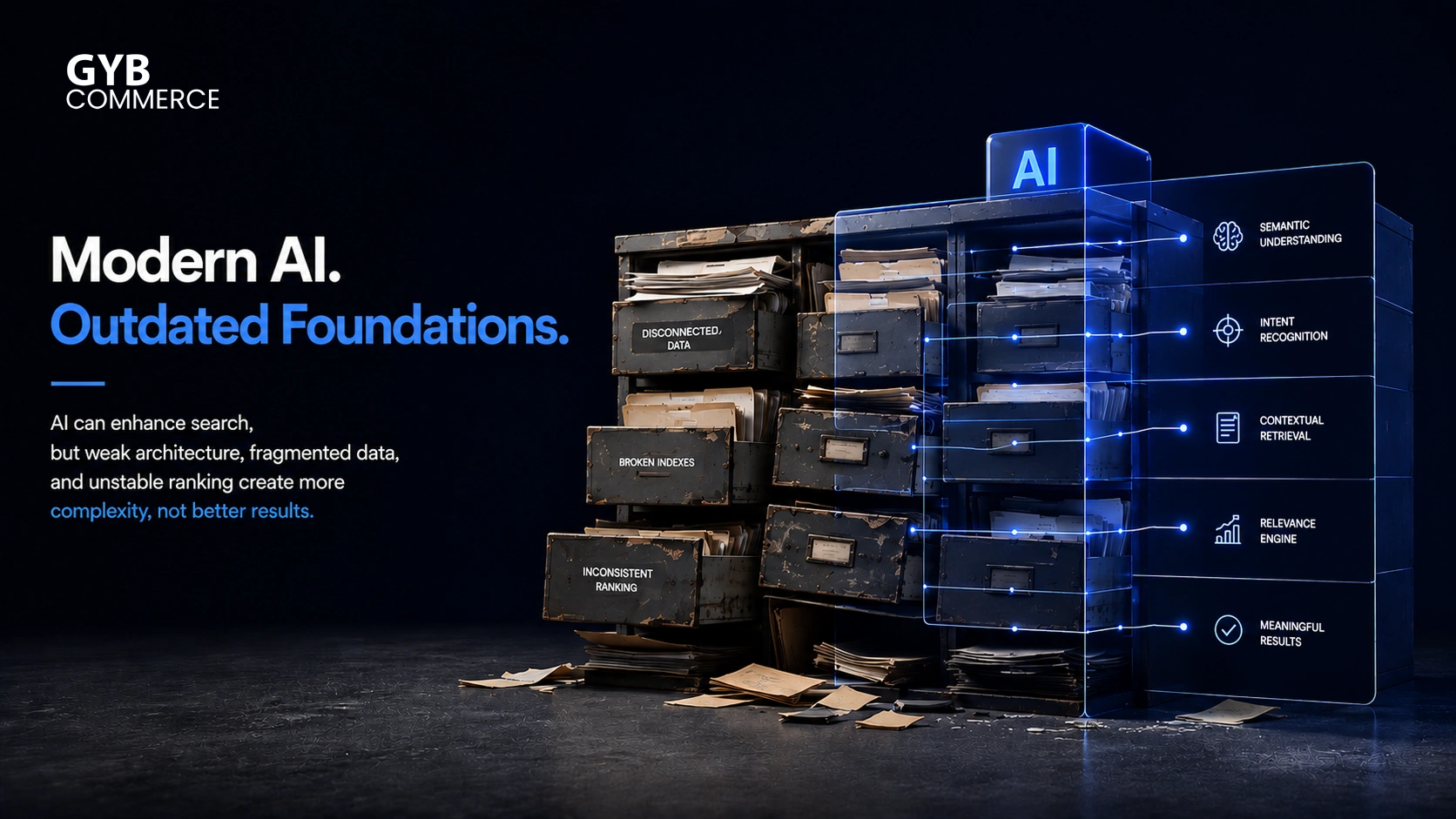
AI search systems fail not because the technology is weak, but because the implementation is flawed. Most organizations adopt AI at the surface level without restructuring their search architecture. This creates a mismatch between system capability and system design.
Instead of improving relevance, AI layers are often added on top of broken foundations. As a result, the system becomes more complex but not more effective. This leads to inconsistent results and poor user experience.
In many cases, failure is caused by:
- Misalignment between AI models and business use cases
- Lack of structured data pipelines
- Poor integration with existing search systems
These issues prevent AI from functioning as intended.
Where AI Search Systems Start Breaking Down
AI search does not fail at one point. It breaks across multiple layers of the system. Each layer introduces its own challenges, and small issues compound as queries move through the pipeline.
The first breakdown often occurs at the query level. If the system cannot correctly interpret user intent, everything that follows becomes unreliable. This creates a cascading failure across the system.
Understanding where these failures occur requires looking at the system step by step. This is not a single problem but a chain of interdependent issues.
You must learn what happens inside a modern AI search engine to identify these specific breakdown points.
Query Understanding Failures in AI Search Systems
Query understanding is the first critical layer in any AI search system. If this layer fails, the entire pipeline is affected. Despite advances in natural language processing, many systems still struggle to interpret intent accurately.
This happens because queries are often ambiguous, incomplete, or context-dependent. AI models may misclassify intent or fail to capture the user’s goal. As a result, the system retrieves irrelevant or partially relevant results.
Common query-level issues include:
- Misinterpretation of ambiguous queries
- Weak intent classification for multi-purpose searches
- Poor handling of long-tail or conversational queries
These failures create a weak foundation for the rest of the system.
Data Quality and Data Silos as Core Limitations
AI search systems rely heavily on data. However, in real-world environments, data is rarely clean, structured, or unified. This creates a major limitation at the system level.
Data often exists in silos across different platforms. Product data, user behavior data, and content data may not be connected. Without integration, AI models operate on incomplete information.
Poor data quality introduces additional challenges:
- Inconsistent or missing data fields
- Outdated or irrelevant information
- Lack of standardized data formats
These issues reduce the accuracy of both retrieval and ranking processes.
Why Embeddings Alone Do Not Fix Search Relevance
Embeddings are often seen as the solution to search problems. They allow systems to represent meaning and improve semantic matching. However, embeddings alone do not guarantee better results.
If the underlying data is weak or the query is misunderstood, embeddings amplify the problem. They retrieve results based on flawed inputs, which leads to irrelevant outputs.
The limitations of relying only on embeddings include:
- Retrieval of semantically similar but irrelevant content
- Lack of alignment with business intent or user goals
- Over-reliance on similarity without contextual validation
This shows that embeddings are only one part of the system, not a complete solution.
The Cold Start Problem in AI Search Systems
AI search systems require data to perform effectively. However, new systems or new datasets often lack sufficient historical data. This creates what is known as the cold start problem.
Without enough data, AI models cannot learn patterns or optimize results. This leads to poor relevance in the early stages of implementation. Users may experience inconsistent or low-quality search results.
Cold start challenges typically include:
- Lack of user interaction data for training models
- Limited content relationships for semantic mapping
- Inability to refine results through feedback loops
This slows down system performance and delays optimization.
Why AI Search Cannot Compensate for Weak System Design
One of the biggest misconceptions is that AI can fix existing search problems. In reality, AI amplifies both strengths and weaknesses. If the system design is flawed, AI will not correct it.
Search systems require strong architecture, clean data, and aligned ranking logic. Without these elements, AI becomes an added layer of complexity rather than a solution.
This is where most implementations fail. Organizations focus on adding AI features instead of fixing system fundamentals. As a result, performance issues persist or even worsen. This raises the critical question of do you actually need an AI search engine before making these investments.
What This Means for Real-World AI Search Implementation
AI search must be treated as a system-level transformation, not a feature upgrade. It requires rethinking how queries are processed, how data is structured, and how results are ranked.
Without this approach, implementations remain fragmented. Systems may appear advanced but fail to deliver meaningful improvements. This creates a gap between expectation and reality.
Ranking Failures and Misaligned Relevance Signals
Once data is retrieved, ranking becomes the deciding layer. This is where most AI search systems silently fail. Even if retrieval is correct, weak ranking logic can distort the final output.
AI models often prioritize semantic similarity over actual usefulness. This creates a gap between relevance and intent. As a result, users receive results that are technically related but practically unhelpful.
Common ranking failures include:
- Over-reliance on similarity instead of intent alignment
- Weak integration of business rules into ranking logic
- Poor handling of multi-intent queries
These issues reduce the effectiveness of the entire search system.
Re-Ranking Complexity and System Instability
To improve accuracy, many systems introduce re-ranking layers. However, these layers add complexity and often create instability. Instead of fixing errors, they sometimes amplify inconsistencies.
Re-ranking models depend heavily on context and data quality. If earlier stages are flawed, re-ranking cannot correct them effectively. This results in unpredictable outputs.
Over time, systems may exhibit:
- Inconsistent ranking behavior across similar queries
- Conflicting signals between ranking layers
- Increased latency due to additional processing
This makes the system harder to maintain and optimize.
Infrastructure Bottlenecks in AI Search Systems
AI search systems require significant computational resources. Unlike traditional search, they rely on embeddings, vector databases, and large models. This increases both cost and complexity.
Infrastructure becomes a critical constraint as systems scale. High query volumes and large datasets create performance challenges. Without proper architecture, systems struggle to maintain speed and reliability.
Key infrastructure challenges include:
- High memory and compute requirements for vector search
- Increased latency due to multi-stage processing
- Difficulty scaling real-time search performance
These bottlenecks limit the practical usability of AI search systems.
Model Drift and Performance Degradation Over Time
AI models do not remain accurate indefinitely. As data and user behavior evolve, models begin to drift. This leads to gradual degradation in performance.
Model drift is often overlooked during implementation. Systems may perform well initially but decline over time without continuous updates. This creates hidden reliability issues.
Typical signs of model drift include:
- Declining relevance in search results
- Increased mismatch between queries and outputs
- Reduced effectiveness of ranking models
Without monitoring and retraining, performance continues to deteriorate.
Scalability Challenges in Real-World Environments
Scaling AI search systems is not just a technical problem. It involves balancing performance, cost, and complexity. Many systems fail when moving from small-scale testing to production environments.
As data volume grows, maintaining relevance becomes more difficult. Systems must process more queries while preserving accuracy. This requires careful optimization across all layers.
Scaling challenges often include:
- Maintaining performance across large datasets
- Managing infrastructure costs at scale
- Ensuring consistent relevance under high load
These issues become more visible as systems expand.
Why AI Search Systems Become Hard to Maintain
As more layers are added, AI search systems become increasingly complex. Each component introduces dependencies that affect the entire system. This makes maintenance difficult.
Small changes in one layer can impact others. For example, updating a model may affect ranking behavior or retrieval accuracy. This interconnected nature creates operational challenges.
Over time, systems may experience:
- Increased debugging complexity
- Difficulty identifying root causes of failures
- Slower iteration cycles
This reduces agility and slows down improvement efforts.
System-Level Reality of AI Search Implementation
AI search is not a plug-and-play solution. It is a multi-layered system that requires alignment across data, models, and infrastructure. Without this alignment, performance issues are inevitable.
Most failures occur because systems are built in isolation. Teams focus on individual components instead of the overall architecture. This leads to fragmented implementations.
To avoid these issues, organizations must:
- Design systems with end-to-end alignment
- Integrate data, models, and ranking logic effectively
- Continuously monitor and optimize performance.
Partnering with professional AI powered search engine development services ensures this alignment from day one.
Frequently Asked Questions
Why do AI search systems fail in production environments?
AI search systems fail in production because real-world conditions introduce complexity that is not present in controlled environments. Issues such as poor data quality, infrastructure limitations, and scaling challenges become more visible. These factors affect performance and reliability.
Without proper system design, AI models cannot deliver consistent results. This leads to gaps between expected and actual performance.
How does model drift impact AI search performance?
Model drift causes AI search systems to lose accuracy over time. As user behavior and data patterns change, models become outdated. This results in reduced relevance and increased mismatches in search results.
Regular monitoring and retraining are required to maintain performance. Without this, systems gradually degrade.
Why is ranking more difficult in AI search systems?
Ranking in AI search systems involves balancing multiple signals such as semantic relevance, user behavior, and business logic. Unlike traditional systems, these signals can conflict with each other. This makes ranking more complex.
If not managed properly, ranking models may prioritize the wrong factors. This leads to irrelevant or inconsistent results.
What makes AI search infrastructure challenging to scale?
AI search infrastructure requires high computational power and memory. Systems must process embeddings, vector searches, and model inference in real time. This increases both cost and complexity.
As query volume grows, maintaining performance becomes difficult. Without optimized infrastructure, latency and reliability issues arise.
How can organizations avoid common AI search implementation failures?
Organizations must focus on system-level design rather than isolated components. This includes aligning data pipelines, query processing, and ranking logic. Each layer must work together effectively.
Continuous monitoring, testing, and optimization are also essential. Without these, systems cannot maintain performance over time.
Final Takeaways
AI search systems fail when they are treated as feature upgrades instead of system transformations. Issues across data, ranking, infrastructure, and scaling create compounded failures.
The complexity of AI search requires careful architecture and continuous optimization. Without this, performance declines despite advanced technology.
Organizations that address these challenges at the system level achieve better relevance, scalability, and reliability. Those that do not will continue to face limitations in real-world implementations.