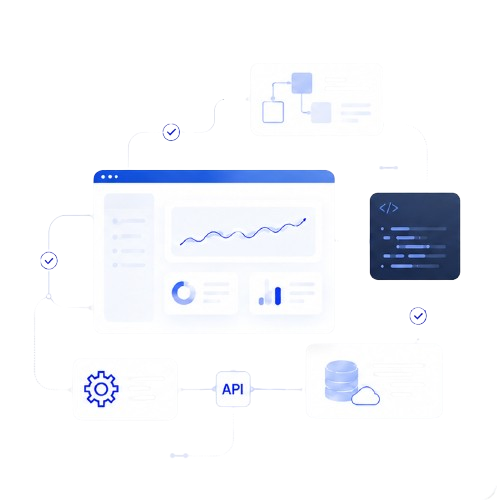
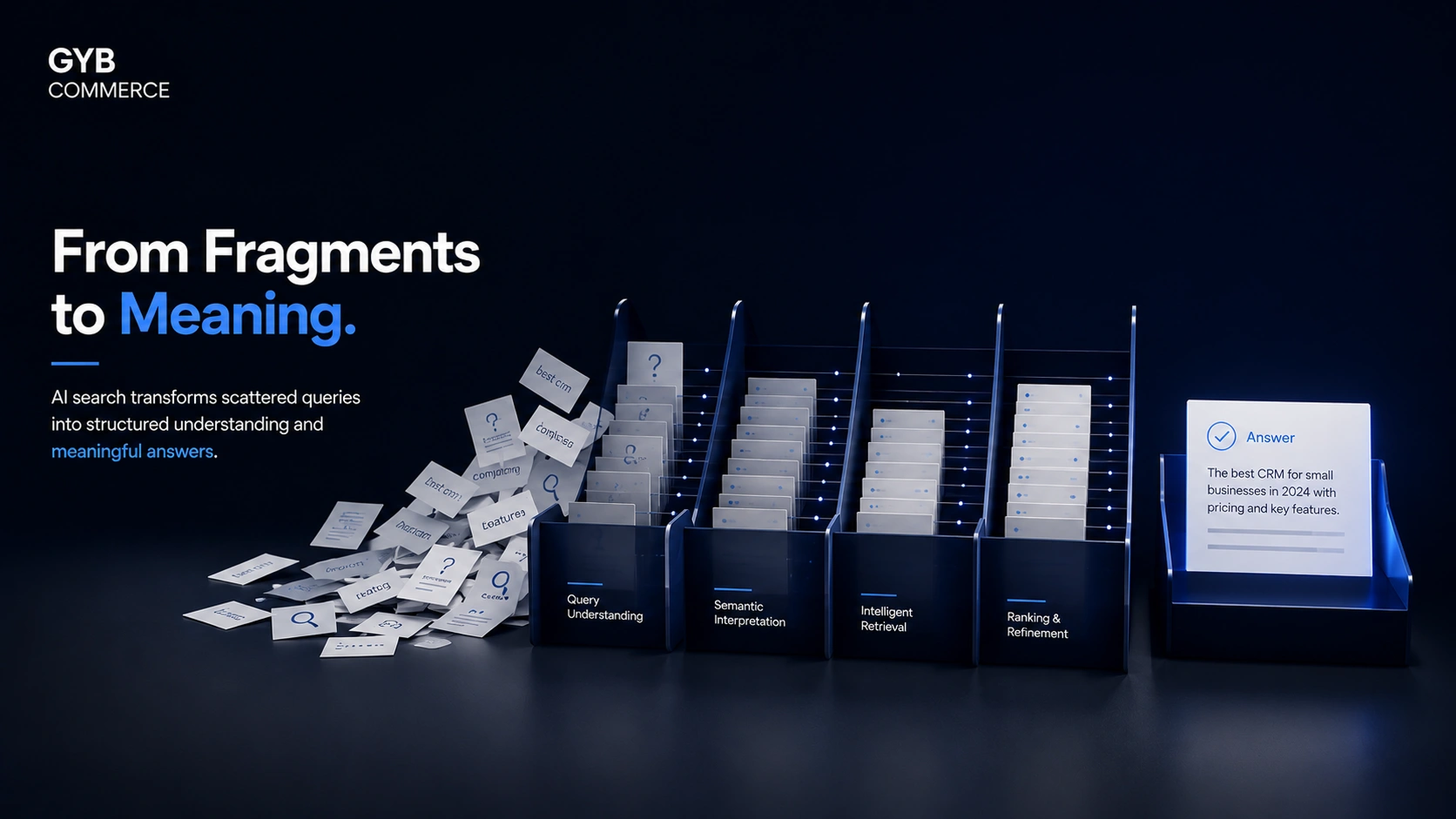
Search no longer works as a simple lookup system. Instead of matching keywords, modern AI search engines process queries through multiple layers of interpretation and decision-making. This shift changes how relevance is defined and delivered.
At a system level, AI search behaves more like a pipeline than a static engine. Each query moves through structured stages, where meaning is extracted, refined, and matched against data. Understanding this pipeline is essential to understanding how AI search actually works.
How an AI Search Engine Processes a Query
Every search begins with a query, but AI systems do not treat it as a string of words. Instead, they interpret it as a signal that needs to be analyzed, structured, and contextualized. This is where the first major shift from traditional search occurs.
Unlike keyword-based systems, AI search engines break queries into components such as intent, entities, and context. This allows them to move beyond literal interpretation and focus on meaning. As a result, even vague or incomplete queries can be understood more effectively.
At a high level, query processing involves:
- Parsing the query structure
- Identifying intent and user goal
- Detecting entities and relationships
- Normalizing language variations
Each of these steps refines the query before it moves further into the system.
What Happens During Query Understanding and Intent Detection
Once the query is processed, the system moves into a deeper understanding phase. Here, AI models analyze semantics rather than surface-level patterns. This is where natural language processing plays a critical role.
For example, queries like “best AI tools for business” and “top platforms for AI in companies” may use different words. However, AI systems recognize that both express similar intent. This allows them to unify different query variations under a shared meaning.
This stage typically includes:
- Semantic interpretation using NLP models
- Intent classification based on query patterns
- Context enrichment using historical and behavioral data
As a result, the system builds a structured representation of what the user is trying to achieve.
This shows exactly why search systems fail to understand user intent when using outdated methods.
How Embeddings and Vector Search Represent Meaning
After understanding the query, AI systems convert it into a numerical representation known as an embedding. This allows the system to compare meaning instead of matching words. In other words, search becomes a similarity problem rather than a keyword problem.
Embeddings place queries and content in a high-dimensional space. Items with similar meaning are positioned closer together, even if they use different language. This enables systems to retrieve relevant results more accurately.
Key characteristics of this process include:
- Transformation of text into vector representations
- Measurement of similarity between query and content
- Retrieval based on semantic closeness rather than keyword overlap
This is a fundamental shift that powers modern semantic search systems.
How Retrieval Systems Identify Relevant Information
Once the query is represented as an embedding, the system retrieves potential matches from its index. This step is known as retrieval, and it determines which pieces of content are relevant enough to be considered.
Unlike traditional indexing, AI search systems use vector databases and advanced retrieval techniques. These systems are designed to handle large-scale data while maintaining speed and accuracy. As a result, retrieval becomes both efficient and context-aware.
At this stage, the system focuses on:
- Finding semantically similar documents
- Filtering results based on relevance thresholds
- Expanding results using related concepts
This ensures that the system does not miss relevant information due to wording differences.
How Retrieval-Augmented Generation Enhances Search Results
Modern AI search engines often go beyond retrieval. They use a method called retrieval-augmented generation, which combines search with content generation. This allows systems to produce direct answers instead of just listing results.
In this approach, retrieved data is passed into large language models. These models generate responses by combining multiple sources into a coherent output. This is how AI-driven answers are created.
This process typically involves:
- Retrieving relevant documents or data sources
- Feeding this information into language models
- Generating structured, context-aware responses
As a result, users receive synthesized answers rather than fragmented links.
Discuss Your AI Powered Search Engine Visibility Project
How AI Search Differs from Traditional Search Systems
Traditional search systems rely on keyword matching and predefined ranking rules. They focus on retrieving documents that contain specific terms. While effective for simple queries, this approach struggles with complexity.
AI search systems, on the other hand, focus on understanding meaning and intent. They use semantic models, embeddings, and learning systems to improve relevance. This creates a more adaptive and intelligent search experience.
The core differences include:
- Keyword matching vs semantic understanding
- Static ranking vs dynamic learning
- Document retrieval vs answer generation
This shift defines the evolution of modern search systems.
What This Means for Modern Search Architecture
As search systems evolve, their architecture becomes more complex. Instead of a single engine, modern systems consist of multiple interconnected layers. Each layer performs a specific function within the pipeline.
These layers work together to process queries, retrieve data, and generate results. This modular approach allows systems to scale and adapt over time. It also enables continuous improvement based on user behavior.
Ranking Systems and Decision Layers in AI Search
Once relevant data is retrieved, the system does not immediately return results. Instead, it evaluates and ranks them using multiple decision layers. This stage determines which results are most useful for the user.
AI search engines rely on ranking models that go beyond basic relevance. They consider context, intent alignment, and user behavior signals. This allows the system to prioritize results that are more likely to satisfy the query.
At this stage, ranking decisions are influenced by:
- Semantic relevance between query and content
- User interaction signals such as clicks and dwell time
- Content quality and authority signals
These layers work together to refine and reorder results dynamically.
Re-Ranking and Contextual Refinement
Initial rankings are often adjusted through re-ranking systems. These systems apply deeper analysis to refine results further. This ensures that the final output aligns closely with user intent.
Re-ranking models evaluate context at a more granular level. They analyze how well each result fits the specific query scenario. This is especially important for ambiguous or multi-intent queries.
As a result, the system can:
- Reorder results based on deeper semantic alignment
- Adjust outputs using real-time context
- Improve accuracy for complex queries
This additional layer improves both relevance and user experience.
AI-Generated Answers and Response Synthesis
Modern AI search systems increasingly generate answers instead of only listing links. This is done using large language models that synthesize information from multiple sources. The goal is to provide a direct and complete response.
This approach changes how users interact with search. Instead of navigating through multiple pages, users receive a consolidated answer. This reduces friction and speeds up information access.
The generation process typically includes:
- Combining data from multiple retrieved sources
- Structuring information into a coherent response
- Ensuring alignment with the original query intent
This is how AI-powered search delivers direct answers instead of fragmented results.
Feedback Loops and Continuous Learning
AI search systems improve over time through feedback loops. These loops use user interactions to refine future results. This makes the system adaptive rather than static.
Every interaction provides signals about relevance. Click patterns, time spent on results, and navigation behavior all contribute to system learning. These signals are processed to improve ranking accuracy.
Continuous learning enables systems to:
- Adapt to changing user behavior
- Improve relevance across similar queries
- Reduce repeated errors in result delivery
This creates a system that evolves with usage.
Personalization and Context-Aware Results
Modern search systems also incorporate personalization. They adjust results based on user history, preferences, and context. This adds another layer of relevance to the system.
Context plays a significant role in this process. Factors such as location, device, and previous interactions influence results. This allows the system to deliver more tailored outputs.
Personalization typically involves:
- Analyzing past user behavior and preferences
- Adjusting rankings based on contextual signals
- Delivering results that align with individual needs
This improves engagement and overall user satisfaction.
Scaling AI Search Systems Across Large Data Environments
As data volume increases, search systems must maintain performance and relevance. AI-based architectures are designed to handle this complexity. They scale more effectively than traditional systems.
Distributed systems and optimized infrastructure allow AI search engines to process large datasets. This ensures fast response times without compromising accuracy. Scalability becomes a core advantage.
At scale, AI systems provide:
- Consistent performance across large datasets
- Efficient handling of high query volumes
- Improved relevance in complex environments
This makes them suitable for enterprise and high-traffic platforms.
System-Level Shift from Retrieval to Understanding
The evolution of AI search reflects a deeper shift in how systems operate. Traditional systems focused on retrieving information. Modern systems focus on understanding and delivering meaning.
This shift changes the role of search engines. They are no longer just tools for finding content. They become systems that interpret and respond to user needs.
Instead of asking what matches the query, the system evaluates:
- What the user is trying to achieve
- What information satisfies that goal
- How to present it effectively
This defines the future of search systems.
Implications for Businesses and Digital Systems
As AI search systems evolve, businesses must adapt their approach. Traditional strategies based on keywords and static content are no longer sufficient. Systems must align with how AI interprets and ranks information.
Search performance now depends on relevance, structure, and intent alignment. Businesses that fail to adapt may struggle with visibility and engagement. This creates a competitive gap.
Organizations need to focus on:
- Structuring content for semantic understanding
- Aligning information with user intent
- Adapting to AI-driven ranking systems
Frequently Asked Questions
How does an AI search engine rank results differently from traditional search engines?
AI search engines rank results based on semantic relevance, user intent, and behavioral signals. Unlike traditional systems that rely heavily on keyword matching, AI models evaluate meaning and context. This allows them to deliver results that better match user expectations.
Over time, ranking improves through continuous learning. Systems adapt based on user interactions, making results more accurate and personalized.
What is retrieval-augmented generation in AI search?
Retrieval-augmented generation is a method that combines information retrieval with content generation. The system retrieves relevant data and then uses language models to generate a structured response. This allows users to receive direct answers instead of navigating multiple sources.
This approach improves efficiency and reduces friction in the search process. It also enables more comprehensive and context-aware responses.
Why are AI-generated answers replacing traditional search results?
AI-generated answers provide faster and more complete responses to user queries. Instead of presenting multiple links, the system synthesizes information into a single output. This improves user experience and reduces the need for additional navigation.
However, this shift also changes how visibility works. Content must now be structured in a way that AI systems can interpret and use effectively.
How do feedback loops improve AI search systems?
Feedback loops use user behavior to refine search results over time. Signals such as clicks, dwell time, and engagement help the system understand what works and what does not. These insights are used to adjust rankings and improve relevance.
This process makes AI search systems adaptive. They continuously learn and evolve based on real user interactions.
How does personalization affect AI search results?
Personalization adjusts search results based on user context and behavior. This includes factors such as past searches, preferences, and location. As a result, different users may see different results for the same query.
This improves relevance and engagement. However, it also adds complexity to how search systems operate and deliver results.
Get Started with AI Powered Search Engine Optimization
Final Takeaways
AI search engines operate through layered systems that process, interpret, and refine queries in real time. From embeddings to ranking models and feedback loops, each component contributes to delivering relevant results.
The shift from keyword matching to intent understanding defines modern search. Systems now focus on meaning, context, and user behavior rather than static signals.
Businesses that align with these systems improve visibility, engagement, and performance. Those that rely on traditional approaches will face increasing limitations as search continues to evolve.
The FDE Hiring Scorecard
A 1-page rubric to evaluate Forward Deployed Engineer candidates across 12 dimensions. Built from interview patterns at Palantir, OpenAI, and Anthropic.
- Score candidates 1–5 across technical & customer-facing skills
- Built-in scoring guide: hire / develop / pass
- PDF — print or share with your hiring team
No spam. We’ll only email you about FDE hiring resources. Unsubscribe anytime.