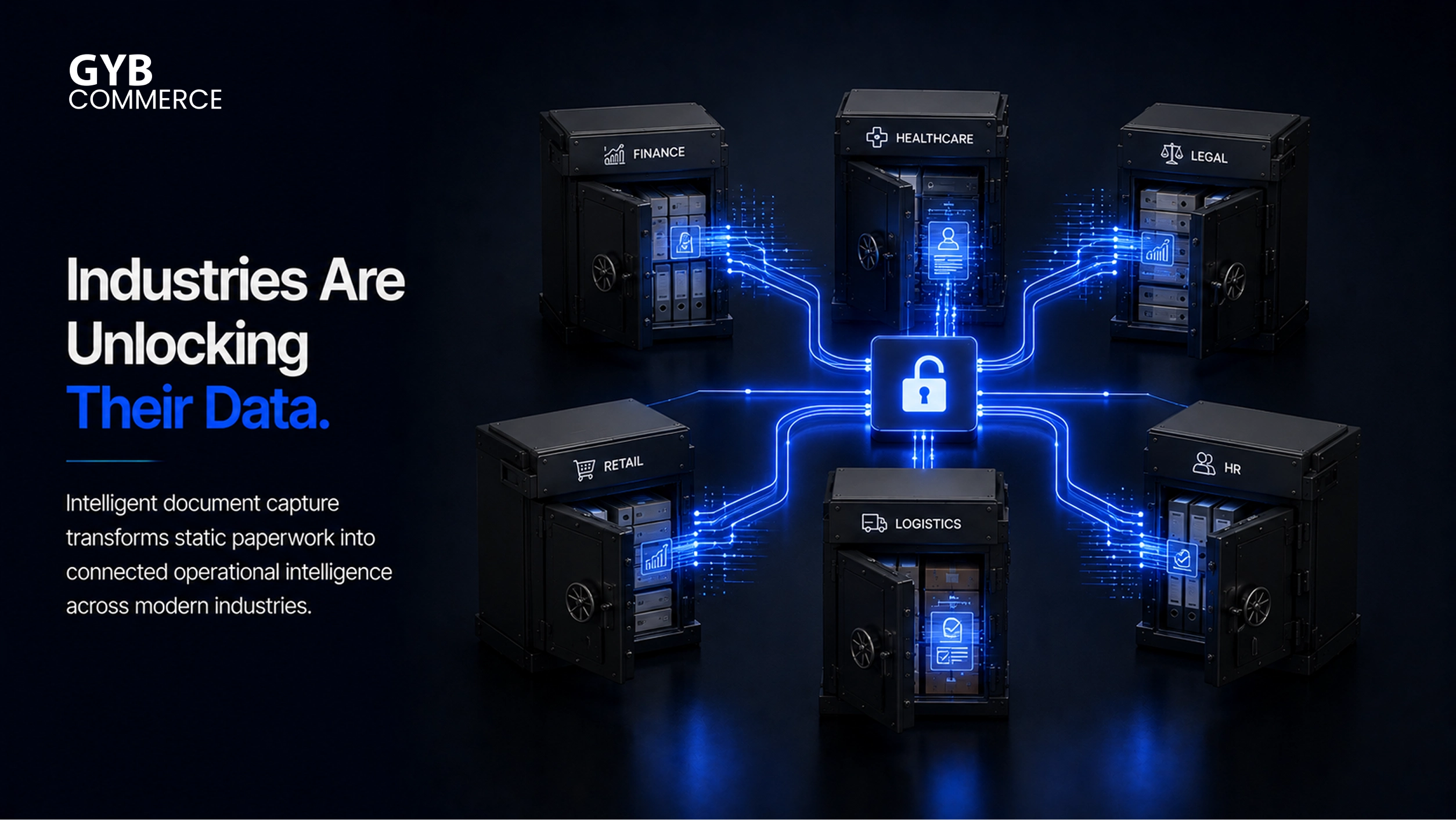
Every industry is dealing with the same underlying problem. Data is growing faster than systems can process it. Documents arrive through emails, PDFs, scans, and forms. Yet most of this information remains unstructured, disconnected, and underutilized.
This is where Intelligent Document Capture Solutions are changing the equation. Instead of treating documents as static files, businesses now process them as live data sources. With AI-powered OCR, Machine Learning, and Natural Language Processing, companies are turning documents into structured, usable information in real time.
The shift is not limited to one sector. From finance to healthcare, and from legal firms to logistics, organizations are moving toward document automation by industry. The goal is simple. Reduce manual effort, improve accuracy, and unlock operational speed without increasing headcount.
Table of Contents
Why Intelligent Document Capture Is No Longer Limited To One Industry
Traditional Optical Character Recognition focused on extracting text. It worked well for clean, structured documents. However, modern businesses deal with messy inputs. Handwritten notes, scanned invoices, multi-page contracts, and fragmented data sources.
This complexity pushed the evolution toward AI-Powered OCR. Today, intelligent systems combine Computer Vision, Deep Learning, and Pattern Recognition to understand documents beyond text. They identify context, classify information, and trigger workflows automatically.
The result is a cross-industry shift. Intelligent document capture is no longer a niche tool. It is now a core layer in industry digital transformation and business process management.
Across industries, the same operational challenges appear:
- High-volume document workflows slow down processing
- Critical data remains trapped inside PDFs and scanned files
- Manual data entry introduces errors and delays
- Compliance requirements demand higher accuracy and traceability
Because these problems are universal, the solution is becoming universal as well. Intelligent OCR use cases now extend across finance, healthcare, legal, retail, and enterprise systems.
At a system level, this transformation is driven by three technologies. Machine Learning models learn from historical data. Natural Language Processing understands context and meaning. Computer Vision interprets visual layouts and structures.
Together, they convert document processing into a scalable, automated pipeline.
How Financial Services Use Intelligent Document Capture To Improve Accuracy And Compliance
The financial sector operates under strict regulatory pressure. Every document must be accurate, traceable, and compliant. Yet most financial workflows still rely on manual validation of forms, statements, and identity records.
This is where document capture for finance delivers immediate impact.
Banks and financial institutions use intelligent document capture to process loan applications, KYC documents, invoices, and transaction records. Instead of manually entering data, systems extract key information automatically and validate it against predefined rules. This automation highlights why manual data entry is still costing your business if you haven’t switched yet.
Pattern Recognition models detect inconsistencies in documents. Data Extraction pipelines structure information into usable formats. This reduces errors while speeding up processing cycles.
The result is not just efficiency. It is a risk reduction. Compliance teams gain better visibility, audit trails improve, and turnaround times drop significantly.
Convert Your Business to Automated OCR
How Healthcare Uses AI Document Processing To Unlock Patient Data And Reduce Delays
Healthcare systems generate massive volumes of documents every day. Patient records, prescriptions, insurance claims, and diagnostic reports all exist across fragmented formats.
Most of this data remains locked in unstructured files. As a result, healthcare providers face delays in accessing critical information.
Document capture for healthcare solves this by transforming static records into searchable, structured data. Using Computer Vision and Deep Learning, systems can read handwritten notes, interpret medical forms, and extract patient data with high accuracy.
This has a direct operational impact. Patient onboarding becomes faster. Insurance claims are processed with fewer errors. Medical histories become accessible across systems.
More importantly, decision-making improves. When data is available in real time, healthcare professionals can act faster and with greater confidence.
How Legal Firms Use Intelligent OCR To Automate Contract And Case File Processing
Legal operations are heavily document-driven. Contracts, agreements, case files, and compliance documents form the backbone of legal workflows.
Traditionally, these documents require manual review. This process is time-consuming and prone to inconsistencies.
With document capture for legal workflows, firms are automating large parts of this process. Intelligent OCR systems extract clauses, identify key terms, and classify documents based on context.
Natural Language Processing plays a critical role here. It enables systems to understand legal language, not just read it. This allows for faster contract analysis, better document organization, and improved case preparation.
The outcome is clear. Legal teams spend less time on repetitive tasks and more time on strategic work. This capability is exactly why you must evaluate traditional OCR vs AI-powered document capture solutions.
How Retail And Ecommerce Businesses Use Document Automation To Streamline Operations
Retail and ecommerce businesses operate on speed. Orders move fast, inventory changes constantly, and customer expectations continue to rise. However, behind the scenes, many operations still depend on manual document handling.
Invoices, receipts, supplier documents, and inventory records often flow through disconnected systems. This creates delays and inconsistencies across operations.
Document automation by industry is solving this gap. Retail businesses now use intelligent document capture to extract data from invoices, match it with purchase orders, and update inventory systems in real time.
This reduces dependency on manual data entry. It also improves accuracy across financial records and stock management.
In ecommerce environments, the impact is even more visible. Multi-channel selling generates data from multiple sources. Intelligent systems consolidate this data, process documents instantly, and ensure that operations remain synchronized.
The outcome is operational clarity. Businesses respond faster, reduce errors, and scale without increasing administrative overhead.
How Logistics And Supply Chain Companies Use Document Capture To Improve Speed And Visibility
Logistics and supply chain operations depend on document flow. Shipping labels, invoices, customs documents, and delivery records are critical to maintaining movement across the supply chain.
When these documents are handled manually, delays become inevitable. Missing data, incorrect entries, and slow processing disrupt the entire chain.
Intelligent document capture transforms this process. Documents are scanned, interpreted, and converted into structured data automatically. This enables real-time tracking and faster decision-making.
For logistics companies, speed is a competitive advantage. Automated document processing ensures that shipments move without unnecessary delays.
From an operational standpoint, this also improves visibility. Teams can access accurate data instantly, reducing bottlenecks and improving coordination across systems.
How HR And Enterprise Teams Use AI To Manage Employee Data And Workflows
HR departments manage large volumes of sensitive documents. Resumes, onboarding forms, employee records, and compliance documents all require accurate handling.
Manual processes slow down hiring cycles and increase the risk of data errors. This directly affects both operational efficiency and employee experience.
Intelligent document capture introduces automation into HR workflows. Systems extract information from resumes, categorize candidates, and populate internal systems without manual intervention.
During onboarding, documents are processed instantly. Employee records are structured and stored in a way that makes retrieval easy and secure.
This aligns closely with broader trends in the business process management industry. Organizations are moving toward automated workflows that reduce administrative burden and improve data consistency.
The result is faster hiring, better data management, and improved internal operations.
What All These Industries Have In Common And Why Adoption Is Accelerating
Despite operating in different environments, these industries share the same underlying challenge. They all deal with large volumes of unstructured data.
Documents are not the problem. The inability to process them efficiently is.
This is why adoption of Intelligent Document Capture Solutions is accelerating across intelligent industries. Businesses are realizing that manual workflows cannot scale with growing data demands.
Industry digital transformation is no longer optional. It is a requirement for staying competitive.
Across finance, healthcare, legal, retail, logistics, and enterprise systems, the same pattern is visible. Organizations that automate document processing gain speed, accuracy, and operational control.
Those that rely on manual processes face delays, errors, and rising costs.
Discover Intelligent OCR Solutions
Frequently Asked Questions
What Is Intelligent Document Capture And How Does It Work Across Industries?
Intelligent Document Capture Solutions use AI technologies like OCR, Machine Learning, and NLP to extract, process, and structure data from documents automatically. This works across industries by adapting to different document types and workflows.
Which Industry Benefits The Most From Document Automation?
No single industry benefits the most because document automation by industry solves a universal problem. However, finance, healthcare, and legal sectors often see the fastest ROI due to high document volumes and compliance requirements.
Is Intelligent OCR Suitable For Small Businesses Or Only Enterprises?
Intelligent OCR is scalable. Small businesses can automate specific workflows, while enterprises can implement large-scale systems. The flexibility makes it suitable for both.
How Accurate Is AI Document Processing Compared To Manual Entry?
AI document processing often achieves higher accuracy than manual entry, especially when trained on industry-specific data. It also reduces human error and improves consistency across workflows.
Can Intelligent Document Capture Integrate With Existing Systems?
Yes, Intelligent Document Capture Solutions integrate with CRMs, ERPs, and other enterprise systems through APIs. This ensures seamless data flow without disrupting existing infrastructure.
What Types Of Documents Can Be Automated Using AI?
Businesses can automate invoices, contracts, forms, receipts, medical records, and employee documents. Intelligent systems handle both structured and unstructured formats efficiently.
How Long Does It Take To Implement Document Automation Solutions?
Implementation timelines vary based on complexity. Basic workflows can be automated within weeks, while enterprise-level deployments may take longer depending on integration requirements.
The Industries Winning Today Are Not Managing Documents They Are Automating Them
The competitive gap is no longer about who has more data. It is about who can process it faster and more accurately.
Industries that adopt intelligent document capture are not just improving efficiency. They are building systems that scale without friction.
Manual workflows cannot keep up with modern data demands. Automation is no longer a future initiative. It is a present requirement.
Businesses that act now gain a clear advantage. Those that delay will continue to struggle with inefficiencies that compound over time.