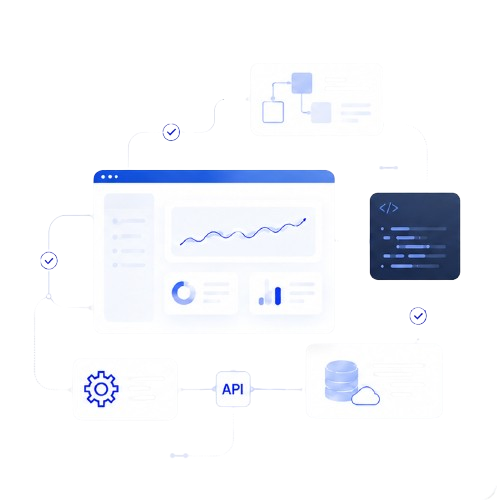
Modern ecommerce isn’t built on one platform. It is built on dozens of connected systems. Every successful online store depends on data moving between applications in real time. When these systems are disconnected, your retail business faces severe operational hurdles.
Manual data entry causes shipping delays and inventory errors. Staff must spend hours copying sales orders into independent record tools. This fragmentation slows down your order fulfillment cycles and hurts consumer retention.
API integration provides the ultimate solution to this operational challenge. It acts as a digital bridge that connects your storefront to external business software. This guide covers how APIs work, the primary connection models, security protocols, and implementation budgets.
What Is API Integration In Ecommerce?
An application programming interface, or API, is a software intermediary that allows two distinct applications to interact with each other. In digital retail, an ecommerce API allows your storefront to share data with tools like accounting systems and shipping carriers. This background connectivity ensures your tools work as a unified network.
What is API integration in a practical sense? It is the process of establishing a stable connection between these different API endpoints. This setup allows your online shopping cart to send transaction details to your warehouse system automatically. Information moves instantly without human intervention.
Online stores rely heavily on these connections because modern retail platforms cannot handle every enterprise task internally. A single commerce engine cannot manage complex global logistics, localized tax laws, and deep client management rules simultaneously. APIs allow you to offload these tasks to specialized third-party applications.
Consider a simple api integration example. A customer enters their credit card details during checkout on a mobile app. The storefront does not process the payment directly. Instead, it securely transmits the transactional data to a payment processor like a PayPal API integration ecommerce app. The processor validates the request and returns a success message to the store in seconds.
How API Integration Works In Ecommerce
The background mechanics of an api integration for ecommerce follow a structured communication loop. One system initiates a request, and the connected system provides a response. This transaction occurs via defined network protocols.
First, your ecommerce platform generates an API request containing specific structured data. This request travels across the internet to a specific web address called an API endpoint. This endpoint represents the exact digital location of the receiving application’s database server.
Before processing the data, the receiving system checks the request credentials. This verification step relies on authentication protocols to ensure the sender has proper access permissions. The system uses tools like an API key or a secure access token to confirm identity.
Once approved, the server processes the incoming information, which is usually formatted in JSON or XML text blocks. It then sends an API response back to your online store. This response confirms the task status, such as updating an internal inventory count or logging a client profile.
Types Of APIs Used In Ecommerce
Developers build api driven ecommerce storefronts using different architectural styles. Each connection protocol handles data exchange using unique structural rules.
REST APIs
Representational State Transfer, or REST, is the most popular architectural layout for api ecommerce networks today. It uses standard HTTP methods like GET, POST, and DELETE to manage data packages. It is highly reliable, easy to scale, and uses lightweight JSON text formats. Most modern public software applications provide REST endpoints by default.
GraphQL APIs
GraphQL is a modern data query language developed to fix the data over-fetching issues found in old systems. Instead of loading an entire product database profile, GraphQL allows your frontend to request specific fields. For instance, you can request just the product price and stock level without downloading image links. This precision increases your page loading speeds significantly.
SOAP APIs
Simple Object Access Protocol, or SOAP, is an older, highly structured communication protocol. It relies exclusively on the XML data format and features strict built-in security compliance rules. While it is slower and heavier than REST, enterprise financial systems and legacy banking setups still require SOAP.
Webhooks
Webhooks function as automated reverse APIs that send data instantly when an event occurs. Instead of your store constantly checking if a supplier has shipped an item, the supplier’s system pushes an alert the moment the status changes. Webhooks use an event-driven framework to deliver real-time data synchronization.
| API Category | Architectural Style | Core Data Format | Communication Type | Best Retail Application |
| REST API | Standardized, stateless layout | JSON or XML text blocks | Client polls server directly | Connecting standard web applications |
| GraphQL | Client-driven query framework | Strict typed JSON sets | Specific field requests | Headless storefront frontend rendering |
| SOAP API | Strict messaging protocol | XML schema exclusively | Formal contract communication | Enterprise banking and financial tools |
| Webhook | Event-driven notification | JSON payload alerts | Server pushes to client instantly | Real-time shipping and order alerts |
Systems That Commonly Connect Through APIs
Building a performant api integration ecommerce ecosystem requires linking several core corporate platforms. Each connection removes an operational bottleneck from your retail pipeline.
ERP Systems
Connecting an enterprise resource planning platform allows your company to manage manufacturing schedules and corporate finances together. The API sends customer purchase data directly to your central corporate database. This unified tracking protects your financial ledger accuracy. If you want to review how these platforms operate, look at our breakdown of erp crm ecommerce integration.
CRM Platforms
Client relationship management tools track customer habits, email histories, and service tickets. An API integration passes consumer buying behavior from your checkout portal straight to your sales dashboard. This lets your marketing team build segmented groups based on real purchase histories.
Payment Gateways
A payment gateway API securely authorizes transactions from credit cards and digital wallets. The interface encrypts user payment details during the checkout phase. This process keeps your store compliant with global security regulations while protecting consumer bank data.
Inventory Management
Real-time stock tracking prevents your online store from selling out-of-stock items. The inventory API updates item availability counts across your backend networks the moment a sale concludes. This synchronization keeps your digital product catalog perfectly accurate.
Shipping Providers
Shipping APIs fetch real-time freight charges directly from carriers during checkout. They allow your warehouse staff to print accurate delivery labels automatically. The interface also pulls tracking numbers and pushes delivery status updates to your customers.
Accounting Software
Automating your corporate bookkeeping reduces accounting errors. An API sends daily transaction registers, sales tax logs, and refund data to tools like QuickBooks or Xero. This setup saves your financial team from manual spreadsheet entry tasks.
Marketing Automation
Linking your email platform to your digital cart allows for automated behavioral marketing. When a shopper leaves items in their basket, an API triggers an abandoned cart email sequence. This automation recovers lost sales without manual oversight.
Marketplaces
Enterprise brands rarely sell on a single digital store. Connecting your store to external digital channels allows you to control multiple storefronts simultaneously. If you want to expand your sales reach, exploring professional ecommerce marketplace development provides a reliable path forward.
POS Systems
If you operate physical retail locations, your brick-and-mortar points of sale must share data with your online warehouse. A POS API syncs your offline sales with your digital store database. This prevents you from promising an item online that was sold in a physical store.
Mobile Apps
Mobile shopping applications require constant access to your primary product catalog data. APIs serve product descriptions and process checkout steps directly within custom mobile interfaces. This layout delivers a uniform buying experience across every consumer device.
Benefits Of API Integration In Ecommerce
Investing in api integrations meaning a total upgrade to your operational workflow. Connecting your technical tools unlocks substantial business advantages.
Real-Time Data Synchronization
APIs eliminate data delays across your corporate network. When a consumer modifies their shipping address, the change propagates to your shipping carrier instantly. This immediate update cycle prevents fulfillment errors and keeps your operations accurate.
Better Customer Experience
Shoppers expect accurate data interactions when browsing your online store. APIs provide instant tracking details, exact stock levels, and localized payment options during their buying journey. This clear information builds consumer brand trust and improves your retention rates.
Operational Efficiency
Automating data workflows removes repetitive tasks from your daily business routines. Your staff no longer needs to download order logs and upload them to separate warehouse tools manually. This efficiency allows your employees to focus on strategic growth tasks.
Automation
Connected networks run entirely on automated rules. You can configure your system to order new stock automatically when an API logs low inventory levels. This reduces the risk of human management errors in your supply chain.
Scalability
A connected system grows easily alongside your transaction volume. If your order rate doubles overnight, your API architecture distributes the data processing load safely across your cloud applications. This structure keeps your storefront responsive during peak shopping holidays.
Data Accuracy
Manual data duplication is prone to mistakes like misspelled names and wrong shipping codes. APIs transfer exact database strings between platforms without altering characters. This precise transfer ensures your internal analytics reports remain completely clean.
Faster Decision Making
Accessing unified data channels helps executives monitor business performance clearly. You can view total sales volumes, stock values, and shipping costs inside one central interface. This quick visibility allows you to adapt to changing market trends fast.
API Security Best Practices
Exchanging financial data across the internet requires strict defensive programming rules. Securing your software connection paths protects your brand from malicious database incursions.
OAuth
OAuth functions as an industry-standard authorization framework for web application security. It grants third-party applications limited access to your digital store without exposing user passwords. The platform issues temporary tokens to validate specific data access tasks safely.
API Keys
An API key acts as a long-term digital password assigned to a specific connected application. Your system must validate this unique string before responding to any incoming data request. Keep these keys hidden within secure server configuration files to prevent exposure.
Authentication
Authentication validates the actual identity of the application attempting to enter your store network. Use modern authentication protocols like JSON Web Tokens to sign your data requests securely. This prevents unauthorized servers from falsifying data records.
Authorization
Authorization determines the specific tasks an authenticated system can execute inside your database. Restrict your third-party tools using the principle of least privilege. For example, a shipping app needs to read address details, but it never needs permission to edit your corporate financial records.
Encryption
All data moving through an ecommerce API must use Transport Layer Security encryption protocols. This encryption prevents malicious actors from intercepting credit card numbers or customer profiles during transmission. Active HTTPS connections are strictly mandatory for all API endpoints.
Rate Limiting
Rate limiting protects your database servers against malicious denial-of-service attacks. It restricts the maximum number of API requests an outside system can make within a minute. This defensive wall keeps your store online even if a connected tool malfunctions and floods your server with requests.
Monitoring
Set up real-time monitoring software to log your data exchange volumes continuously. Tracking your daily API interaction rates helps you identify unusual communication spikes early. Automated alerts notify your engineering team the moment a connection path fails.
Logging
Maintain comprehensive system logs that track the execution status of every incoming and outgoing API request. Document the exact HTTP status codes and response messages returned by your connected tools. Reviewing these data logs simplifies technical troubleshooting when an application drops offline.
Common API Integration Challenges
Connecting separate software platforms involves resolving distinct engineering hurdles. Anticipating these technical friction points keeps your development project on track.
Data Mapping
Every software application uses unique rules to organize its internal data tables. For instance, your store might log customer names in a single text field, while your ERP uses separate fields for first and last names. Developers must build clear middleware transformations to map these fields accurately.
Versioning
Third-party software providers update their API configurations constantly to launch features or patch security holes. When an external vendor alters their endpoint code, your existing integration path can break suddenly. Developers must use API versioning strategies to maintain stable legacy connections during software updates.
Third-Party Dependencies
Relying on external cloud applications introduces operational dependencies. If an external payment processor experiences a server outage, your store’s checkout line will stall instantly. Build defensive error handling rules to ensure your site stays active during external system failures.
Rate Limits
Many commercial SaaS platforms enforce strict daily API call restrictions on their standard subscription tiers. If your online sales volume spikes, you can hit these usage limits quickly. Exceeding your allowed tier can cause the provider to block your data synchronization paths until the next billing cycle.
Error Handling
When an API connection fails due to a network glitch, your system must handle the issue cleanly. A silent failure can result in lost orders and mismatched inventory logs. Your code must feature automated retry logic to re-send failed data payloads once the network stabilizes.
Testing
Validating custom code connections inside a live retail environment is incredibly dangerous. Developers need a fully isolated sandbox environment to test data workflows safely. Running simulated checkout requests inside a sandbox prevents you from corrupting your live production records.
Documentation
Poorly written API manuals slow down your development timeline significantly. If an external system lacks clear field definitions and sample payloads, engineers must waste time using trial-and-error methods. Prioritize software vendors that provide verified, up-to-date developer manuals.
API Integration Best Practices
Following structured engineering models guarantees a more stable and performant software architecture. Use these guidelines to plan your integration project efficiently.
Planning
Map out your entire corporate data flow on paper before writing code. Identify which system serves as the primary master source for specific data points like inventory counts or client profiles. This structural clarity prevents duplicate data conflicts across your platforms.
Documentation
Document your custom API configurations and middleware connections thoroughly. Maintain updated records of all custom endpoints, data translation maps, and authentication steps. Clear internal documentation ensures your future engineering teams can maintain the system easily.
Sandbox Testing
Always build and validate your data connections inside an isolated staging environment first. Test your system using distorted payloads, bad authentication keys, and high transaction volumes. Ensure your error handling systems catch these bugs before moving code to production.
Monitoring
Install continuous server monitoring tools to track the health of your live data connections. Your dashboard should display average response times, data payload sizes, and connection error rates clearly. Early visibility allows you to resolve system slowdowns before they impact your consumers.
Maintenance
Treat your corporate API connections as living software infrastructure that requires ongoing care. Schedule regular technical audits to update access tokens, review error logs, and verify version compatibility. Keeping your connections clean avoids unexpected system downtime.
Performance Optimization
Optimize your data payloads to keep your website fast and responsive. Use background queuing systems to handle non-urgent API tasks like updating marketing lists. This prevents heavy database actions from blocking your core checkout processing pipeline.
API Integration Costs And Planning Considerations
The overall api integration cost varies extensively based on the structural nature of your software stack. Understanding these financial variables helps you plan your development budget accurately.
A primary cost driver is the overall technical complexity of the platforms you need to link together. Connecting standard plugins via built-in platform marketplaces involves modest api integration charges. These simple setups require minimal custom engineering to launch successfully.
However, connecting legacy on-premise software or custom corporate infrastructure demands dedicated custom programming. Developers must build unique middleware scripts to translate mismatched data models securely. This custom development increases your upfront engineering investment.
You must also budget for ongoing platform maintenance and third-party API licensing fees. Many advanced software tools charge ongoing usage fees based on your total monthly API request volume. Review these structural fee tiers early to calculate your true total cost of ownership over time.
When Do You Need Custom API Integration?
Pre-built platform plugins work well for standard, small retail operations. However, scaling organizations eventually face complex business challenges that standard software cannot resolve.
Custom API connections become mandatory when your company operates multiple distinct sales channels simultaneously. Managing inventory across a web store, a mobile app, and external digital marketplaces requires a centralized data engine. Custom configurations ensure your stock updates accurately everywhere at once.
Enterprise business environments running advanced ERP systems also require bespoke connection pipelines. These large corporate networks use unique data rules that basic web applications cannot interpret. Building custom connection points allows you to sync your retail checkout rows with complex corporate logistics software smoothly.
Custom code is equally necessary for managing complex multi-warehouse inventory systems or advanced international trade accounts. If you run a scaling shop, implementing modern enterprise ecommerce features requires custom connectivity to maintain system stability. Transitioning to these modern structures is an intricate process. If you are preparing for a system modernization project, review our comprehensive ecommerce migration checklist to organize your development phases safely.
Real-World API Integration Examples
Reviewing actual business use cases demonstrates how connected applications improve daily operations. These configurations focus on achieving clear business outcomes.
- Shopify → Enterprise ERP: A high-volume store transfers daily consumer order logs to a central ERP automatically. The ERP adjusts manufacturing schedules and updates corporate asset ledgers without human intervention.
- WooCommerce → Enterprise CRM: A growing retail brand syncs customer purchase histories directly with their service dashboard. Support agents can view a buyer’s complete order timeline instantly when answering technical questions. If you want to deploy a fast, connected store layout using this framework, utilizing professional woocommerce development services can help you build a clean system architecture.
- Marketplace → Central Inventory System: An international brand sells items on their primary site and multiple external digital channels simultaneously. A central inventory API updates product availability metrics across all channels the moment an item sells out anywhere. This prevents expensive overselling errors.
- Payment Gateway → Accounting Tools: A digital storefront sends transactional payment receipts straight to automated bookkeeping software. The app categorizes sales tax revenues and processes card processing fees independently, saving your accounting staff hours of manual spreadsheet work.
- Shipping API → Order Management: Your shopping cart sends delivery addresses to carriers instantly during checkout. The carrier returns exact shipping labels and tracking numbers to the warehouse backend while emailing the tracking links to your consumers automatically.
Frequently Asked Questions
What is API integration in ecommerce?
API integration in ecommerce is the process of connecting an online storefront to external business software platforms using application programming interfaces. This technical bridge allows separate tools like inventory databases, payment gateways, and shipping systems to share transactional data automatically in real time.
How much does an ecommerce API integration cost?
The total financial investment depends heavily on whether you use pre-built platform plugins or require custom development. Basic marketplace extensions involve low setup fees, while advanced custom enterprise connections require unique middleware programming. Custom builds carry higher initial development costs but eliminate expensive manual data entry errors for scaling brands.
What is the difference between a REST API and a Webhook?
A REST API operates on a polling model where your storefront must actively request data updates from an external server at regular intervals. A Webhook uses an event-driven framework that automatically pushes data to your store the exact second a specific event occurs, such as a shipping carrier changing a delivery status.
Why do ecommerce stores need custom API integrations?
Online stores require custom integrations when their backend business processes outgrow standard pre-made plugins. Custom connections are necessary for linking enterprise resource planning tools, managing complex multi-warehouse inventory arrays, or deploying advanced b2b ecommerce solutions that require distinct customer pricing rules.
How do APIs protect customer payment information?
Commerce APIs secure sensitive consumer data by using advanced encryption standards like Transport Layer Security during transmission. They use secure authorization frameworks like OAuth and restricted access tokens to ensure that only verified payment gateways can view or process encrypted financial strings.
Final Takeaways
Establishing robust API integrations in ecommerce transforms your disconnected business applications into a high-performing digital network. Automating data flow between your shopping cart, ERP, CRM, and logistics tools eliminates manual entry delays and reduces inventory tracking errors. Selecting the correct API architecture, such as REST or event-driven Webhooks, ensures your technical foundation remains stable and responsive under heavy transaction volumes. Prioritizing modern security practices like token authorization and rate limiting protects your enterprise from data breaches while delivering a fast, reliable buying experience for your consumers.
Building a connected retail ecosystem requires careful technical planning, precise data mapping, and expert software architecture design. If you need assistance linking your corporate platforms or developing custom data pipelines, consult with an experienced technical agency to map out your software strategy. Contact GYB Commerce today to speak with our solutions architects about modernizing your digital store through custom API integrations and advanced system connectivity.