
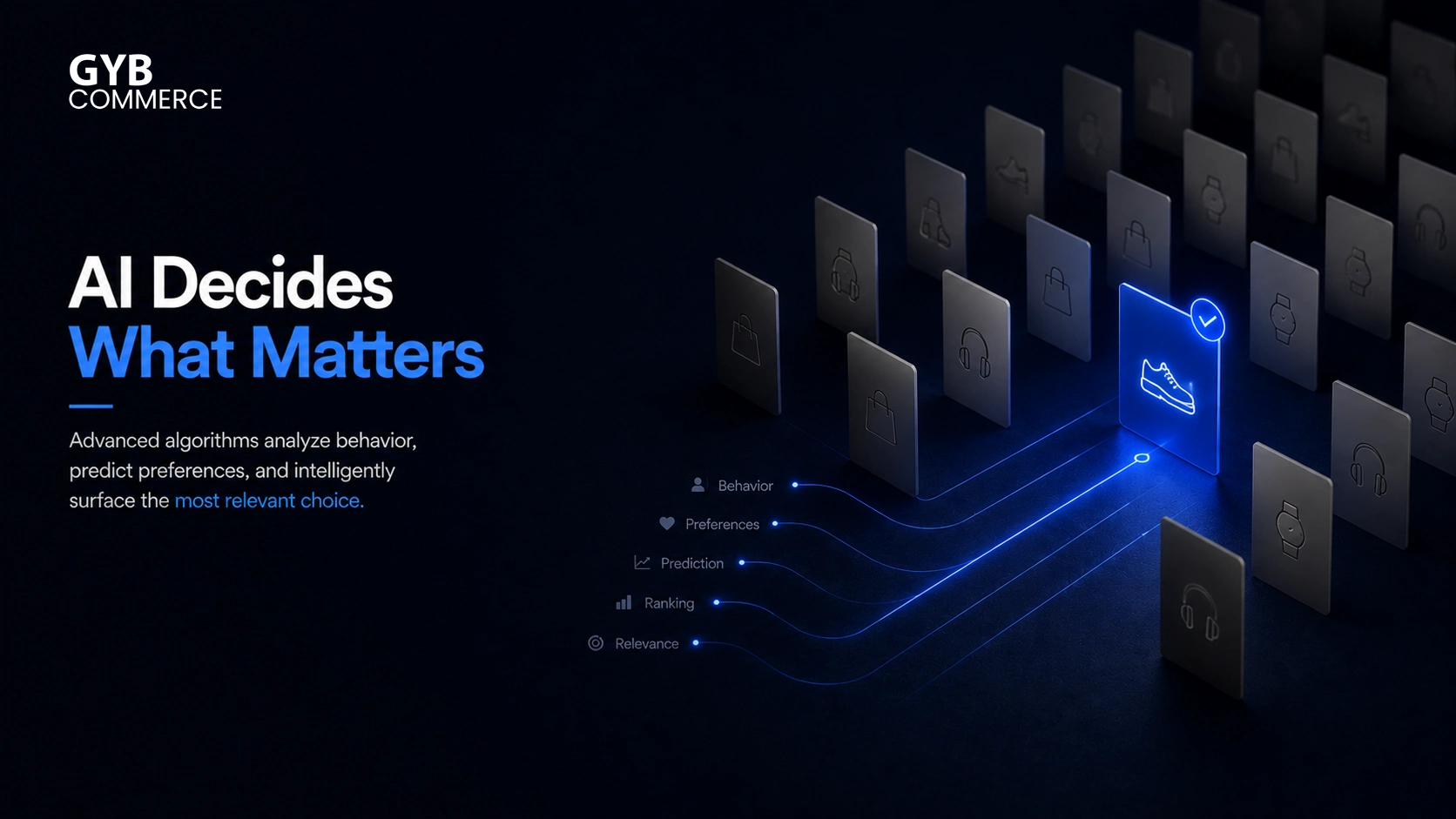
In modern digital systems, an AI recommendation algorithm is not simply a tool that suggests items. Instead, it acts as a structured decision-making system that evaluates user behavior, predicts preferences, and ranks outcomes in real time. From platforms like Netflix to Amazon, these algorithms determine what users see, when they see it, and why it appears relevant. Therefore, understanding the underlying logic is essential if you want to grasp how personalization actually works at scale.
Table of Contents
What Is an AI Recommendation Algorithm?
From Suggestions to Decision Systems
At its core, an AI recommendation algorithm is a scoring mechanism. It does not randomly suggest items. Instead, it evaluates multiple signals such as user behavior, item attributes, and contextual data to assign relevance scores.
In practical terms, the system continuously answers one question.
Which item is most likely to match this user’s intent right now?
This shift from static suggestions to dynamic decision-making defines modern recommendation systems. Earlier systems relied on basic rules. However, today’s algorithms use machine learning to adapt and evolve with every interaction.
As a result, recommendations are no longer fixed outputs. They are calculated decisions that change in real time. This shift redefines what a recommendation engine is today.
Why Algorithms Matter More Than Data Alone
It is easy to assume that more data automatically leads to better recommendations. However, data alone does not create value. The algorithm determines how that data is interpreted.
For example, two systems may use identical datasets. Yet, one produces highly relevant recommendations while the other fails to engage users. The difference lies in how the algorithm processes relationships, patterns, and signals.
This is where techniques such as machine learning and predictive analytics come into play. These approaches allow systems to move beyond raw data and uncover hidden patterns in user behavior.
Therefore, the real power of an AI recommendation algorithm is not in the data it collects. It is in how intelligently that data is transformed into decisions.
The Core Logic Behind Recommendation Algorithms
Similarity Scoring
The first step in most recommendation algorithms is measuring similarity. The system needs to understand how users or items relate to each other.
This is typically done through similarity scoring techniques. For instance, the algorithm may compare users based on shared behaviors or match items based on attributes. If two users interact with similar content, the system assumes they may have similar preferences.
Mathematically, this often involves calculating distances or angles between vectors. While the exact formulas vary, the goal remains consistent. Identify patterns of closeness between users and items.
This concept powers foundational techniques such as collaborative filtering, where the system relies on collective user behavior to generate suggestions.
However, similarity alone is not enough. It only tells the system what is related, not what is most relevant.
Predicting User Preferences
Once relationships are identified, the algorithm moves to prediction. At this stage, it estimates how likely a user is to engage with a specific item.
This process often involves models trained on historical data. For example, if a user consistently interacts with a certain type of product or content, the system learns to assign higher probabilities to similar items.
A widely used approach here is matrix factorization. This method breaks down large interaction datasets into smaller patterns, often referred to as latent factors. These factors represent hidden preferences that are not directly observable.
Through this process, the algorithm does not just react to past behavior. It anticipates future actions.
Ranking and Final Selection
After prediction, the system faces its most critical step. It must decide what to show first.
This is where ranking models come into play. The algorithm assigns scores to candidate items and orders them based on relevance. The highest-ranked items are then presented to the user.
In real-world systems, this stage is highly optimized. Platforms like YouTube and Spotify process millions of items in milliseconds. They cannot evaluate everything equally. Therefore, ranking becomes the key decision layer.
Read about how recommendation engines work to see this full pipeline.
Importantly, ranking is not based on a single factor. It combines multiple signals, including:
- User preferences
- Item popularity
- Context such as time or device
- Business objectives like engagement or retention
As a result, the final recommendation is not just accurate. It is strategically selected to maximize impact.
Types of AI Recommendation Algorithms and How They Differ
Collaborative Filtering: Learning from Collective Behavior
One of the most widely used approaches in any AI recommendation algorithm is collaborative filtering. This method focuses on user behavior rather than item attributes.
In simple terms, the system identifies patterns across users. If two users show similar interactions, the algorithm assumes their preferences align. As a result, it recommends items liked by one user to the other.
Platforms like Amazon heavily rely on this approach to power “customers also bought” suggestions.
There are two main variations within collaborative filtering:
- User-based filtering, where the system finds similar users and recommends what they liked
- Item-based filtering, where the system recommends items similar to what the user already interacted with
This approach works well at scale. However, it depends heavily on historical data. Without enough interaction data, its accuracy drops.
This limitation introduces what is commonly known as the cold start problem.
Content-Based Filtering: Understanding Item Characteristics
While collaborative filtering depends on users, content-based filtering focuses on the items themselves.
Here, the algorithm analyzes features such as category, keywords, or attributes. Then it builds a profile of user preferences based on past interactions.
For example, if a user frequently watches action movies, the system will recommend similar content. Platforms like Netflix combine this method with other techniques to improve recommendation accuracy.
This approach is powered by techniques such as natural language processing, which helps systems understand textual data like descriptions or reviews.
Unlike collaborative filtering, content-based filtering does not require other users’ data. Therefore, it handles new items more effectively.
However, it has its own limitation. It tends to recommend similar items repeatedly, which reduces diversity and discovery.
Hybrid Algorithms: Combining Multiple Signals
Modern systems rarely rely on a single method. Instead, they combine multiple approaches into hybrid recommendation algorithms.
A hybrid system merges collaborative filtering and content-based filtering. This allows it to balance accuracy with diversity.
For example, Netflix uses a hybrid approach. It analyzes both user behavior and content features to deliver better recommendations.
The advantage here is clear. Collaborative filtering captures crowd behavior, while content-based filtering captures item-level understanding.
Together, they create a more complete recommendation system.
However, this also increases complexity. Hybrid systems require more computation, more data pipelines, and more tuning.
Advanced Approaches in AI Recommendation Algorithms
Graph-Based Recommendation Algorithms
As systems scale, relationships between users and items become more complex. This is where graph-based recommendation algorithms come into play.
Instead of treating data as isolated points, these algorithms model it as a network. Users, items, and interactions form interconnected nodes.
Technologies like TigerGraph enable this type of processing at scale.
Through graph structures, algorithms can:
- Analyze multi-hop relationships between users and items
- Detect hidden connections that traditional models miss
- Generate more context-aware recommendations
For example, a user may not directly interact with a product. However, through indirect connections, the system can still identify relevance.
This approach is especially useful in complex domains such as fraud detection, supply chain optimization, and social networks.
Deep Learning and Neural Models
Another major shift in recommendation algorithms comes from deep learning.
Using models such as neural networks, systems can process large volumes of structured and unstructured data.
These models can learn:
- Complex user behavior patterns
- Sequential interactions such as browsing sessions
- Contextual signals like time and device
As a result, recommendations become more dynamic and responsive.
However, deep learning models require significant computational resources. They also introduce challenges related to explainability and transparency.
Why AI Recommendation Algorithms Matter Today
Driving Personalization at Scale
In today’s digital ecosystem, users expect personalized experiences. An AI recommendation algorithm enables this by automating decision-making at scale.
Instead of manually curating content, businesses rely on algorithms to deliver relevant suggestions instantly.
This improves:
- User engagement
- Customer satisfaction
- Retention rates
For example, YouTube keeps users engaged by continuously updating recommendations based on real-time behavior.
Impact on Business Outcomes
Beyond user experience, recommendation algorithms directly influence business performance.
They help organizations:
- Increase conversion rates through targeted suggestions
- Improve operational efficiency by automating decisions
- Unlock revenue growth through cross-selling and upselling
This is why recommendation systems are now central to industries such as e-commerce, media, and digital advertising. Custom AI recommendation engine solutions help businesses achieve these exact outcomes.
Challenges and Considerations
Despite their advantages, recommendation algorithms are not without challenges.
Some of the most critical issues include:
- Data privacy concerns, especially with user tracking
- Algorithm bias, which can reinforce existing patterns
- Lack of transparency in complex models
Balancing personalization with ethical considerations is becoming increasingly important.
Frequently Asked Questions
What is an AI recommendation algorithm in simple terms?
An AI recommendation algorithm is a system that predicts what a user may like based on their behavior and data patterns. It uses machine learning to improve over time.
What are the main types of AI recommendation algorithm models?
The main types include collaborative filtering, content-based filtering, and hybrid models. Each uses different data signals to generate personalized recommendations.
Why is an AI recommendation algorithm important for businesses?
An AI recommendation algorithm helps businesses deliver personalized experiences, increase engagement, and drive conversions. It directly impacts revenue and customer retention.
What is the biggest challenge in AI recommendation algorithms?
One major challenge is the cold start problem, where the system lacks enough data for new users or items. This reduces recommendation accuracy initially.
How do AI recommendation algorithms improve over time?
They continuously learn from user interactions, feedback, and new data. This allows them to refine predictions and improve recommendation accuracy.
Are AI recommendation algorithms only used in e-commerce?
No, they are used across multiple industries. These include streaming platforms, healthcare, finance, and cybersecurity, where personalized decision-making is critical.
Can AI recommendation algorithms be biased?
Yes, they can reflect biases present in the data. Therefore, careful design and monitoring are required to ensure fair and balanced recommendations.
Final Takeaways
AI recommendation algorithms are no longer optional components. They are core decision systems that shape how users interact with digital platforms. From similarity scoring to deep learning models, these algorithms continuously evolve to deliver better personalization. Understanding their structure helps you see how modern systems balance relevance, scalability, and business impact.