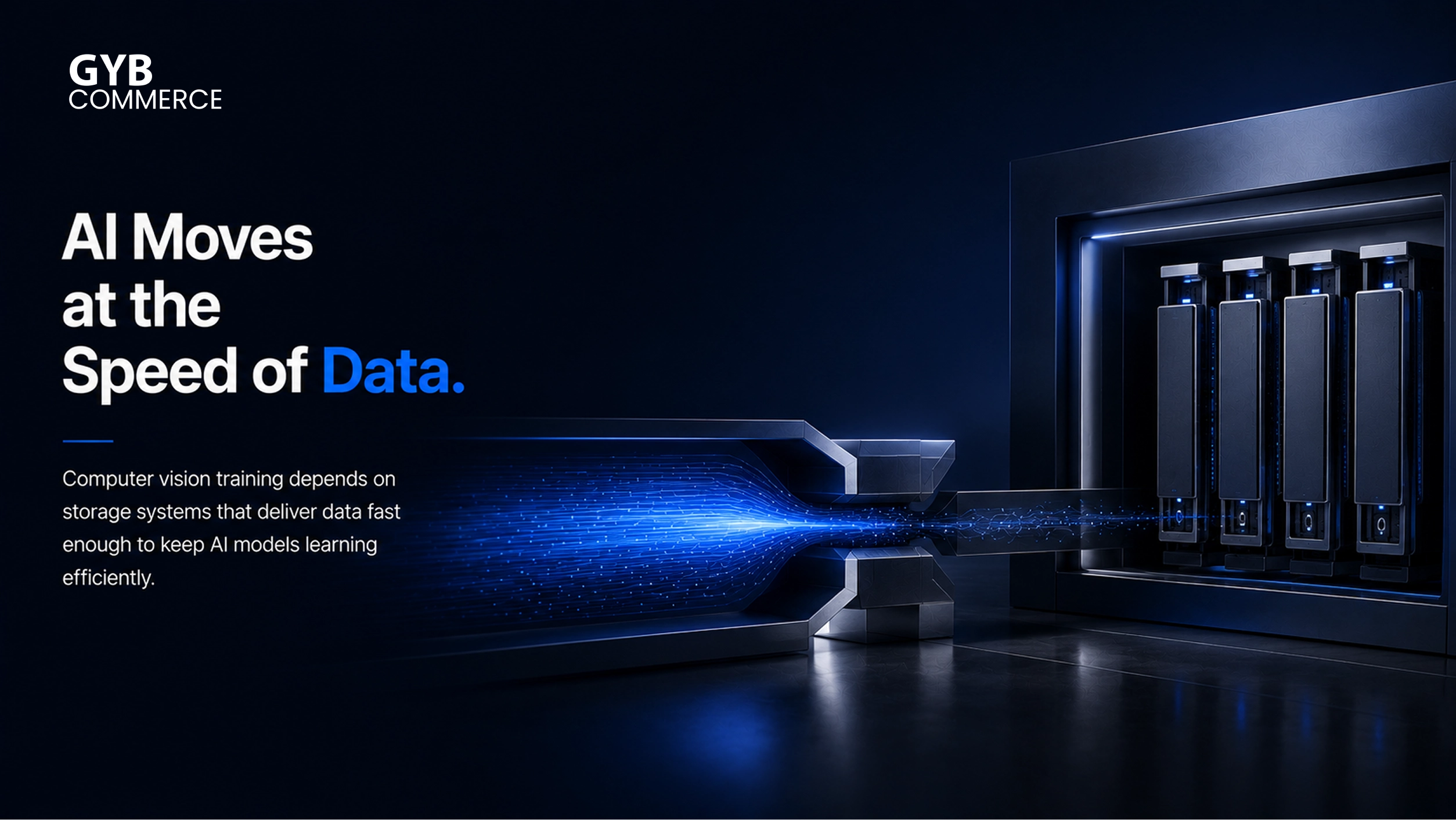
Computer vision training often looks like a model problem on the surface. However, in practice, it is a data movement problem first. Large volumes of images must move continuously between storage systems and compute resources. If that flow slows down, the entire pipeline suffers. As a result, even powerful GPUs remain underutilized when storage cannot keep up.
At the same time, organizations are dealing with rapidly growing datasets. High-resolution images, video frames, and augmented data increase storage demands significantly. Therefore, storage solutions are no longer just a backend component. They directly influence training speed, cost efficiency, and scalability. Understanding this relationship is essential before scaling any computer vision system.
Table of Contents
What Role Does Storage Play In Computer Vision Training?
How Data Pipelines Power Computer Vision Workloads
Every computer vision system relies on structured data pipelines to function properly. These pipelines move training datasets from storage into processing layers where models extract features and learn patterns. Without efficient pipelines, even well-designed models struggle to perform consistently.
For instance, image processing workflows often include loading, preprocessing, and augmentation steps. Each step depends on how quickly data can be accessed and transferred. As datasets grow larger, the importance of efficient data pipelines becomes more obvious. They ensure that GPUs receive a steady stream of data without interruption. This steady flow of data is exactly what computer vision is built upon to process images in real time.
Why Storage Becomes A Bottleneck In AI Training
Storage becomes a bottleneck when data cannot be delivered fast enough to compute resources. This usually happens due to limited throughput or high data access latency. When that occurs, GPUs spend more time waiting than processing, which reduces overall training efficiency.
In many real-world scenarios, organizations invest heavily in compute infrastructure. However, they overlook storage performance. As a result, I O bottlenecks slow down training cycles and increase operational costs. This imbalance creates a situation where the system cannot fully utilize its capabilities.
How Storage And Compute Must Work Together
Storage and compute must operate as a unified system rather than separate components. GPUs and accelerators process data at high speed, but they depend entirely on how quickly storage systems can supply that data. Therefore, any mismatch between storage and compute leads to inefficiencies.
In practice, this means organizations must design infrastructure with balance in mind. Storage compute balance ensures that data flows consistently without delays. When both layers are aligned, computer vision training becomes faster, more stable, and easier to scale.
CTA: Discuss Your Computer Vision Project
How Does Storage Architecture Impact Training Speed?
What Is The AI Storage Hierarchy?
AI storage follows a layered hierarchy that determines how quickly data moves through the system. At the base, storage devices such as disks and flash arrays hold large datasets. Above that, data fabric connects storage to compute resources. At the top, GPU memory processes data at extremely high speeds.
This hierarchy matters because each layer has different performance characteristics. Storage devices offer scalability, while GPU memory provides speed. The data fabric acts as a bridge between the two. If any layer becomes inefficient, the entire pipeline slows down.
Why High Throughput Storage Improves Training Time
High throughput storage allows large volumes of data to move quickly between storage and compute layers. This reduces the time required to load datasets into memory. As a result, training cycles become shorter and more efficient.
For example, when models process image batches, they rely on continuous data flow. If storage throughput is low, delays occur between batches. Over time, these delays add up and significantly increase training duration. Therefore, improving throughput directly improves performance.
How Low Latency Storage Enhances Model Training
Low latency storage ensures that data can be retrieved quickly whenever it is needed. This becomes especially important during iterative training processes where models repeatedly access datasets. Faster access leads to smoother and more consistent training cycles.
In addition, low latency helps maintain synchronization between different components of the system. When data retrieval is fast, models can process inputs without unnecessary waiting. This improves both training speed and overall system reliability.
Which Storage Technologies Accelerate Computer Vision Training?
How NVMe And SSD Storage Improve Data Access
Traditional hard drives cannot handle the speed requirements of modern computer vision workloads. In contrast, SSD and NVMe storage devices provide significantly faster read and write speeds. This improvement directly impacts how quickly datasets can be loaded into training pipelines.
NVMe storage, in particular, reduces latency and increases parallel data access. As a result, models receive data faster, which improves training efficiency. When working with large-scale image datasets, this difference becomes very noticeable. Faster storage ensures that compute resources remain active instead of waiting.
What Role Do Distributed Storage Systems Play?
Distributed file systems allow data to be stored across multiple nodes instead of a single location. This setup improves both scalability and performance. When datasets grow, distributed systems can handle increased demand without slowing down.
Moreover, distributed storage clusters enable parallel data access. Multiple GPUs can retrieve data simultaneously without creating bottlenecks. This is especially useful in large-scale computer vision training where multiple models or tasks run at the same time.
How Object Storage Supports Large Scale Datasets
Object storage platforms are designed to manage massive datasets efficiently. Unlike traditional file systems, they allow flexible storage of unstructured data such as images and videos. This makes them ideal for computer vision workloads.
In addition, object storage scales easily as data grows. Organizations can store and retrieve large volumes of training data without restructuring their infrastructure. This flexibility supports continuous model improvement and experimentation.
How GPU Direct Storage Reduces Data Transfer Overhead
GPU Direct Storage enables direct communication between storage systems and GPU memory. This reduces the need for intermediate data transfers through CPU memory. As a result, data moves faster and more efficiently across the system.
This approach minimizes overhead and improves training speed. It also reduces latency in data pipelines, which is critical for high-performance AI workloads. When implemented correctly, it creates a more streamlined training process. Advanced enterprise computer vision solutions leverage this exact architecture to maximize efficiency.
How Do Storage Solutions Scale Computer Vision Training?
What Is Scale-Up Vs Scale-Out Storage?
Scale-up storage increases capacity within a single system. It adds more resources to existing infrastructure but has limitations in performance growth. On the other hand, scale-out storage distributes data across multiple systems, allowing both capacity and performance to grow together.
For computer vision training, scale-out approaches are more effective. They support increasing data volumes and higher processing demands without creating bottlenecks.
Why Distributed Storage Enables Large Scale AI Training
Distributed storage systems allow data to be spread across multiple nodes. This enables parallel processing and faster data access. As datasets grow larger, this approach ensures that performance remains consistent.
In real-world scenarios, distributed storage design supports multi-node training environments. It allows teams to train complex models without being limited by storage constraints.
How Storage Supports Growing Training Datasets
Computer vision datasets continue to expand due to data augmentation and synthetic data generation. Storage systems must handle this growth efficiently. Otherwise, training processes become slower and harder to manage.
Scalable storage architecture ensures that new datasets can be added without disrupting existing workflows. It also supports continuous model improvement by enabling access to diverse training data.
What Are The Key Challenges In Storage For AI Training?
How Data Volume Creates Infrastructure Complexity
As computer vision systems evolve, data volume increases rapidly. High-resolution images and video data require significant storage capacity. Managing this data becomes more complex over time.
Organizations must handle data organization, retrieval, and processing efficiently. Without proper planning, storage systems become difficult to scale and maintain.
Why Bandwidth And Throughput Limit Performance
Network bandwidth plays a critical role in data transfer between storage and compute layers. If bandwidth is limited, data cannot move fast enough to support training workloads. This creates performance bottlenecks.
In addition, throughput limitations slow down data pipelines. Even if storage capacity is sufficient, poor performance can still impact training speed.
How Poor Storage Design Slows Down AI Models
Poor storage design often leads to inefficient data access patterns. This results in delays during training and increases system costs. Over time, these inefficiencies compound and affect overall performance.
A well-designed storage system avoids these issues by aligning with workload requirements. It ensures smooth data flow and consistent training results.
How Can Organizations Optimize Storage For Computer Vision Training?
How To Design Efficient Data Pipelines
Efficient data pipelines ensure smooth data flow between storage and compute layers. This involves organizing datasets, optimizing preprocessing, and managing data movement effectively. Proper pipeline design reduces delays and improves training performance.
In addition, data pipeline orchestration helps automate processes. It ensures that data is available when needed without manual intervention.
Why Data Locality Improves Training Efficiency
Data locality refers to storing data close to where it is processed. This reduces the distance data must travel, which improves access speed. As a result, training becomes faster and more efficient.
When data is located near compute resources, latency decreases significantly. This creates a more responsive and reliable training environment.
How To Balance Cost And Performance In Storage Systems
Organizations must balance cost and performance when choosing storage solutions. High-performance systems offer speed but can be expensive. On the other hand, lower-cost options may not meet performance requirements.
A hybrid approach often works best. Combining different storage types allows organizations to optimize both cost and efficiency.
Consulting with the top computer vision companies in 2026 ensures these hardware systems are balanced properly.
What Best Practices Improve Storage Performance
To improve storage performance, organizations can follow a few key practices:
- Use caching layers to store frequently accessed data
- Implement parallel storage architectures for faster access
- Monitor system performance to identify bottlenecks
These practices help maintain consistent performance and support scalable AI workloads.
Frequently Asked Questions
How do storage solutions accelerate computer vision training in real-world systems?
Storage solutions accelerate computer vision training by improving data access speed and reducing delays in data pipelines. Faster storage ensures that GPUs receive continuous data, which increases overall training efficiency.
Why is storage important for computer vision training pipelines?
Storage is important because it controls how quickly data moves through the system. Efficient storage reduces latency and prevents bottlenecks, which helps maintain consistent training performance.
What type of storage is best for computer vision training?
High-performance storage such as NVMe and distributed file systems works best for computer vision training. These solutions provide fast data access and support large-scale datasets.
How does latency affect computer vision training performance?
High latency slows down data retrieval, which delays training processes. Low latency storage improves responsiveness and ensures smoother training cycles.
Can poor storage slow down AI model training?
Yes, poor storage design can significantly slow down AI training. It creates bottlenecks that reduce GPU utilization and increase overall training time.
What is the role of GPUs in computer vision training?
GPUs process large volumes of image data efficiently. However, their performance depends on how quickly storage systems can supply data.
How do distributed storage systems support AI workloads?
Distributed storage systems enable parallel data access and scalability. They allow multiple nodes to process data simultaneously, which improves performance for large-scale AI workloads.
Final Takeaways
Storage plays a critical role in computer vision training, even though it is often overlooked. It directly impacts how quickly data moves through the system and how efficiently models are trained.
High-performance storage solutions reduce latency, improve throughput, and eliminate bottlenecks. As a result, they enable faster and more reliable training processes.
Organizations that design scalable storage architectures early achieve better outcomes. They can handle growing datasets, optimize performance, and support long-term AI development.