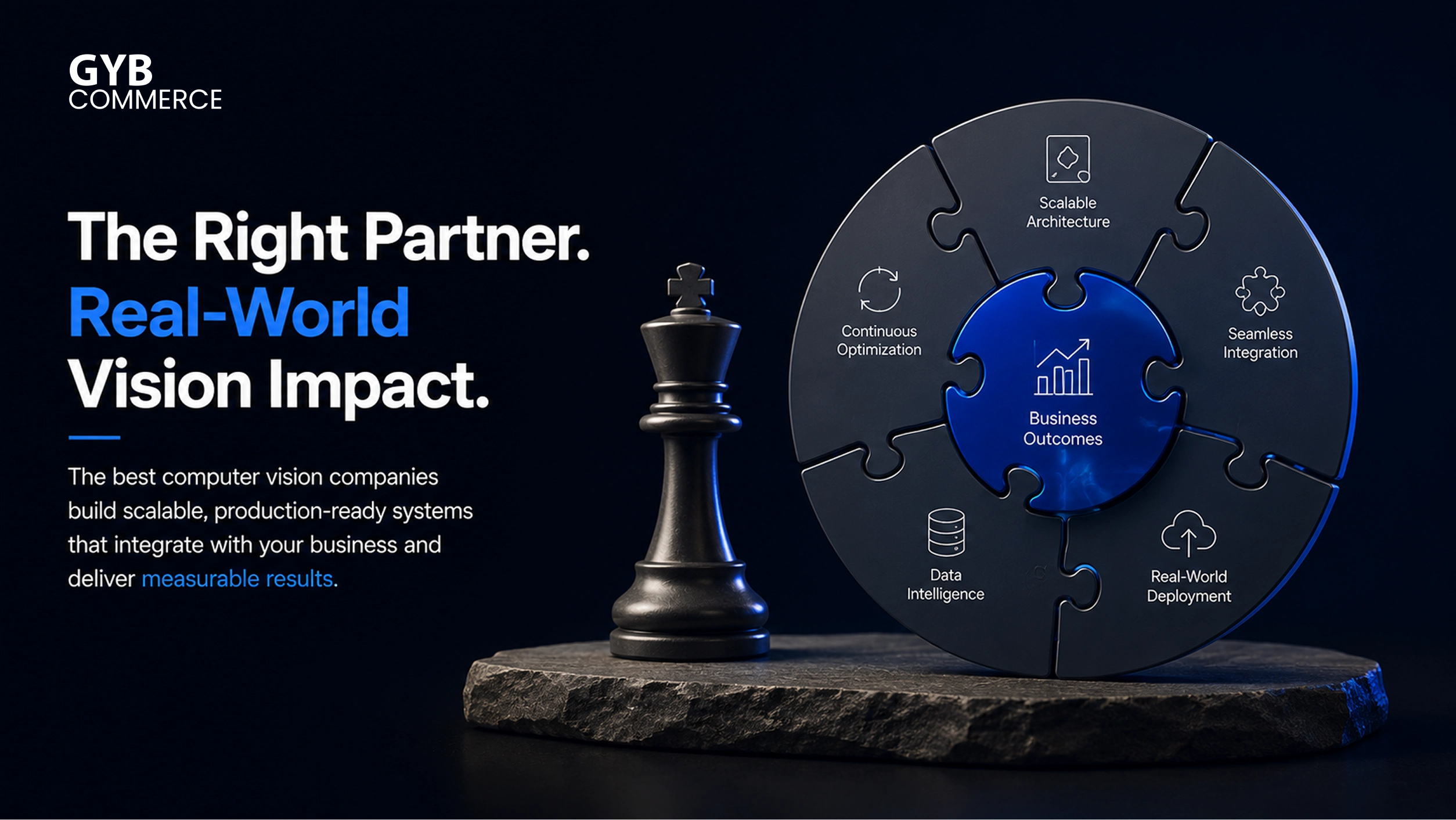
Computer vision has moved from experimentation to production across industries. Businesses now rely on it to process images, automate decisions, and extract insights at scale. As adoption increases, the demand for reliable computer vision partners has also grown. Companies are no longer looking for prototypes. They want production-ready systems that integrate with existing infrastructure and deliver measurable outcomes.
However, choosing the right provider is not straightforward. The “best” computer vision company depends on your use case, data maturity, and deployment environment. Some vendors focus on pre-built models, while others specialize in custom systems. This guide lists leading computer vision companies and helps you understand which type of provider aligns with your business goals.
Top Computer Vision Companies in 2026
1. GYB Commerce
GYB Commerce focuses on architecture-first computer vision solutions built for real-world deployment. Instead of offering generic models, the company designs systems that align with business workflows, data pipelines, and infrastructure requirements.
Their approach centers on integrating computer vision into existing ecosystems, including CRMs, ERPs, and automation layers. This makes their solutions suitable for enterprises that require scalable systems rather than isolated AI models.
GYB Commerce is best suited for organizations that need end-to-end implementation, from data processing to deployment and optimization.
Explore their custom computer vision solutions to see how they automate visual inspection.
2. Tezeract
Tezeract delivers custom computer vision systems with a strong focus on production readiness. The company works across industries, building solutions for object detection, facial recognition, and video analytics.
Their strength lies in combining technical execution with business outcomes. They focus on systems that reduce operational overhead and improve decision-making speed.
Tezeract is a strong fit for businesses that want tailored solutions without managing complex internal AI teams.
3. Gestalt Robotics
Gestalt Robotics specializes in computer vision for industrial automation and robotics. Their systems enable machines to interpret visual data in manufacturing and logistics environments.
They combine classical vision techniques with modern machine learning models to improve efficiency and accuracy. This hybrid approach works well in structured industrial settings.
Gestalt Robotics is ideal for manufacturers building smart factories and automated production lines.
4. DeepC
DeepC focuses on medical imaging and diagnostic support using computer vision. Their solutions help healthcare providers analyze radiology data more efficiently.
The company operates in regulated environments and builds systems that meet compliance standards. Their models assist professionals rather than replace them, improving diagnostic workflows.
DeepC is best suited for healthcare institutions and medical technology providers.
5. OneVision Software AG
OneVision Software AG develops computer vision solutions for print and publishing workflows. Their systems automate image processing, quality control, and production optimization.
They focus on reducing manual intervention in high-volume environments. This improves consistency and speeds up processing pipelines.
OneVision is a strong choice for businesses in publishing, packaging, and media production.
6. FlyPix AI
FlyPix AI provides computer vision tools for retail, logistics, and geospatial analysis. Their solutions include object detection, tracking, and anomaly detection.
The company focuses on adaptability, allowing businesses to apply vision models across different use cases. Their systems integrate with operational workflows to improve efficiency.
FlyPix AI is suitable for organizations managing large-scale visual data in dynamic environments.
7. VarTech Systems
VarTech Systems combines rugged hardware with computer vision capabilities. Their systems are designed for harsh environments such as manufacturing plants and energy facilities.
They focus on reliability, ensuring that vision systems operate under extreme conditions. This makes them different from software-only providers.
VarTech Systems is best for industries that require durable, hardware-integrated solutions.
8. Arthur AI
Arthur AI specializes in monitoring and validating AI models, including computer vision systems. Their platform helps organizations track performance, detect bias, and maintain compliance.
They provide a governance layer that ensures models remain accurate over time. This is critical for enterprises deploying AI at scale.
Arthur AI is ideal for companies that need visibility and control over deployed models.
9. Verkada
Verkada focuses on computer vision for security and surveillance. Their platform combines hardware and software to deliver real-time analytics.
They enable organizations to monitor environments, detect anomalies, and improve safety. Their cloud-based approach simplifies deployment and management.
Verkada is a strong fit for enterprises prioritizing physical security and monitoring.
10. Iterative Health
Iterative Health develops computer vision systems for gastrointestinal diagnostics. Their technology assists doctors during real-time medical procedures.
Their models improve detection accuracy and support clinical decision-making. The company emphasizes validation and real-world deployment.
Iterative Health is best suited for healthcare providers and medical device companies.
Understanding the Business Impact of Computer Vision
Automation of Visual Inspection
Computer vision systems replace repetitive manual inspection with consistent, data-driven analysis. In manufacturing, models detect defects in real time, which reduces human error and improves quality control. As a result, businesses maintain uniform standards across large production volumes.
Moreover, automated inspection systems operate continuously, which increases throughput without increasing labor costs. This directly impacts efficiency and reduces operational delays.
Reviewing the technical basics of what computer vision is helps clarify exactly how these operational benefits are achieved.
Enhanced Data Analytics from Visual Data
Visual data is one of the most underutilized assets in most organizations. Computer vision enables systems to process images and videos, then extract patterns that humans cannot easily detect.
For example, retailers analyze in-store movement, while logistics companies monitor package flow. These insights improve decision-making and allow businesses to optimize operations based on real data rather than assumptions.
Operational Efficiency and Cost Reduction
Computer vision reduces dependency on manual processes across workflows. Tasks such as sorting, monitoring, and verification become automated, which lowers operational costs over time.
In addition, systems process data faster than human teams. This improves turnaround time and allows businesses to scale operations without proportional increases in workforce size.
Security, Safety, and Monitoring Systems
Computer vision enhances security by enabling real-time monitoring and anomaly detection. Systems identify unusual behavior, detect threats, and trigger alerts instantly.
This is especially useful in environments where constant monitoring is required. Businesses improve safety standards while reducing reliance on manual surveillance systems.
Evaluation Criteria for the Best Computer Vision Companies
Model Accuracy and Performance Benchmarks
Accuracy is the foundation of any computer vision system. Organizations evaluate models using metrics such as precision, recall, and F1 score. However, real-world performance matters more than controlled testing results.
Therefore, it is important to assess how models perform under varying conditions, including lighting, angles, and noise.
Scalability and Deployment Architecture
A solution that works in a test environment may fail at scale. Businesses must evaluate whether the system supports cloud, edge, or hybrid deployment.
Scalability also depends on how efficiently the system processes large volumes of visual data. Poor architecture leads to bottlenecks and increased latency.
Knowing how storage solutions accelerate computer vision training prevents these infrastructure bottlenecks early on.
Data Strategy and Training Capabilities
The quality of a computer vision system depends heavily on its training data. Organizations must assess how vendors handle dataset collection, annotation, and augmentation.
High-quality datasets improve accuracy, while poor data leads to unreliable outputs. Some providers also use synthetic data to enhance model performance.
Integration and Infrastructure Compatibility
Computer vision systems rarely operate in isolation. They must integrate with existing infrastructure such as CRMs, ERPs, and analytics platforms.
Seamless integration reduces friction during deployment and ensures that insights flow across systems without disruption.
Industry Expertise and Use-Case Alignment
Different industries require different approaches to computer vision. A healthcare solution differs significantly from a retail or manufacturing system.
Therefore, businesses should prioritize vendors with proven experience in their specific domain. This reduces risk and accelerates implementation.
Long-Term Support and Optimization
Computer vision systems require continuous monitoring and improvement. Models can degrade over time due to changes in data patterns, known as model drift.
Vendors should provide ongoing support, including retraining and optimization, to maintain performance and reliability.
Categories of Computer Vision Solution Providers
Enterprise AI Platforms
These providers offer large-scale AI ecosystems with broad capabilities. They provide pre-built tools and infrastructure that support multiple AI use cases.
However, customization can be limited, which may restrict flexibility for complex requirements.
Cloud-Based AI Providers
Cloud providers offer scalable infrastructure and pre-trained models that accelerate deployment. Businesses can quickly build and deploy solutions without managing hardware.
That said, reliance on cloud infrastructure may introduce latency or compliance challenges in certain industries.
Specialized Computer Vision Startups
Startups focus on niche use cases and often deliver innovative solutions. They move quickly and adapt to specific industry needs.
However, they may lack the scalability or long-term support required for enterprise deployments.
Custom Computer Vision Development Companies
These companies build tailored solutions aligned with business workflows and infrastructure. They focus on integration, scalability, and production deployment.
This approach is ideal for organizations with complex requirements that cannot be solved with off-the-shelf tools.
How to Choose the Right Computer Vision Partner
Aligning Technology with Business Goals
The selection process should begin with clear business objectives. Organizations must define what they want to achieve, whether it is cost reduction, efficiency, or automation.
This ensures that the chosen solution delivers measurable value rather than just technical capability.
Evaluating Technical Depth vs Practical Deployment
Some vendors focus on research and prototypes, while others specialize in production-ready systems. Businesses should prioritize partners that have proven deployment experience.
This reduces implementation risks and ensures smoother integration into existing workflows.
Assessing Total Cost of Ownership
Initial development cost is only one part of the equation. Businesses must also consider infrastructure, maintenance, and scaling expenses.
A low upfront cost may lead to higher long-term expenses if the system lacks efficiency or scalability.
Ensuring Scalability and Future Readiness
Computer vision systems must handle growing datasets and evolving requirements. Organizations should evaluate whether the solution can scale without major redesign.
Future readiness is critical for long-term success.
Verifying Real-World Performance and Case Studies
Case studies provide insight into how a solution performs in real environments. Businesses should look for proven results across similar use cases.
This helps validate vendor claims and reduces uncertainty during decision-making.
Frequently Asked Questions
What makes a computer vision company the best choice?
The best computer vision company is defined by its ability to meet your specific use case requirements. This includes accuracy, scalability, and integration capability.
A strong provider also demonstrates real-world deployment experience and measurable results.
Are custom computer vision solutions better than pre-built tools?
Custom solutions offer greater flexibility and integration, which makes them suitable for complex workflows. Pre-built tools, however, allow faster deployment for simpler use cases.
The right choice depends on your business needs and technical constraints.
How much do computer vision solutions cost?
Costs vary based on complexity, data requirements, and infrastructure. Simple implementations may cost less, while enterprise-grade systems require higher investment.
Ongoing costs such as maintenance and scaling should also be considered.
Which industries benefit most from computer vision?
Industries such as healthcare, retail, manufacturing, and logistics benefit significantly from computer vision. These sectors rely heavily on visual data and repetitive processes.
Automation and real-time insights create measurable improvements in efficiency.
How long does it take to deploy a computer vision system?
Deployment timelines depend on data availability and system complexity. Some projects take weeks, while others require several months.
Proper planning and data readiness can significantly reduce implementation time.
What are the risks of choosing the wrong vendor?
Choosing the wrong vendor can lead to poor system performance, integration challenges, and increased costs.
It may also result in delays and failure to achieve expected outcomes.
How do companies measure success in computer vision projects?
Success is measured through accuracy, efficiency improvements, and cost reduction. Businesses also evaluate impact on operational workflows and decision-making.
Continuous monitoring ensures that the system maintains performance over time.
Final Takeaways
There is no universal best computer vision company. The right choice depends on your use case, data strategy, and infrastructure requirements.
Businesses should focus on scalability, integration, and long-term performance rather than short-term cost. A well-chosen partner enables sustainable growth and operational efficiency.
The FDE Hiring Scorecard
A 1-page rubric to evaluate Forward Deployed Engineer candidates across 12 dimensions. Built from interview patterns at Palantir, OpenAI, and Anthropic.
- Score candidates 1–5 across technical & customer-facing skills
- Built-in scoring guide: hire / develop / pass
- PDF — print or share with your hiring team
No spam. We’ll only email you about FDE hiring resources. Unsubscribe anytime.