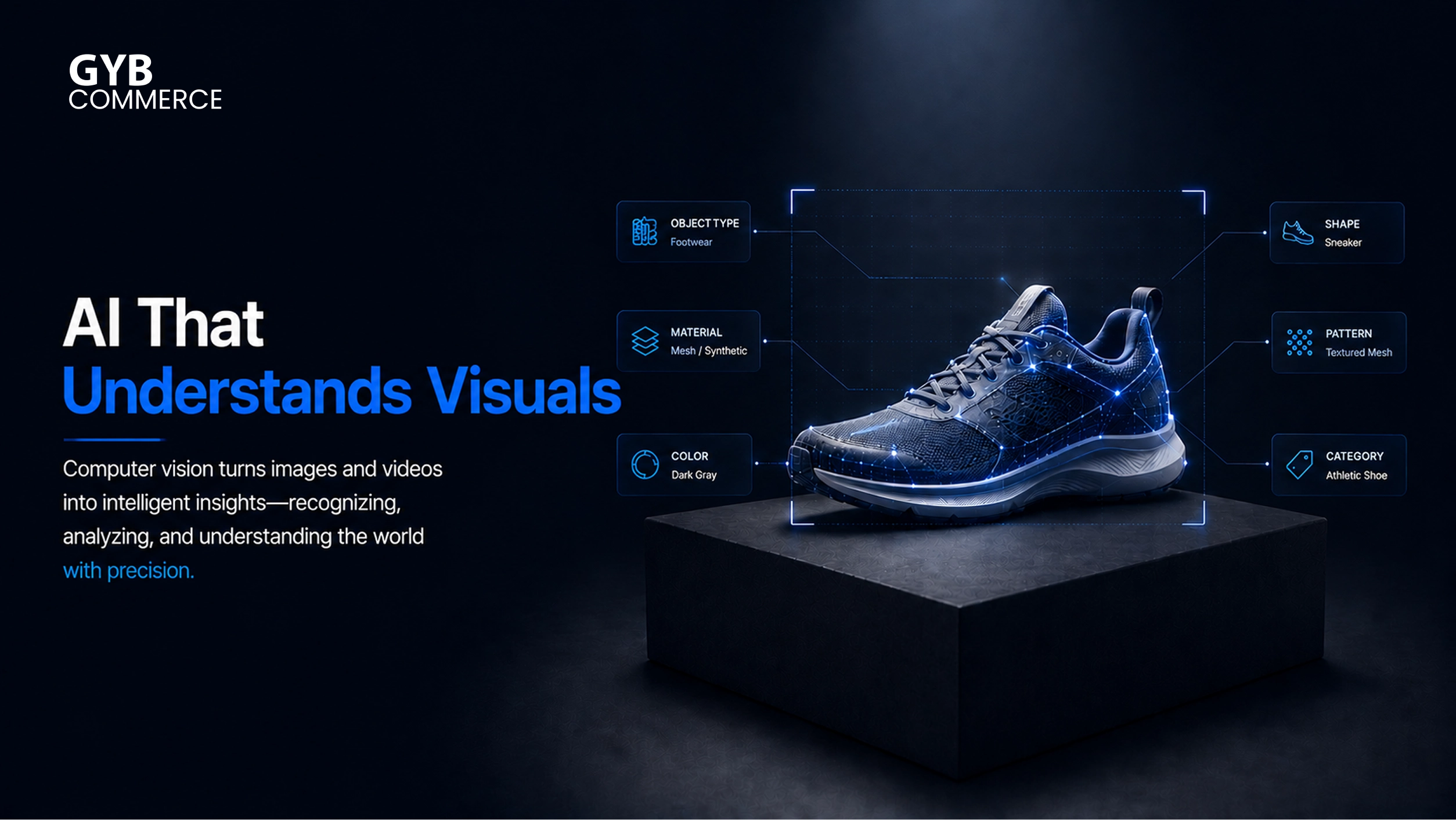
Computer vision is the ability of machines to interpret and understand visual data such as images and videos. It plays a central role in modern artificial intelligence, enabling systems to extract meaning from visual inputs instead of relying only on text or numbers. As businesses generate massive volumes of visual data daily, from surveillance footage to product images, the need to process this information efficiently has become critical.
At the same time, computer vision is no longer limited to research labs. It is actively used in healthcare, retail, manufacturing, and security systems. From detecting diseases in medical scans to enabling automated checkout experiences, its applications are expanding rapidly. Understanding what computer vision is and how it works helps you see why it has become a foundational technology in AI-driven systems.
Table of Contents
What Is Computer Vision And Why Does It Exist?
What Does Computer Vision Actually Mean
Computer vision is a field within Artificial Intelligence that enables machines to interpret visual inputs. In simple terms, it allows computers to understand what they see.
For humans, recognizing an object in an image feels natural. However, for machines, an image is just a collection of pixel values. Computer vision transforms this raw data into structured insights.
This includes recognizing objects, identifying patterns, and understanding scenes. As a result, machines can perform tasks that once required human vision.
How Computer Vision Connects To Artificial Intelligence
Computer vision works closely with Machine Learning and Deep Learning. These technologies allow systems to learn patterns from data instead of relying on fixed rules.
For example, instead of manually programming a system to recognize objects, models are trained on large datasets. Over time, they improve their accuracy through exposure to more data.
Organizations like IBM have contributed to advancements in this space. Insights shared on IBM Think, including work by Rina Diane Caballar and Cole Stryker, highlight how computer vision continues to evolve.
Why Businesses Rely On Computer Vision Today
Businesses process large volumes of visual data daily. This includes product catalogs, security footage, medical images, and operational visuals.
Handling this manually is slow and inconsistent. Computer vision automates this process, making it faster and more reliable.
It helps organizations:
- process thousands of images in seconds
- improve accuracy in detection and classification
- reduce manual effort in repetitive tasks
Because of this, computer vision has become a key component of digital transformation strategies.
CTA: Get Started with Premium Computer Vision Solutions
How Does Computer Vision Work Step By Step?
Step 1, Image Acquisition And Input Data
The process begins with capturing visual data. This data can come from cameras, sensors, or stored image repositories.
Large datasets like ImageNet, COCO, and Open Images are commonly used to train models. These datasets provide labeled images that help systems learn patterns. Understanding how storage solutions accelerate computer vision training is critical when managing these massive datasets.
Step 2, Preprocessing And Feature Extraction
After acquisition, images go through preprocessing. This step includes resizing, normalization, and noise reduction.
Then comes feature extraction. The system identifies key elements such as edges, textures, and shapes.
This step converts raw image data into meaningful features that models can analyze effectively.
Step 3, Model Interpretation Using Deep Learning
At this stage, models analyze the extracted features. Most systems rely on Convolutional Neural Networks.
CNNs process images in layers, starting with basic features and moving toward complex patterns. This layered approach allows accurate recognition.
More recently, architectures like Vision Transformer have emerged. These models use attention mechanisms to capture relationships within images.
Step 4, Output Generation And Decision Making
Finally, the system produces an output. This could be a classification, detection result, or segmentation map.
For example, a model might identify objects in an image or classify it into a category. These outputs are then used to trigger actions.
In business systems, this may include alerts, automation workflows, or real-time decision making.
Key Computer Vision Tasks You Should Know
Image Classification Explained
Image classification assigns a single label to an entire image. For example, identifying whether an image contains a cat or a dog.
This task is simple but forms the foundation for many advanced computer vision systems.
Object Detection In Real World Systems
Object detection identifies and locates multiple objects within an image. It provides both classification and position information.
For instance, detecting cars, people, and traffic signs within the same frame. This is widely used in surveillance and automation systems.
Image Segmentation And Instance Segmentation
Image segmentation divides an image into multiple regions. Each region corresponds to a different object or part.
Instance segmentation goes further by distinguishing between individual objects of the same type.
For example, identifying each person separately in a crowded scene instead of grouping them together.
Real World Examples Of Computer Vision
Healthcare And Medical Imaging Use Cases
Computer vision plays a critical role in healthcare, especially in radiology and diagnostics. It helps analyze medical images with high precision.
For example, models can detect conditions like pneumonia from chest scans. These systems are trained on thousands of labeled images, which improves diagnostic accuracy.
Hospitals use computer vision to support doctors, not replace them. It helps reduce workload and speeds up decision making in critical situations.
Retail And Customer Behavior Analysis
Retail businesses use computer vision to understand customer behavior and improve operations. It is widely used in modern store environments.
For instance, automated checkout systems track items without manual scanning. This reduces friction and improves customer experience.
It also helps analyze foot traffic, product interactions, and shelf performance. As a result, businesses make better merchandising decisions.
Manufacturing And Quality Inspection
In manufacturing, computer vision is used for quality control and defect detection. It ensures that products meet strict standards.
Cameras capture product images during production. The system then checks for defects such as cracks, misalignments, or missing components.
This process is faster and more consistent than manual inspection. It reduces errors and improves production efficiency.
Implementing custom computer vision solutions allows factories to achieve zero-defect production consistently.
Core Technologies Behind Computer Vision
Role Of Convolutional Neural Networks
Convolutional Neural Networks are the backbone of most computer vision systems. They are designed to process visual data efficiently.
CNNs work by scanning images in layers. Each layer detects different features, starting from edges and moving to complex patterns.
This layered approach allows models to recognize objects accurately, even in complex scenes.
Evolution Toward Vision Transformers
Vision Transformer represents a newer approach in computer vision. It uses attention mechanisms instead of traditional convolution.
This allows the model to understand relationships across the entire image, not just local regions.
As a result, vision transformers often perform better in tasks that require global context.
Data Preparation And Augmentation Techniques
Data plays a central role in computer vision performance. High-quality datasets lead to better models.
Common techniques include:
- data augmentation, such as flipping or rotating images
- synthetic data generation to expand datasets
- balancing datasets to reduce bias
These methods improve model robustness and generalization.
Why Computer Vision Is Important For Businesses
Automation And Operational Efficiency
Computer vision reduces manual effort by automating visual tasks. This includes inspection, monitoring, and analysis.
Businesses can process large volumes of visual data without increasing human workload. This improves efficiency across operations.
Improving Accuracy And Decision Making
Human analysis can be inconsistent, especially at scale. Computer vision provides consistent and repeatable results.
For example, detecting defects or identifying objects becomes more reliable. This leads to better decisions based on accurate data.
Supporting Digital Transformation Initiatives
Computer vision is a key enabler of digital transformation. It allows businesses to convert visual data into actionable insights.
As organizations adopt AI-driven systems, computer vision becomes an essential component of modern infrastructure.
Limitations And Challenges Of Computer Vision
Data Dependency And Dataset Bias
Computer vision models depend heavily on data quality. Poor or biased datasets lead to inaccurate results.
If training data lacks diversity, the system may fail in real-world scenarios. This remains a major challenge in deployment.
Accuracy Challenges In Real Environments
Real-world environments are unpredictable. Lighting, angles, and occlusions can affect performance.
Models trained in controlled environments may struggle when conditions change. This impacts reliability in production systems.
Infrastructure And Compute Requirements
Computer vision requires significant computational power. Training models can be resource intensive.
Deploying these systems also requires scalable infrastructure. This includes GPUs, storage, and optimized pipelines.
How Computer Vision Connects To Modern AI Systems
Relationship With Machine Learning And Deep Learning
Computer vision is deeply connected to Machine Learning and Deep Learning.
These technologies enable systems to learn from visual data and improve over time. Without them, computer vision would remain limited to rule-based approaches.
Integration With Broader AI Ecosystems
Computer vision does not operate in isolation. It often works alongside other AI systems such as natural language processing and automation platforms.
For example, a system may combine visual data with text inputs to make better decisions. This integration creates more intelligent and adaptive solutions.
Evaluating the top computer vision companies in 2026 helps you find the right integration partner for these systems.
Frequently Asked Questions
What Is Computer Vision In Simple Words?
Computer vision is a technology that allows machines to see and understand images or videos. It helps systems interpret visual data in a meaningful way.
In simple terms, what is computer vision can be understood as giving computers the ability to recognize and analyze what they see.
How Does Computer Vision Work?
Computer vision works by capturing images, processing them, and analyzing patterns using trained models. It converts visual data into structured outputs.
When asking what is computer vision, it is important to understand that it relies on machine learning and deep learning to improve accuracy.
What Are Computer Vision Examples?
Computer vision examples include facial recognition, medical image analysis, and automated checkout systems. It is also used in manufacturing and security.
These examples show what is computer vision in action across different industries and use cases.
Is Computer Vision Part Of AI?
Yes, computer vision is a key part of artificial intelligence. It focuses specifically on understanding visual data.
When discussing what is computer vision, it is often described as a subfield of AI that deals with images and videos.
What Are Computer Vision Tasks?
Computer vision tasks include image classification, object detection, and image segmentation. These tasks help systems interpret visual data.
Understanding what is computer vision requires knowing these core tasks and how they are applied.
How Accurate Is Computer Vision?
The accuracy of computer vision depends on data quality, model design, and real-world conditions. High-quality datasets improve performance significantly.
When evaluating what is computer vision, accuracy is a critical factor that varies based on implementation.
Where Is Computer Vision Used?
Computer vision is used in healthcare, retail, manufacturing, and security. It supports automation and improves decision making.
These applications highlight what is computer vision and why it is widely adopted across industries.
Final Takeaways
Computer vision enables machines to interpret and analyze visual data at scale. It transforms raw images into actionable insights that support real-world decisions.
As AI continues to evolve, computer vision will play an even greater role in automation and intelligence. Understanding its foundations helps you see how modern systems are built and where they are heading.