What is a Forward Deployed Engineer? The 2026 Guide
Everything you need to know about the role tech CEOs are calling the most in-demand hire of 2026 — including what FDEs actually do, who's hiring them, salary benchmarks, required skills, and how to hire one yourself.
The Forward Deployed Engineer (FDE) has become the most talked-about role in tech. Sundar Pichai and Aaron Levie both publicly named it the most in-demand engineering hire of 2026.Ffastcompany OpenAI, Anthropic, Databricks, Ramp, Palantir, and Google Cloud are all hiring aggressively. Job postings for the role have grown 800% since the start of the AI deployment wave.Tthe-ken
So what exactly does a Forward Deployed Engineer do? Why are top AI labs paying senior FDEs $400K+ in total compensation? And how do growth-stage startups bring on FDE capabilities without spending two years building an in-house team?
This is the complete 2026 guide. If you're a founder evaluating whether you need an FDE, a hiring manager scoping the role, or an engineer thinking about the career path — this covers everything.
- What is a Forward Deployed Engineer?
- Where the FDE role came from (Palantir's "Delta" engineers)
- What Forward Deployed Engineers actually do
- FDE vs Solutions Architect vs Sales Engineer
- Which companies hire FDEs in 2026
- Forward Deployed Engineer salary in 2026
- Skills every Forward Deployed Engineer needs
- Why the FDE role is exploding right now
- Does your company actually need an FDE?
- How to hire a Forward Deployed Engineer
- Frequently Asked Questions
1. What is a Forward Deployed Engineer?
A Forward Deployed Engineer (FDE) is a customer-embedded software engineer who works directly inside an enterprise customer's environment — implementing, customizing, and shipping the production code that makes a vendor's product actually work for that customer.Pposthog
The phrase comes from military terminology. "Forward deployed" means stationed at the edge — close to operations, not at headquarters. In tech, it means the engineer sits with the customer, writes code that runs in the customer's stack, and stays on the account until the deployment is delivering measurable business value.
Unlike traditional product engineers who optimize for reuse across many customers, an FDE optimizes for one customer at a time. Their job is to close the gap between what the vendor's platform does out of the box and what this specific customer needs it to do. That gap is often where 80% of enterprise AI projects fail — not because the model is bad, but because nobody bridges the integration, data, and workflow chasm between the product and the customer's reality.
The short definition: A Forward Deployed Engineer is a senior software engineer who lives inside the customer's codebase, ships production-grade integrations and custom logic, and owns the deployment end to end — from kickoff to renewal.
2. Where the FDE role came from
The role was pioneered by Palantir in the early 2010s, where they were called "Deltas." Palantir's customers — intelligence agencies, hospitals, large banks, manufacturers — had data and security constraints so complex that a normal sales motion couldn't deliver value. Even running a demo required weeks of NDAs and clearances.Ppragmaticengineer
Palantir's solution was to send actual engineers into customer sites. These Deltas worked with the customer for months, sometimes years, building custom workflows on top of Palantir's core products. By 2016, Palantir had more FDEs than traditional software engineers. The model was so successful that Palantir's market cap eventually grew past $300 billion — largely on the back of customer outcomes that FDEs delivered.Ffirstround
For a decade, the role was unique to Palantir and a handful of imitators. Most B2B software companies dismissed it as "glorified consulting" — too labor-intensive to scale.
Then generative AI happened. Every enterprise wanted to deploy LLMs into their workflows. Every deployment was different. The model worked beautifully in a sandbox demo and broke immediately on contact with the customer's real data, real SSO, real compliance requirements, and real legacy systems. Suddenly every AI company needed Palantir-style engineers to ship the last mile.
OpenAI built a deployment organization. Anthropic, fresh off a $30B raise, scaled customer-facing engineering. Databricks, Cohere, Scale AI, and Ramp followed. By 2024, "Forward Deployed Engineer" was the fastest-growing job title in tech.Aa16z
3. What Forward Deployed Engineers actually do
An FDE's day-to-day work spans five distinct buckets. Most of the role is engineering, but the surface area is much wider than a typical software engineering job.
1. Discovery and scoping
FDEs start by understanding the customer's actual business problem — not the one in the sales deck. They sit with operators, read internal documents, audit the customer's data, and define what "success" looks like in measurable terms. This is where the FDE earns trust as a technical peer rather than a vendor representative.
2. Architecture and integration design
The customer's stack is messy. There's a legacy CRM nobody fully understands, an OIDC/SAML auth setup, a compliance team that needs to sign off on data residency, and a security team that controls production credentials. The FDE designs an integration architecture that fits inside all of those constraints.
3. Writing and shipping production code
This is what separates an FDE from a solutions architect or sales engineer. The FDE writes the actual integration code — the custom evals, the RAG pipeline, the API glue, the agentic workflow logic — and ships it to production in the customer's environment. They use the customer's CI/CD, the customer's secrets management, and the customer's deployment patterns.Ggpt-trainer
4. Debugging in live customer environments
Things break. Latency spikes at peak load. A regex misclassifies 3% of intents. The model hallucinates on a specific document type the customer didn't surface in discovery. The FDE debugs in production, often while sitting in the customer's Slack alongside their engineers, fixing things in real time.
5. Feeding learnings back to the core product team
Every FDE deployment surfaces patterns. Three different customers all needed the same authentication flow. Five customers asked for the same eval framework. The FDE writes up the patterns and pushes them back to the core product team, who eventually generalize them as features. This is how Palantir Foundry, OpenAI's Realtime API, and Anthropic's Applied AI tooling were born — from FDE learnings.
One way to think about it: An FDE is functionally a CTO for one customer, with the backing of a product company. They own end-to-end execution of a high-stakes deployment, just like a startup CTO would, but with the leverage of an entire engineering organization behind them.
4. Forward Deployed Engineer vs Solutions Architect vs Sales Engineer
If you're scoping the role for your company, you've probably also looked at Solutions Architects and Sales Engineers. They sound similar. They are not. Here's how they differ in practice.
| Capability | Forward Deployed Engineer | Solutions Architect | Sales Engineer |
|---|---|---|---|
| Writes production code | Yes — primary output | Rarely | Demo code only |
| Embedded with customer | Yes — weeks to months | Partial — pre-sales | No |
| Owns deployment outcome | Yes | No | No |
| System design | Yes | Yes — primary output | Surface-level |
| Pre-sales demos | Sometimes | Often | Yes — primary output |
| Post-launch support | Yes | No | No |
| Influences product roadmap | Yes — direct feedback loop | Indirect | Indirect |
The simplest test: if your enterprise customer hits a problem at 2am and pings their account team, who can actually fix it? A Sales Engineer escalates. A Solutions Architect diagrams a fix. An FDE writes a patch and ships it. For a complete breakdown, see our companion comparison: Forward Deployed Engineer vs Solutions Architect vs Sales Engineer.
5. Which companies hire FDEs in 2026
As of mid-2026, the FDE role has spread far beyond Palantir. Here's the current landscape.Hhashnode
AI labs and foundation model companies
- OpenAI — runs a dedicated deployment organization led by the Head of Forward Deployed Engineering
- Anthropic — calls them "Applied AI Engineers"; mission is embedding Claude into enterprise workflows
- Cohere — hires FDEs to ship custom agents on the Cohere Agentic Platform
- Scale AI — Forward Deployed Data Scientists/Engineers architecting data solutions for top labs
Data and platform infrastructure
- Palantir — the original; FDEs (FDSEs) still the largest function inside the company
- Databricks — "AI Engineers, FDE" who build first-of-their-kind AI applications on the Databricks platform
- C3 AI — heavy FDE hiring for enterprise AI deployments
AI-native B2B SaaS
- Ramp — uses FDEs for complex enterprise migrations and custom integrations
- Box — CEO Aaron Levie has publicly emphasized FDE hiring as a 2026 priorityFfastcompany
- ActionIQ — high-paying FDE roles for customer data platform deployments
- HoneyHive, Bug0, Matta — emerging AI startups treating FDEs as foundational hires
Established giants newly adopting the model
- Google Cloud — launched a dedicated FDE team in 2026; CEO Thomas Kurian has publicly announced plans to hire hundreds of FDEsFfastcompany
- Adobe — "Forward Deployed AI Engineers" working with Firefly customers
- Salesforce — Senior FDEs driving outcomes through hands-on Einstein implementation; committed to 1,000 FDE-class engineersEentrepreneurloop
- EY — launched a global Forward Deployed Engineering practice in April 2026
- Accenture — launched a dedicated FDE practice in partnership with Microsoft in March 2026
6. Forward Deployed Engineer salary in 2026
FDE compensation is one of the most visible signals of how strategic this role has become. The numbers come from public salary databases and job postings as of May 2026.
US salary ranges (May 2026)
| Source | Range | Notes |
|---|---|---|
| Glassdoor average | $155,442 | Based on 598 self-reported salaries |
| Glassdoor typical range | $124K – $198K | 25th to 75th percentile |
| Recruiting from Scratch median | $210K base | Across 44 recent placements |
| Industry-wide TC average | $238,000 | Total compensation including stock |
| Palantir FDE on Levels.fyi | $171K – $415K | Median TC $215K (last updated May 2026) |
| Senior at top AI labs | $350K – $550K | OpenAI & Anthropic mid-to-senior bands |
| Staff-level FDEs | $630,000+ | Top of market at frontier labs |
| Hourly contract rates | $90 – $300/hr | Junior to expert tier globally |
Sources for this table span four salary databases: Glassdoor, Recruiting from Scratch, Hashnode's industry analysis, and Levels.fyi's Palantir-specific data.Gglassdoor+3
What drives the variance
- Domain expertise: Defense, financial services, healthcare, and energy add 40–60% premiums. A security clearance can add $30K–$80K to base.Ssecondtalent
- Frontier model exposure: Working with Claude, GPT-4o, or Gemini at the frontier pays more than mid-tier SaaS FDE work.
- Geography: New York has overtaken San Francisco as the #1 FDE hub (35% of postings vs 11%) thanks to fintech demand.Hhashnode
- Outcome bonuses: Unlike traditional engineering, FDE comp often includes 10–30% bonuses tied to renewals and expansion revenue.
"Average TC for an FDE is now $238,000, with the range typically between $205,000 and $486,000. Palantir pays. The high pay reflects the high-stress, high-impact, and high-travel nature of the job. You're paid for leverage." — Hashnode, Tech's Secret Weapon: The Complete 2026 Guide to the Forward Deployed Engineer
Need an FDE without the $400K total comp ticket?
GYB Commerce provides pre-vetted, Claude- and OpenAI-certified Forward Deployed Engineers — embedded with your customer team in 14 days, at 40–70% lower cost than US-based hires. Actively serving US, UK, and UAE markets.
Hire a Forward Deployed Engineer →7. Skills every Forward Deployed Engineer needs
FDEs need a "T-shaped" profile: deep technical skill in a core stack, plus broad execution skills that most software engineers don't develop. Here's the modern 2026 skill stack.
Technical depth (the vertical of the T)
- Production languages: Python and TypeScript are table stakes. Go, Rust, or Java helpful in regulated industries.
- Cloud platforms: Deep hands-on with at least one of AWS, GCP, or Azure. Compute, storage, networking, IAM, secrets.
- Data engineering: SQL fluency, ETL pipelines, vector databases (Pinecone, Weaviate), warehouse fundamentals (Snowflake, BigQuery, Databricks).
- LLM tooling: Claude and OpenAI APIs, LangChain, LlamaIndex, n8n, prompt engineering, fine-tuning basics, eval design.
- RAG & agentic patterns: Building Retrieval-Augmented Generation pipelines end to end. Designing agent orchestration with tool use, memory, and guardrails.
- API and integration: REST, GraphQL, OAuth/OIDC/SAML, webhooks, custom connectors. Frontend basics (React/Next.js) to ship working demos.
- DevOps fluency: Docker, Kubernetes basics, CI/CD, observability. Enough to deploy without a dedicated DevOps team.
Execution breadth (the horizontal of the T)
- Customer empathy: The ability to sit with an operator who's frustrated with their current tools and genuinely understand why.
- Problem decomposition: Ambiguous problems are the norm. FDEs break "make this work" into MVP, scope cuts, and a sequencing plan.
- Radical ownership: Nobody is going to remind the FDE to follow up. The deployment lives or dies on their initiative.
- Communication: Comfortable in customer war rooms, exec readouts, and Slack threads with non-technical stakeholders.
- Product sense: Knowing when to ship a hack vs build a primitive that scales across customers.
- Travel and stress tolerance: The job has a higher burnout rate than most engineering roles. Top FDEs build their own pacing.
8. Why the FDE role is exploding right now
The 800% spike in FDE postings isn't random hype. Three structural shifts in enterprise software are driving it.Aa16z
Shift 1: AI capabilities outran enterprise readiness
Every Fortune 500 wants to "deploy AI." Most of them can't. Their data is messy, their auth is legacy, their workflows are tribal knowledge, and their compliance teams are conservative. The model works in the demo and breaks on contact with reality. Someone has to bridge that gap, with code, on site.
Shift 2: Products outgrew product-led growth
For the past decade, the dominant B2B SaaS playbook was PLG — make the product so easy to use that customers self-serve. But AI products have a complexity floor PLG can't clear. You can't self-serve a multi-million-dollar enterprise AI deployment. You need engineering presence.
Shift 3: Enterprise customers got tired of consultants
Traditional system integrators and Big Four consultants charge $400/hr to write PowerPoints. Enterprise buyers have caught on. They want engineers who ship code, not slides. The FDE model — engineer-grade work, vendor-aligned incentives — fits the moment exactly.
"The most advanced platform is useless if it sits on a shelf. The 2026 FDE is the person who breaks through the integration wall." — Hashnode, The Complete 2026 Guide to the Forward Deployed Engineer
9. Does your company actually need an FDE?
FDEs are not the right answer for every B2B company. Hiring one when you don't need one is expensive and often slows you down. Here's how to tell.
You probably need an FDE if:
- Your ACVs are over $100K/year and trending toward six or seven figures
- Your enterprise customers consistently get stuck in implementation
- Your renewal conversations are blocked on "we never got it fully deployed"
- You're selling an AI product and your customers' data is messy or regulated
- Your product team is being pulled into customer-specific work and slowing the roadmap
- You're losing deals to competitors who "deploy in 30 days, guaranteed"
You probably don't need an FDE if:
- Your product is genuinely self-serve with sub-$10K ACVs
- Your customers reach value within the first hour of signup
- You haven't validated product-market fit yet
- Your enterprise pipeline is fewer than 5 deals in flight
The honest take: Many startups think they need FDEs when they actually need better onboarding, better documentation, or a simpler product. But once you're closing Fortune 500 contracts and the implementation phase is killing renewals, an FDE function isn't optional — it's the unlock.
10. How to hire a Forward Deployed Engineer
You have three options. Each has tradeoffs.
Option 1: Build an internal FDE team
Best for: Series B+ companies with predictable enterprise pipeline and 12+ months of runway.
Timeline: 60–120 days to fill a senior FDE role. Multiply by team size.
Cost: $200K–$400K fully loaded per US-based FDE. Senior leads at top AI labs clear $500K total comp.Rrecruitingfromscratch
Pros: Deepest product knowledge over time. Strongest culture fit. Compounding leverage as your FDE org learns.
Cons: Slow to hire. Expensive. Hard to scale up and down with deal flow. Burnout risk if you can't keep them challenged.
Option 2: Use contract FDEs from a US firm
Best for: Validating the FDE motion before committing to in-house hires.
Timeline: 4–8 weeks.
Cost: $200–$300/hr.
Pros: Fast to start. No long-term commitment. High seniority.
Cons: Expensive at scale. Less product loyalty. Hard to retain the same engineer across deployments.
Option 3: Hire through a staff augmentation agency (overseas-vetted)
Best for: AI startups and growth-stage SaaS companies who need FDE capacity without the US-based price tag.
Timeline: 7–14 days.
Cost: 40–70% lower than US-based equivalents.
Pros: Fastest to deploy. Pre-vetted bench. Replacement guarantees. Same technical depth, dramatically lower burn rate. Scales up and down with deal flow.
Cons: Timezone alignment requires planning (we solve this by aligning engineers to your customer's working hours).
At GYB Commerce, every FDE on our roster is independently certified on Anthropic Claude and OpenAI tooling, with hands-on experience building RAG pipelines, agentic workflows, and production LLM deployments. We actively place engineers with companies across the US, UK, and UAE, with a 14-day deployment guarantee and a 90-day replacement policy.
Ready to hire your first Forward Deployed Engineer?
Get a shortlist of pre-vetted, Claude- and OpenAI-certified FDEs within 72 hours. Embedded with your customer team in 14 days. No long-term commitment.
Talk to GYB Commerce →Key Takeaways
- A Forward Deployed Engineer is a customer-embedded software engineer who writes production code inside the customer's environment and owns the deployment end to end.
- The role originated at Palantir in the early 2010s and exploded across the AI industry once enterprise LLM deployments became mission-critical.
- Average 2026 total comp sits near $238K, with senior FDEs at top AI labs clearing $400K–$486K. Glassdoor reports a $155K US average.
- OpenAI, Anthropic, Palantir, Databricks, Google Cloud, Ramp, Adobe, and many more are hiring aggressively.
- FDEs differ from Solutions Architects and Sales Engineers primarily by writing production code and owning customer outcomes end to end.
- You can hire FDEs in-house, via contractors, or through staff augmentation agencies — the right answer depends on your deal velocity, budget, and timeline.
11. Frequently Asked Questions
What does a Forward Deployed Engineer actually do?
How much does a Forward Deployed Engineer make in 2026?
Which companies hire Forward Deployed Engineers?
What skills does a Forward Deployed Engineer need?
Is Forward Deployed Engineer the same as Solutions Architect or Sales Engineer?
Can you outsource or hire a Forward Deployed Engineer through a staff augmentation agency?
How long does it take to hire a Forward Deployed Engineer?
Does a Forward Deployed Engineer need a security clearance?
The bottom line
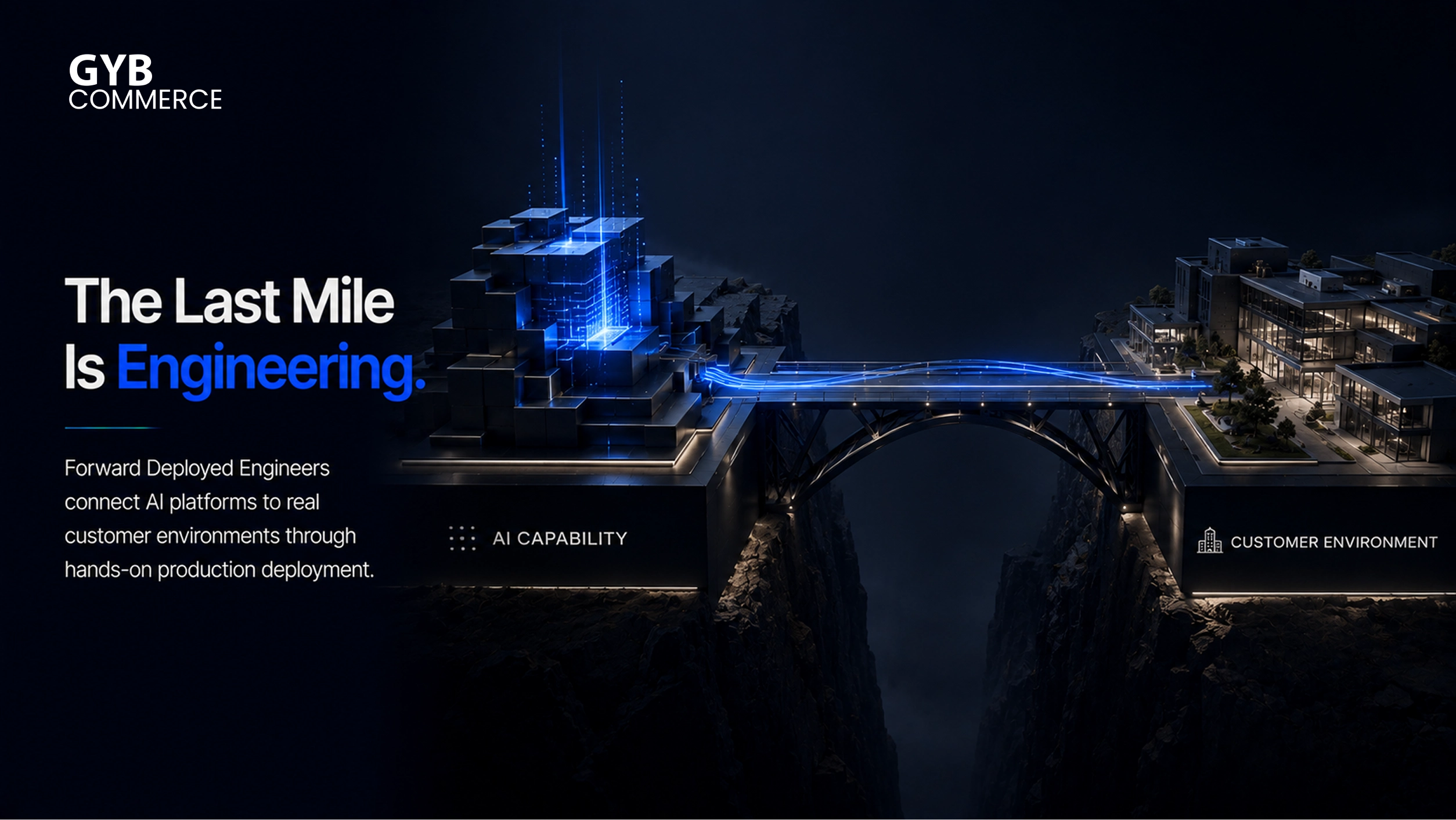
The Forward Deployed Engineer isn't a trend. It's the structural answer to a real problem: enterprise AI deployments fail when nobody owns the last mile, and that last mile is engineering work that has to happen inside the customer's environment.
If you're a founder or hiring manager evaluating whether to bring on FDE capacity, the question isn't "should we hire one?" — the question is how to do it: build internal, hire contractors, or augment with a specialized agency. For most growth-stage AI and SaaS companies, augmentation is the fastest, lowest-risk way to validate the motion before committing to a $200K–$400K internal hire.
If that's where you are, we can help. Our Forward Deployed Engineers are Claude- and OpenAI-certified, embedded with customers in 14 days, and serving US, UK, and UAE markets. Book a discovery call and we'll send a shortlist within 72 hours.
The FDE Hiring Scorecard
A 1-page rubric to evaluate Forward Deployed Engineer candidates across 12 dimensions. Built from interview patterns at Palantir, OpenAI, and Anthropic.
- Score candidates 1–5 across technical & customer-facing skills
- Built-in scoring guide: hire / develop / pass
- PDF — print or share with your hiring team
No spam. We’ll only email you about FDE hiring resources. Unsubscribe anytime.