Customer expectations have shifted toward instant, always-available support across multiple channels. Businesses are now judged not only by what they sell, but by how quickly they respond and resolve issues. Traditional support models struggle to keep up with this demand, especially when query volumes increase.
Automated customer service addresses this gap by enabling faster responses, consistent interactions, and scalable support operations. It allows businesses to manage growing customer demands without increasing operational complexity.
Table of Contents
Advantages of Automated Customer Service
24/7 availability and continuous support
Automated customer service ensures that support is always accessible, regardless of time zones or working hours. Customers can resolve issues, access information, or get assistance at any time without waiting for agents.
This continuous availability reduces response delays and improves accessibility for global audiences. It also eliminates dependency on shift-based support teams.
Reduced customer service costs
One of the most significant advantages of automated customer service is cost reduction. Automation handles repetitive queries and routine processes that would otherwise require human agents.
This reduces staffing requirements, lowers operational overhead, and minimizes training costs. Over time, businesses can maintain high service levels while operating with leaner support teams. These benefits explain how to reduce customer service costs with automation.
Improved efficiency and faster response times
Automated systems process customer queries instantly. They retrieve relevant information, trigger workflows, and deliver responses without delays.
This removes bottlenecks in traditional support systems where agents handle queries sequentially. As a result, businesses can handle higher volumes of requests while maintaining speed and accuracy.
Enhanced customer experience and consistency
Consistency plays a critical role in customer satisfaction. Automated customer service ensures that every interaction follows a structured approach and delivers accurate responses.
In addition, integration with customer data enables personalized interactions. Systems can tailor responses based on previous interactions, preferences, or behavior, creating a more relevant experience.
Scalability without proportional cost increase
As businesses grow, customer support demand increases. Traditional models require hiring more agents, which increases costs and complexity.
Automation removes this limitation by allowing systems to handle multiple interactions simultaneously. This enables businesses to scale support operations without adding equivalent resources.
Increased productivity of support teams
Automation improves the efficiency of human agents by reducing repetitive workloads. Routine queries, such as FAQs or status updates, are handled by automated systems.
This allows agents to focus on complex or high-value issues that require human judgment. As a result, overall productivity increases and support teams can deliver better outcomes.
Key benefits of automated customer service at a glance
- Provides round-the-clock customer support across channels
- Reduces operational and staffing costs significantly
- Improves response speed and resolution time
- Ensures consistent and accurate communication
- Scales support operations without additional resources
- Enhances productivity of customer support teams
Role of Automation in Customer Service
Automation acts as the foundation of modern customer support systems. It connects workflows, tools, and communication channels into a unified process that operates with minimal manual intervention.
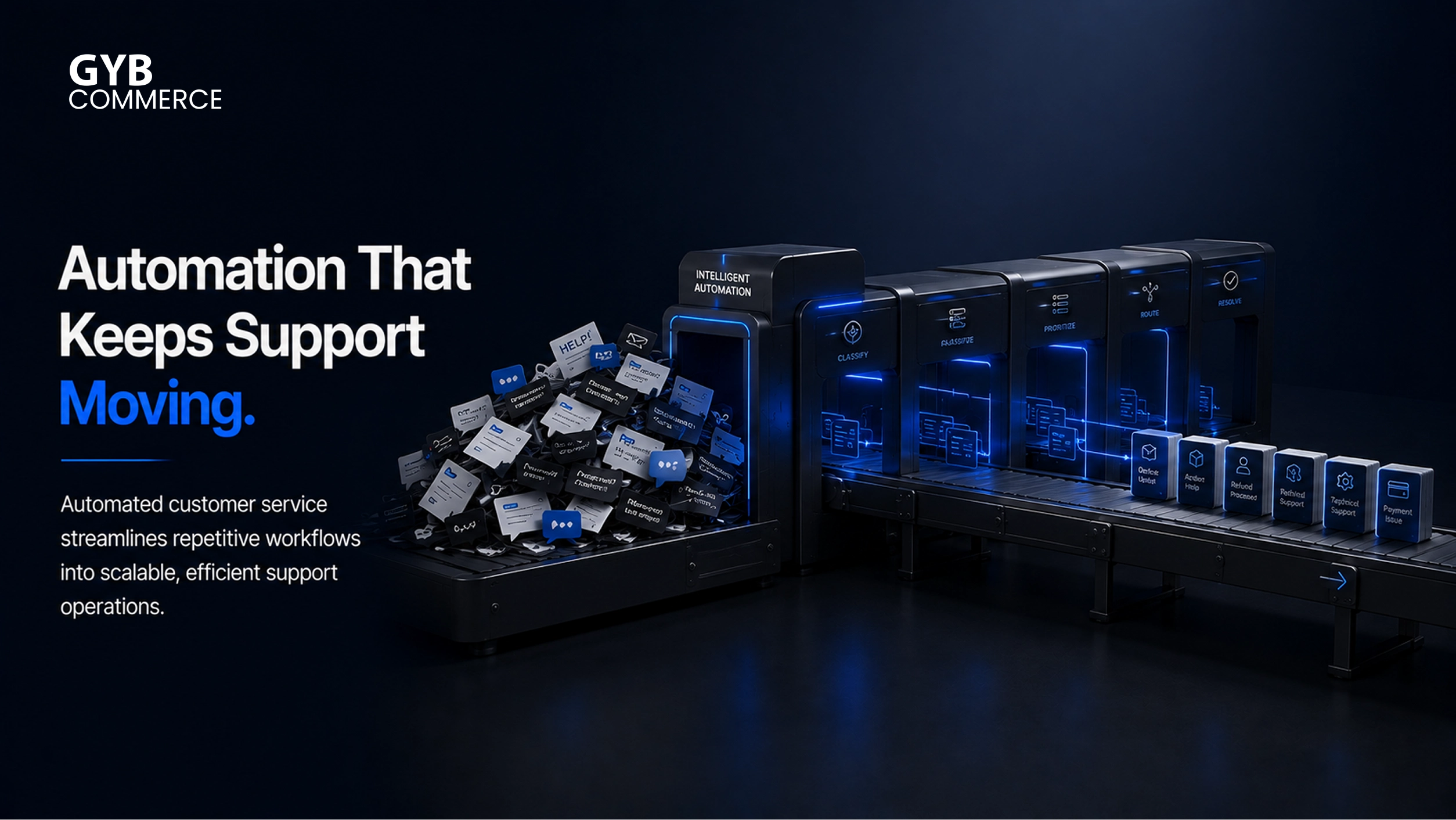
When a customer query is received, automated systems can categorize the request, retrieve relevant information, and either resolve it instantly or route it to the appropriate agent. This structured approach improves response accuracy and reduces handling time.
Integration with CRM systems, ticketing platforms, and communication tools further strengthens this process. It ensures that all customer interactions are tracked, managed, and optimized within a centralized system.
Discover exactly what role automation plays in customer service daily workflows.
How Customer Service Automation Improves Efficiency
Faster query handling and resolution
Automated customer service improves efficiency by reducing the time required to handle each interaction. Systems can instantly interpret user queries, retrieve relevant data, and generate accurate responses without delays.
This removes the dependency on manual lookup processes. As a result, customers receive immediate assistance, and overall resolution time decreases significantly across support operations.
Streamlined workflows and task execution
Automation connects different parts of the customer service process into a single workflow. Tasks such as ticket creation, categorization, routing, and follow-ups are executed automatically.
This eliminates repetitive manual steps and reduces the risk of human error. It also ensures that every request follows a structured path, which improves consistency and operational control.
Intelligent routing and prioritization
Automation systems use predefined logic and AI models to route queries to the right destination. High-priority or complex issues are directed to skilled agents, while simple queries are handled automatically.
This improves efficiency by ensuring that resources are used effectively. Agents spend less time sorting requests and more time resolving issues that require attention.
Real-time data access and response accuracy
Automated systems integrate with customer databases, CRM platforms, and knowledge bases. This allows them to access real-time data and provide accurate responses instantly.
Instead of relying on fragmented systems, businesses can deliver consistent and informed support. This reduces miscommunication and improves the overall quality of service.
How to Reduce Customer Service Costs with Automation
Lower dependency on large support teams
Automation reduces the need for large customer support teams by handling high volumes of repetitive queries. Tasks such as answering FAQs, tracking orders, or updating account information can be fully automated.
This allows businesses to operate efficiently with smaller teams while maintaining service quality. It also reduces hiring and onboarding costs.
Reduced training and operational overhead
Training new agents requires time, resources, and ongoing supervision. Automated systems minimize this requirement by standardizing responses and workflows.
Businesses can reduce training costs while maintaining consistency in service delivery. This is especially beneficial for organizations experiencing rapid growth.
Optimized resource allocation
Automation ensures that human agents focus only on complex or high-value tasks. This improves resource utilization and reduces wasted effort on repetitive activities.
By optimizing how resources are used, businesses can achieve better outcomes without increasing operational expenses.
Cost-saving impact of automation at scale
- Reduces cost per interaction by automating repetitive queries
- Minimizes staffing requirements for high-volume support
- Lowers infrastructure and operational expenses
- Decreases error-related costs and rework
- Improves long-term cost efficiency through scalability
Real Examples of Automated Customer Service
Automated customer service is widely used across industries to handle common support scenarios. These implementations demonstrate how automation improves both efficiency and customer experience.
Chatbots for handling common queries
AI-powered chatbots are used to respond to frequently asked questions, guide users, and provide instant support. They reduce the need for human intervention in routine interactions.
Automated ticket routing systems
Support systems automatically categorize and route incoming requests based on priority, topic, or customer type. This ensures faster handling and reduces delays in response.
Self-service portals and knowledge bases
Customers can access help articles, FAQs, and troubleshooting guides without contacting support teams. This empowers users to resolve issues independently.
AI-powered assistants for personalized support
Advanced systems use customer data to deliver personalized responses. These assistants can recommend solutions, track interactions, and provide context-aware support.
How to Get Started with Automated Customer Service
Define clear automation goals
Businesses should begin by identifying which processes need automation. High-volume and repetitive tasks are ideal starting points, as they deliver immediate impact.
Clear goals help ensure that automation efforts align with business objectives and customer expectations.
Choose the right tools and platforms
Selecting the right customer service software is critical. Businesses should look for solutions that support integration, scalability, and omnichannel communication.
The chosen tools should fit within existing systems and support future growth. Implement these upgrades using expert customer service automation solutions.
Integrate automation with existing systems
Automation works best when connected with CRM platforms, ticketing systems, and communication channels. Integration ensures that data flows seamlessly across systems.
This creates a unified support environment where automation can operate effectively.
Maintain balance between automation and human support
While automation improves efficiency, human agents remain essential for handling complex issues. Businesses should design systems that allow smooth transitions between automated and human support.
This balance ensures that customers receive the right level of assistance at every stage.
Key considerations before implementing automation
- Ensure data quality and structured knowledge bases
- Define clear workflows and escalation paths
- Maintain transparency in automated interactions
- Continuously monitor performance and improve systems
- Balance automation with human support for complex cases
Frequently Asked Questions
What is automated customer service?
Automated customer service refers to the use of technology such as AI, chatbots, and workflows to handle customer interactions. It reduces the need for manual involvement in repetitive tasks.
These systems improve efficiency by providing instant responses and consistent support across different communication channels.
How does automated customer service improve efficiency?
Automated customer service improves efficiency by reducing response time and streamlining workflows. Systems can handle multiple queries simultaneously without delays.
This allows businesses to process higher volumes of requests while maintaining accuracy and consistency in responses.
How does automated customer service reduce costs?
Automated customer service reduces costs by minimizing the need for large support teams. It handles repetitive tasks that would otherwise require human agents.
This lowers staffing, training, and operational expenses while maintaining service quality.
What role does automation play in customer service?
Automation acts as the backbone of modern customer service systems. It connects workflows, tools, and communication channels into a unified process.
This enables faster responses, better resource allocation, and improved overall efficiency.
Is automated customer service better than human support?
Automated customer service is not a replacement for human support. It is designed to handle repetitive and routine tasks efficiently.
Human agents remain essential for complex issues that require judgment, empathy, and problem-solving.
What tools are used in automated customer service?
Automated customer service uses tools such as chatbots, CRM systems, ticketing platforms, and workflow automation software.
These tools work together to manage interactions, process queries, and deliver consistent support.
Can small businesses use automated customer service?
Small businesses can benefit significantly from automated customer service. It allows them to handle customer queries efficiently without building large support teams.
Automation helps small businesses scale their operations while maintaining service quality.
Final Takeaways
Automated customer service has become a critical component of modern business operations. It improves efficiency, reduces costs, and enables scalable support without compromising quality.
By combining automation with human expertise, businesses can create a balanced support system that delivers both speed and personalization.