Forward Deployed Engineer vs Solutions Architect vs Sales Engineer: The 2026 Comparison
Three customer-facing technical roles, three completely different jobs. This side-by-side breakdown covers responsibilities, salary, deliverables, and a decision framework for which one your company actually needs to hire.
Founders describe the same hiring need three different ways. "We need someone technical who can talk to customers." "We need an engineer who can help us close deals." "We need someone to make sure deployments don't break." On the surface, that sounds like one role. It's three.Mmbassett
Forward Deployed Engineer (FDE), Solutions Architect (SA), and Sales Engineer (SE) all involve technical people talking to customers. The similarities end there. Conflating them is one of the most expensive mistakes in B2B technical go-to-market — you end up hiring the wrong person for the wrong stage and wondering why deals stall, deployments break, or your product roadmap never catches up to what customers actually need.
This is the definitive 2026 comparison. We'll cover what each role actually does, how they're paid, how to choose between them, and where each fits in the modern AI-first enterprise sales motion.
Forward Deployed Engineer
Embedded with the customer. Writes and ships production code inside the customer's environment. Owns the deployment end to end.
Solutions Architect
Designs the technical blueprint. Maps the customer's stack to the vendor's product. Rarely writes production code in the customer's environment.
Sales Engineer
Supports the sales cycle. Runs demos, answers technical questions, and helps qualified buyers commit. Role typically ends at contract signature.
- The three roles at a glance
- What a Forward Deployed Engineer actually does
- What a Solutions Architect actually does
- What a Sales Engineer actually does
- Side-by-side comparison table
- Salary comparison (2026 data)
- Which role should you hire first?
- The 3-question decision tree
- Real-world examples: OpenAI, Palantir, AWS
- Common hiring mistakes to avoid
- Frequently Asked Questions
1. The three roles at a glance
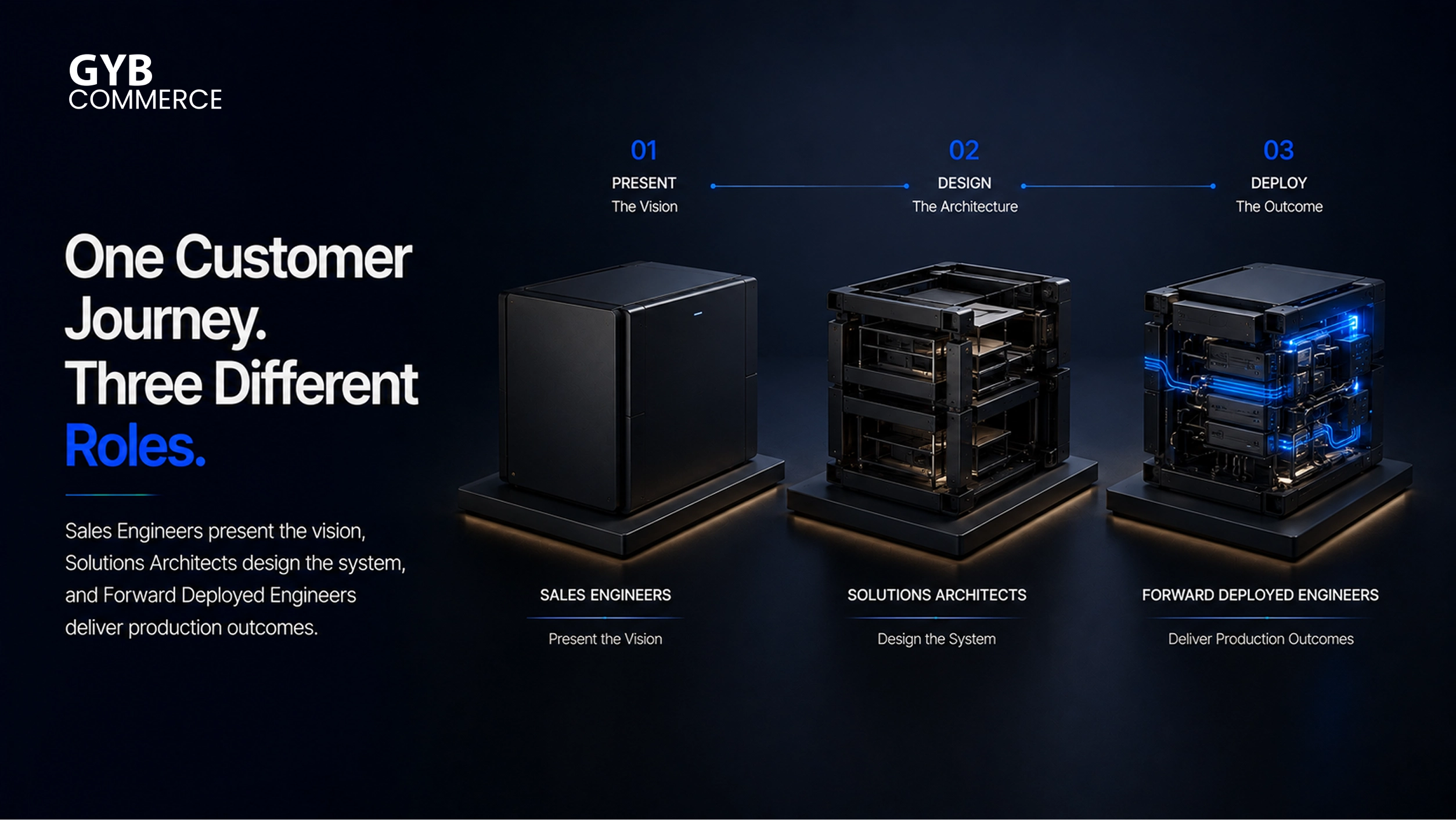
Before going deep on each, here's the cleanest mental model: they sit at different points in the customer lifecycle.
- Sales Engineer (pre-sale): Helps you sell. Operates from the first demo to contract signature.
- Solutions Architect (pre-sale → early implementation): Helps you design. Operates from the technical evaluation through the early architecture phase.
- Forward Deployed Engineer (post-sale): Helps you ship. Operates from kickoff through full production deployment, renewal, and expansion.
Or in industry shorthand: "The Sales Engineer sells the dream. The Solutions Architect draws the blueprint. The Forward Deployed Engineer is the master builder on the ground."Uunderdog.io
If your product is mature and the sales motion is predictable, you mostly need SEs and SAs. If your product is powerful but hard to deploy — which describes nearly every enterprise AI product in 2026 — you need FDEs.Mmbassett
2. What a Forward Deployed Engineer actually does
A Forward Deployed Engineer is a customer-embedded software engineer who writes and ships production code inside the customer's environment, owns the deployment end to end, and stays on the account until it's delivering measurable business outcomes.Ggpt-trainer
FDE primary responsibilities
- Scope the customer's actual use case (often different from the sales-deck version)
- Architect the integration to fit inside the customer's data, auth, and compliance constraints
- Write production code — RAG pipelines, agentic workflows, custom integrations, evals — in the customer's repo or environment
- Debug live issues alongside the customer's engineering team
- Feed learnings back to the core product team to influence the roadmap
- Stay on the account through renewal and expansion conversations
The defining characteristic: an FDE writes production code in the customer's environment. That's what separates the role from a Solutions Architect (who designs but rarely writes shipping code at the customer site) and a Sales Engineer (who builds demos but doesn't operate production systems).Ppragmaticengineer
For a complete deep-dive into the FDE role — origins, full skill stack, 2026 salary benchmarks, and which companies are hiring — see our companion article: What is a Forward Deployed Engineer? The 2026 Guide.
3. What a Solutions Architect actually does
A Solutions Architect is a technical role focused on designing systems and translating customer requirements into a coherent architectural plan. SAs operate at a higher level of abstraction than FDEs — they decide which services, patterns, and integrations to use, but typically don't write the production code that implements them at the customer site.Kkore1
SA primary responsibilities
- Design the technical architecture for a customer's deployment (compute, storage, networking, security, integration points)
- Run design reviews with both internal engineering and customer engineering teams
- Produce architecture decision records, system diagrams, and Terraform/IaC modules
- Map customer business requirements to vendor product capabilities
- Support the sales process with technical credibility (often jointly with Sales Engineers)
- Hand off the implementation to delivery teams or customer engineering
Most "Solutions Architect" job postings in 2026 specify a cloud platform — AWS Solutions Architect, Azure Solutions Architect, Google Cloud Solutions Architect. SAs at hyperscalers and enterprise software vendors are typically the technical face during the buying process and the first weeks of implementation. After that, they usually move to the next account.
Some SAs do write code — at smaller companies, the line between SA and Senior Engineer is fuzzy. But the canonical SA role is design-heavy, not delivery-heavy.
4. What a Sales Engineer actually does
A Sales Engineer (also called Pre-Sales Engineer or Solutions Consultant at some companies) is a customer-facing technical role focused on supporting the sales cycle. The SE is the technical counterpart to an Account Executive: where the AE handles commercial discussions, the SE handles technical credibility — running demos, answering deep technical questions, and addressing the prospect's technical objections.Rrepvue
SE primary responsibilities
- Run technical demos and product walkthroughs for prospects
- Build proof-of-concept (POC) environments to validate the product fits the prospect's use case
- Answer technical questions during the buying process — APIs, security, compliance, integration patterns
- Help write the technical sections of RFPs and security questionnaires
- Support the AE through deal close
- Hand off post-close work to Customer Success, Solutions Architects, or Forward Deployed Engineers
The SE's compensation usually reflects this orientation: a meaningful portion is variable, tied to closed-won revenue. SEs are measured on deals influenced, not deployments shipped.Gglassdoor
A key distinction often missed: SEs build demos and POCs, but those are sandboxed environments running on synthetic or anonymized data. SEs are not typically building inside the customer's production environment.
5. Side-by-side comparison: FDE vs SA vs SE
Here's the full breakdown across the dimensions that matter when scoping the role.
| Dimension | Forward Deployed Engineer | Solutions Architect | Sales Engineer |
|---|---|---|---|
| Where in the customer lifecycle | Post-sale through renewal | Late pre-sale → early implementation | Pre-sale only |
| Writes production code at the customer site | ✓ Primary output | Rarely | ✗ Demo code only |
| Designs system architecture | ✓ Yes | ✓ Primary output | Surface-level |
| Builds product demos and POCs | Sometimes | ✓ Yes | ✓ Primary output |
| Embedded with customer team for weeks/months | ✓ Yes | Days to weeks | ✗ Per-call basis |
| Owns deployment outcome | ✓ Yes | ✗ Hands off | ✗ Hands off |
| Post-launch support & iteration | ✓ Yes | ✗ Hands off to delivery | ✗ Hands off to CS |
| Influences product roadmap | ✓ Direct feedback loop | Indirect | Through deal-loss data |
| Compensation tied to deals closed | Sometimes outcome bonuses | Sometimes | ✓ Primary commission driver |
| Compensation tied to renewals | ✓ Often | ✗ Rarely | ✗ Rarely |
| Typical reporting structure | Engineering or Customer Engineering | Pre-Sales or Customer Engineering | Sales |
| Customer-per-engineer ratio | 1 (deeply embedded) | 3–10 (parallel design) | 10+ (deal flow) |
| Best for product stage | Evolving / AI-native / complex | Mature with custom deployments | Mature with repeatable sale |
The most important row is "Writes production code at the customer site." That single dimension separates the FDE from the other two roles. Everything else flows from it.
6. Salary comparison: 2026 US data
Compensation reflects the leverage of each role. Sales Engineers carry the most variable comp tied to deals. Solutions Architects sit in a higher base band because architecture decisions are high-leverage. FDEs typically command the highest total compensation because they combine engineering depth with customer-facing leverage on renewals and expansion revenue.
| Role | US Average | Typical Range | Senior / Top of Market |
|---|---|---|---|
| Sales Engineer | $156K | $125K – $202K | $250K+ (90th percentile) |
| Solutions Architect | $163K base | $128K – $230K base; TC up to $340K | $400K+ at hyperscalers |
| Forward Deployed Engineer | $155K base; $238K TC | $124K – $486K | $550K+ at OpenAI/Anthropic; $630K+ Staff |
Sources for the above table: Glassdoor (Sales Engineer + FDE), KORE1 (Solutions Architect), Hashnode (FDE total comp), and Levels.fyi (Palantir FDE specific).Gglassdoor+4
What the numbers tell you
- Sales Engineers have the widest variance because their comp is heavily commission-driven. A great SE at a fast-growing software company can clear $250K+; a mid-tier SE at a stagnant company might cap at $130K.
- Solutions Architects at hyperscalers (AWS, Azure, GCP) often clear $300K+ TC because their architectural decisions directly influence multi-million-dollar contracts.Kkore1
- Forward Deployed Engineers have the highest ceiling. At frontier AI labs (OpenAI, Anthropic, Palantir), senior FDEs are compensated like senior engineers plus a customer-outcome premium. Staff-level FDEs at top labs clear $630K+ in total compensation.Hhashnode+1
One nuance worth flagging: Sales Engineer and Solutions Architect titles are often used interchangeably at smaller companies. At enterprise software vendors, they're distinct functions. When scoping a hire, focus on the responsibilities you actually need filled — not the title.
Need an FDE but don't want the $400K+ US comp burden?
GYB Commerce provides pre-vetted, Claude- and OpenAI-certified Forward Deployed Engineers — embedded with your customer team in 14 days, at 40–70% lower cost than US-based hires. Serving US, UK, and UAE markets.
Hire a Forward Deployed Engineer →7. Which role should you hire first?
Here's the operating principle: each role solves a different problem. Hiring the wrong one wastes 6–12 months. The clearest signal is to look at where your sales motion is breaking.Mmbassett
If your problem is "deals are stalling" → hire a Sales Engineer
You have qualified pipeline. AEs are running discovery calls. But deals get stuck in the technical evaluation phase. Buyers keep asking questions your AE can't answer. POCs drag on. RFPs come back with technical objections you didn't see coming. You need a Sales Engineer.
An SE will compress your sales cycle, raise your technical credibility, and unblock the deals that should be closing. This is the role with the clearest, most predictable ROI when product-market fit is established.
If your problem is "deals close but implementations fail" → hire a Solutions Architect
Your sales motion works. Contracts get signed. But once the customer tries to actually deploy, everything stalls. The customer's stack is more complex than the AE understood. Internal engineering can't keep up with bespoke design work. Implementations slip from 30 days to 90 to 180. You need a Solutions Architect.
An SA will create reusable architectural patterns, run design reviews with customers before kickoff, and make implementation predictable. The SA's deliverable is consistency — fewer fires, faster time-to-value, scalable delivery.
If your problem is "the product needs custom work to deliver value" → hire a Forward Deployed Engineer
This is the AI-native pattern. The product is genuinely powerful — but every customer needs the last mile built for them. The agent works in the demo and breaks on contact with their data. The RAG pipeline needs to be tuned for their document types. Their authentication and compliance constraints are unique. You need a Forward Deployed Engineer.
The FDE will live inside the customer's environment, write the custom code that makes the product work for them specifically, and feed those learnings back to your core product team. Over time, what was bespoke becomes a productized feature — which is exactly the flywheel Palantir, OpenAI, and Anthropic have built around the role.Ffastcompany
8. The 3-question decision tree
When you're not sure which role you need, walk through these three questions in order.
If yes → continue.
If no, and the blocker is custom code that doesn't yet exist in your product → you need a Forward Deployed Engineer.
If yes → continue.
If yes → your product is mature enough to scale without FDEs. Focus on SEs and SAs to scale GTM.
Most growth-stage AI startups land at Question 3 and discover they need an FDE function — even if they didn't realize that's what they were looking for. The product works in principle but doesn't deliver value without ongoing engineering presence inside the customer.
9. Real-world examples: How OpenAI, Palantir, and AWS structure these roles
Looking at how mature, well-resourced companies structure their customer-facing engineering tells you a lot about where each role fits.
OpenAI: distinct FDE and Solutions Architect teams
OpenAI runs both a Solutions Architecture team and a Forward Deployed Engineering team. Colin Jarvis — who heads OpenAI's Forward Deployed Engineering — originally joined as a Solutions Architect in 2022 and ran SA before building the FDE function in early 2025.Ppragmaticengineer
OpenAI's published distinction: SAs are more advisory; they rarely write code on customers' infrastructure, and usually build minimum viable products with anonymized or offline data. FDEs are more hands-on and work with more ambiguity, writing code directly inside customer environments.
Palantir: FDE as the dominant function
Palantir invented the role and historically had more Forward Deployed Software Engineers than traditional software engineers. The Palantir FDE (or FDSE) embeds with Fortune 500 customers — banks, hospitals, government agencies, manufacturers — for months at a time, building custom workflows on Foundry. Levels.fyi data shows Palantir FDSE total comp at $171K–$415K with a median of $215K.Llevels.fyi
AWS: Solutions Architect as the front line
AWS has thousands of Solutions Architects (and the AWS Solutions Architect certification is one of the most-pursued cloud credentials in the world). AWS SAs design cloud architectures for customers but typically don't write production code inside the customer's environment — the customer's own engineering team or AWS Professional Services handles delivery. This is the canonical SA pattern.
Ramp: FDE as a strategic GTM weapon
Ramp's Forward Deployed Engineering team, led by Leo Mehr, handles complex enterprise migrations and custom integrations. Ramp's own engineering blog describes the role as "a strategic unlock for modern B2B companies" — the engineer who turns a high-value enterprise contract into actual deployed software.Hhashnode
Salesforce, Adobe, Google Cloud: hybrid structures
Adobe, Salesforce, and Google Cloud have all launched dedicated "Forward Deployed AI Engineer" functions in 2026 alongside their existing SA and SE teams. The structure isn't either/or — it's all three, with each role focused on a different point in the customer journey.Ffastcompany
10. Common hiring mistakes to avoid
Mistake 1: Hiring an FDE when you actually need an SA
Symptom: your customers want predictable, well-documented architecture, not custom code. If your product is mature and what you really need is reusable design patterns, you need a Solutions Architect — not an engineer embedded for months in each account. FDEs are overkill (and over-budget) for mature products.
Mistake 2: Hiring an SE when you actually need an FDE
Symptom: deals close, but customers stall in implementation. Sales Engineers are great at closing deals — they're not great at deploying complex software inside customer environments. If your problem starts after contract signature, no amount of SE hires will fix it.
Mistake 3: Asking one person to do all three roles
You'll see this at early-stage startups: one "Solutions Engineer" who runs demos, designs architecture, and embeds with customers. It works at 5 customers. It breaks at 25. The problem isn't the person — it's the role design. Each function pulls in a different direction, and you can't optimize for all three simultaneously.Mmbassett
Mistake 4: Confusing "Solutions Engineer" with "Solutions Architect"
At many companies, "Solutions Engineer" is just a renamed Sales Engineer role focused on pre-sales. At other companies, it's an SA role. Always read the actual responsibilities in the job description, not the title.
Mistake 5: Hiring full-time FDEs before validating the motion
FDE-as-a-full-time-hire is a $200K–$500K commitment. Many growth-stage startups don't yet know if the FDE motion will work for their product. The cleaner approach: validate the motion with contract or augmentation FDEs first, learn what good FDE work looks like inside your customers, then hire full-time. We help companies do exactly this — pre-vetted FDEs deployed in 14 days with no long-term commitment.
Key Takeaways
- Sales Engineers sell. Solutions Architects design. Forward Deployed Engineers build. They operate at different points in the customer lifecycle and solve different problems.
- The dividing line: only FDEs write production code inside the customer's environment. SAs design systems; SEs build demos.
- Salary in 2026 (US): SE averages $156K; SA averages $163K base ($340K TC at top); FDE averages $238K TC with senior at top AI labs clearing $550K+.
- Hire decision rule: Deals stalling? SE. Implementations failing? SA. Customers needing custom code to get value? FDE.
- The 2026 reality: AI-native products typically need all three — but the FDE is the role that's exploding because every enterprise AI deployment has a "last mile" engineering problem.
- Don't conflate the roles. Asking one person to do all three is the most common (and most expensive) hiring mistake in B2B technical GTM.
Hiring your first Forward Deployed Engineer?
We embed pre-vetted, Claude- and OpenAI-certified FDEs with your customer team in 14 days. Validate the motion without the $400K+ US comp commitment. Active in US, UK, and UAE markets.
Book a Discovery Call →11. Frequently Asked Questions
What is the main difference between a Forward Deployed Engineer and a Solutions Architect?
What is the difference between a Sales Engineer and a Forward Deployed Engineer?
Which role should I hire first — FDE, Solutions Architect, or Sales Engineer?
How do salaries compare between FDE, Solutions Architect, and Sales Engineer in 2026?
Can one person do all three roles?
Is a Solutions Engineer the same as a Solutions Architect?
Do FDEs replace Solutions Architects and Sales Engineers?
Can I hire an FDE through a staff augmentation agency instead of going in-house?
The bottom line
If you take one thing from this article: these roles are not interchangeable. They sit at different points in the customer lifecycle, optimize for different outcomes, and require different compensation structures. The mistake most companies make is treating "technical person who talks to customers" as a single hire — and then wondering why nothing improves.
Use the decision tree. Be honest about where your sales motion is actually breaking. Hire the role that matches the problem.
And if you've concluded you need an FDE — which is the right answer for most growth-stage AI and enterprise SaaS companies in 2026 — we can help you validate the motion fast. Pre-vetted, Claude- and OpenAI-certified Forward Deployed Engineers, embedded with your customer team in 14 days, serving US, UK, and UAE markets.
The FDE Hiring Scorecard
A 1-page rubric to evaluate Forward Deployed Engineer candidates across 12 dimensions. Built from interview patterns at Palantir, OpenAI, and Anthropic.
- Score candidates 1–5 across technical & customer-facing skills
- Built-in scoring guide: hire / develop / pass
- PDF — print or share with your hiring team
No spam. We’ll only email you about FDE hiring resources. Unsubscribe anytime.