
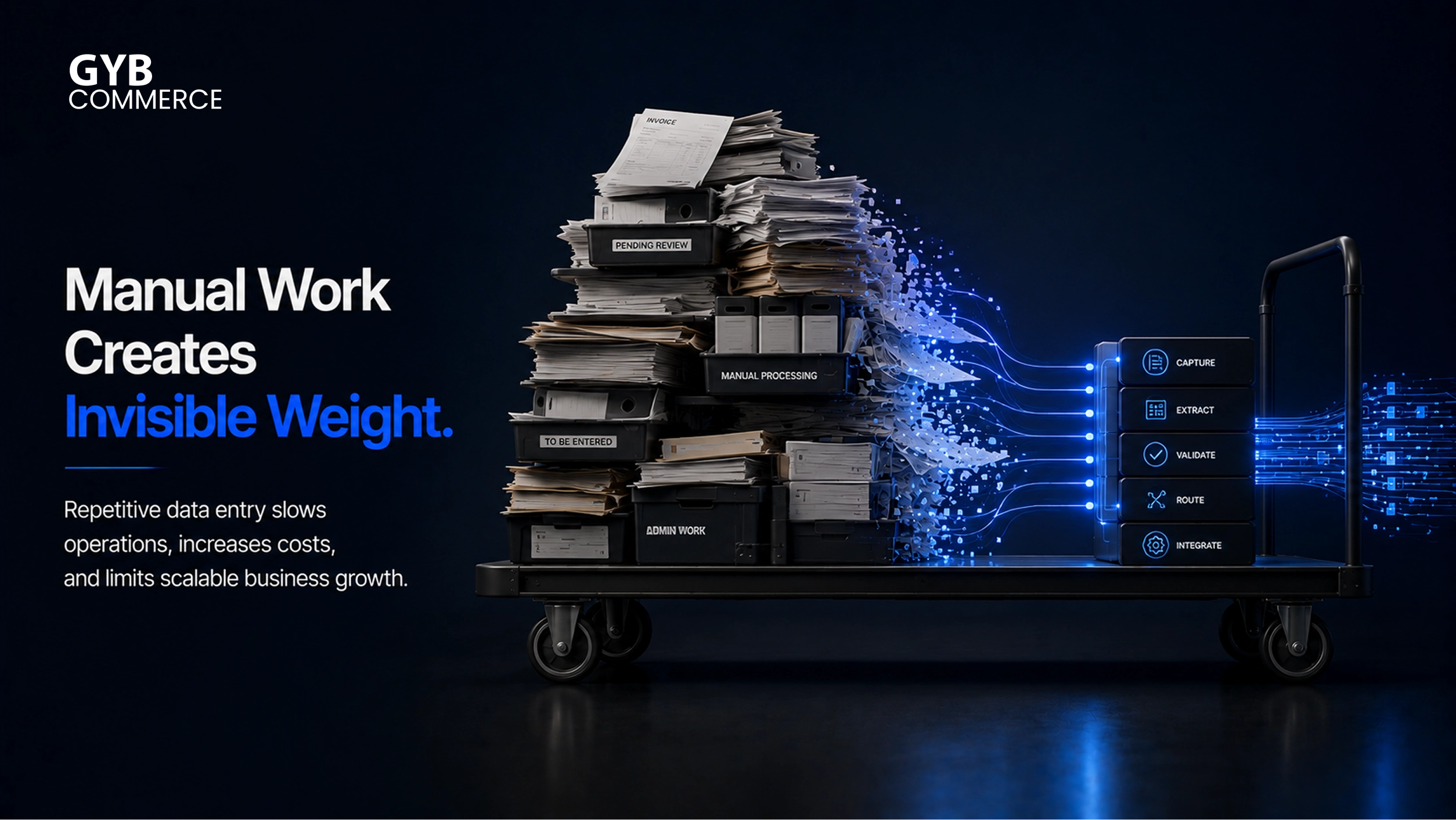
Manual data entry is still deeply embedded in modern business operations. Teams continue to extract data from emails, PDFs, and forms, then enter it into systems like Excel, CRM platforms, or accounting tools. At a surface level, this process seems routine. However, when scaled across departments, it creates serious inefficiencies.
The real problem is not just time loss. Manual data entry introduces hidden costs that affect accuracy, speed, and decision-making. These costs are rarely tracked directly, which is why many businesses underestimate their impact. Over time, this becomes an invisible tax on operations, quietly reducing productivity and profitability.
What Is Manual Data Entry And Why Does It Still Exist In Modern Workflows
Manual data entry is the process of transferring information from one source to another by human effort. This includes copying data from documents, emails, spreadsheets, or forms into digital systems. Despite advances in automation, many organizations still depend on it.
One major reason is system fragmentation. Businesses often use multiple tools such as Excel, Gmail, Tally or QuickBooks, and CRM platforms. These systems do not always connect. As a result, employees manually move data between them.
Another factor is limited adoption of modern solutions like AI-based document processing. Many organizations continue with legacy workflows because they underestimate the cost of change, even when inefficiencies are obvious.
The Hidden Employee: Understanding The True Cost Of Manual Data Entry
Manual data entry behaves like an invisible employee within your business. It consumes time, requires effort, and adds no direct value to revenue generation. Instead, it operates in the background, slowing down processes.
Employees spend hours handling repetitive tasks. This reduces their ability to focus on strategic work such as customer engagement or operational improvements. Over time, this shift affects overall team performance.
The impact is both operational and strategic. Businesses lose time, but they also lose opportunities. Skilled employees are occupied with low-value tasks instead of contributing to growth.
The Real Cost Of Manual Data Entry That Businesses Overlook
The cost of manual data entry goes beyond salaries. It affects multiple areas of the business, often without clear visibility.
- Time loss across teams due to repetitive data handling
- Increased labor costs from inefficient workflows
- Higher error rates leading to rework and corrections
- Delays in reporting and decision-making
- Reduced productivity in high-value roles
These factors combine to create a significant operational burden. Over time, they impact both margins and scalability.
The 1-10-100 Rule Of Human Error In Data Entry
The 1-10-100 rule explains how error costs escalate. Fixing a mistake early is inexpensive. However, once the error spreads through systems, the cost increases rapidly.
At the entry stage, correction is simple. Once the data moves into reports or workflows, fixing it becomes more complex. If left unresolved, the financial impact can be severe.
Manual data entry increases the likelihood of such errors. Even a small error rate becomes costly when applied to large volumes of data.
Opportunity Cost: What Your Team Is Not Doing Instead
Every hour spent on manual data entry replaces higher-value work. This is where opportunity cost becomes critical. Businesses pay skilled employees for tasks that do not drive growth.
A sales representative entering data is not closing deals. An operations manager updating records is not improving systems. These trade-offs directly affect performance.
Over time, teams appear busy but deliver less impact. This imbalance slows down business progress.
Profit Leak: How Small Inefficiencies Turn Into Large Financial Losses
Small inefficiencies often go unnoticed. However, repeated daily, they turn into measurable financial loss. This is known as a profit leak.
Each delayed entry, incorrect record, or duplicated effort adds friction. Individually, these issues seem minor. Collectively, they reduce margins and affect outcomes.
Manual data entry sits at the center of this problem. It introduces inconsistency and slows down workflows. Businesses that ignore it often struggle to scale efficiently. Learning what document capture is provides the framework to stop these leaks
Why Manual Document Processing Errors Are Increasing In 2026
In 2026, data volume has increased significantly. Businesses now handle information from emails, PDFs, scanned files, and digital forms. This makes manual processing more complex.
At the same time, expectations have changed. Faster processing and higher accuracy are now required. Manual workflows cannot consistently meet these demands.
Different document formats also create challenges. Employees must interpret varied layouts and structures. This increases both processing time and error rates.
As a result, businesses are seeing more delays and inconsistencies. This shift highlights the growing need for automation and intelligent document capture solutions.
The Silo Problem: Why Your Business Systems Do Not Talk To Each Other
Most businesses rely on multiple tools to manage operations. These include platforms like Excel, Gmail, WhatsApp, CRM systems, and accounting software. While each tool serves a purpose, they rarely communicate effectively with one another.
This creates the silo problem. Data stays locked within individual systems, and there is no seamless flow between them. As a result, employees are forced to act as connectors, manually transferring information across platforms.
This approach slows down workflows and increases the risk of errors. It also limits visibility, making it harder to access accurate, real-time data. Over time, these disconnected systems create operational friction that affects overall efficiency.
The Scalability Trap: Why Manual Processes Break As You Grow
Manual data entry may seem manageable at a small scale. However, as your business grows, the volume of data increases rapidly. This is where the scalability problem becomes clear.
Manual processes scale linearly. If your workload doubles, you need more employees to handle it. This increases operational costs and reduces profit margins. Growth becomes tied to hiring, which is not sustainable in the long term.
Automated systems, on the other hand, scale without adding proportional cost. They can handle higher volumes without increasing effort. Businesses that rely on manual workflows often hit a ceiling where growth becomes difficult to manage. This limitation is exactly why intelligent document capture solutions benefit specific industries scaling rapidly today.
Speed And Customer Experience: The Hidden Competitive Disadvantage
Speed is a critical factor in modern business. Customers expect quick responses and seamless experiences. Manual data entry slows down processes and creates delays in communication.
When teams rely on manual updates, they cannot access real-time information. This affects response times, order processing, and service delivery. Even small delays can impact customer satisfaction.
Competitors using automated systems operate faster. They respond quicker, process requests efficiently, and deliver better experiences. Over time, this creates a clear competitive gap.
How Businesses Are Fixing This With Automation And AI Document Capture
To overcome these challenges, businesses are shifting toward automation. Technologies like AI, OCR, and workflow automation are replacing manual data entry processes.
Modern systems can extract data from documents automatically. They process information from emails, PDFs, and forms without human intervention. This reduces dependency on repetitive tasks.
Automation also connects different systems. Data flows seamlessly between platforms, eliminating the need for manual transfer. This improves accuracy, speed, and overall efficiency.
As a result, businesses gain better control over their operations. They reduce costs, improve data quality, and scale more effectively.
How Intelligent Document Capture Eliminates Manual Entry Errors
Intelligent document capture combines OCR and AI to automate data extraction. It converts unstructured data into structured formats that systems can use directly.
The process typically includes text recognition, data extraction, and validation. These layers ensure that information is captured accurately before it enters workflows. This significantly reduces errors compared to manual entry.
Unlike traditional methods, intelligent systems adapt to different document formats. They can handle invoices, forms, emails, and more without requiring manual configuration.
Signs Your Business Is Losing Money Due To Manual Data Entry
Many businesses do not realize the extent of their losses until inefficiencies become visible. However, there are clear indicators that manual data entry is affecting performance.
- Teams spend excessive time on repetitive administrative tasks
- Frequent data errors require constant corrections
- Delays occur in reporting and decision-making
- Systems do not sync, requiring manual updates
- Operational costs increase without proportional growth
Recognizing these signs is the first step toward improvement. Businesses that address these issues early can avoid larger operational challenges.
Discuss Automating Your Project
Frequently Asked Questions
What Is The Cost Of Manual Data Entry For Businesses In 2026
The cost of manual data entry includes time loss, labor expenses, and error-related corrections. Businesses also face indirect costs such as delayed decisions and reduced productivity. Over time, these factors create a significant financial impact.
How Do Manual Document Processing Errors Impact Business Operations
Manual document processing errors lead to inaccurate data, which affects reporting and decision-making. These errors can also cause delays, compliance issues, and poor customer experiences. The impact often increases as data volume grows.
How Can Businesses Automate Data Entry Processes Effectively
Businesses can automate data entry using AI-powered tools, OCR technology, and workflow automation systems. These solutions extract and process data automatically, reducing manual effort and improving accuracy across operations.
What Is The Difference Between Manual Data Entry And Automated Document Processing
Manual data entry relies on human effort to input information, while automated document processing uses technology to extract and manage data. Automation is faster, more accurate, and scalable compared to manual methods.
Why Is Manual Data Entry Not Scalable For Growing Businesses
Manual data entry requires more resources as data volume increases. Businesses need to hire more staff to keep up, which raises costs. This limits scalability and reduces operational efficiency over time.
How Does Intelligent Document Capture Reduce Document Processing Costs
Intelligent document capture reduces costs by automating data extraction and minimizing errors. It speeds up workflows and eliminates repetitive tasks, allowing businesses to operate more efficiently with fewer resources.
What Tools Are Used To Replace Manual Data Entry In Modern Businesses
Modern businesses use tools such as OCR software, AI-based document processing systems, APIs, and workflow automation platforms. These technologies work together to streamline data handling and improve operational performance.
Final Takeaways
Manual data entry is no longer just an operational inconvenience. It is a hidden cost center that affects accuracy, efficiency, and scalability. While it may seem manageable in the short term, its long-term impact is significant.
As businesses handle more data, the limitations of manual processes become more visible. Errors increase, workflows slow down, and costs rise. These challenges make it difficult to compete in a fast-moving environment.
Automation and intelligent document capture provide a clear path forward. They remove repetitive tasks, improve data accuracy, and enable scalable growth. Businesses that adopt these solutions position themselves for long-term efficiency and performance.