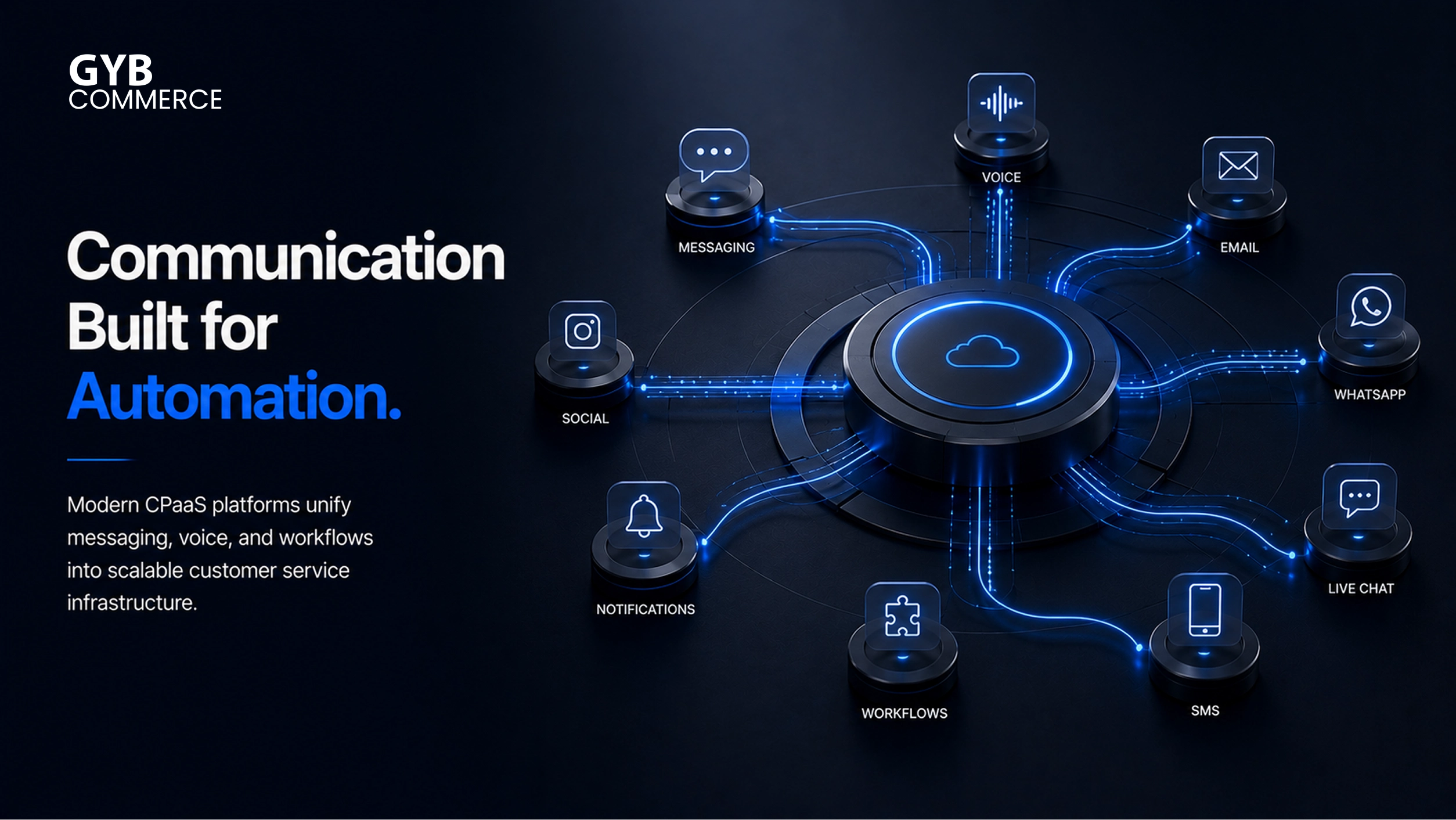
Customer service is no longer limited to support tickets and call centers. Businesses now operate across SMS, WhatsApp, voice, and in-app messaging. This shift has made cloud communication platforms essential for delivering real-time, scalable support experiences.
Which CPaaS platforms offer tools for customer service automation is a critical question for companies building modern support systems. The right platform enables automated workflows, integrates communication APIs, and supports omnichannel engagement without infrastructure complexity.
As a result, choosing the right CPaaS provider directly impacts response time, customer satisfaction, and operational efficiency.
Table of Contents
Which Are the Best CPaaS Platforms for Customer Service Automation?
Modern CPaaS platforms are evaluated based on API flexibility, automation capabilities, omnichannel support, and scalability. The following platforms stand out for enabling customer service automation at scale.
We offer scalable customer service automation solutions built on top of these platforms.
1. Twilio
Twilio is a developer-first CPaaS platform built for programmable communication. It provides APIs for SMS, voice, video, WhatsApp, and email, allowing businesses to build custom customer service workflows.
Its strength lies in flexibility. Teams can design automated notifications, IVR systems, and chatbot integrations using tools like Twilio Studio and Conversations API. This makes it suitable for complex, high-scale support systems.
Best Fit For
Organizations with strong development teams that need full control over communication workflows and global messaging infrastructure.
2. Infobip
Infobip offers an enterprise-grade CPaaS platform with strong global messaging infrastructure. It combines SMS, WhatsApp, RCS, email, and voice into a unified communication layer.
Beyond APIs, Infobip includes built-in journey orchestration and a contact center solution. This allows businesses to automate customer interactions while maintaining consistent cross-channel experiences.
Best Fit For
Enterprises that need reliable global delivery, strong WhatsApp capabilities, and integrated automation tools without heavy custom development.
3. Vonage
Vonage provides a full-stack CPaaS solution covering messaging, voice, and video APIs. It is known for its strong voice infrastructure and real-time communication capabilities.
Its API suite enables automated customer service workflows such as call routing, verification, and conversational messaging. Additionally, Vonage integrates well with CRM systems for end-to-end support automation.
Best Fit For
Businesses that require strong voice and video capabilities alongside messaging automation.
4. Twixor
Twixor positions itself as an omnichannel conversational platform with built-in automation and AI capabilities. It supports WhatsApp, SMS, RCS, email, and social messaging within a unified interface.
Unlike API-only platforms, Twixor includes a low-code journey builder, campaign management, and analytics. This allows teams to automate customer journeys without relying heavily on engineering resources.
Best Fit For
Enterprises looking for a unified CPaaS platform with low-code automation, AI orchestration, and strong governance features.
5. MessageBird
MessageBird focuses on simplifying communication workflows through APIs and omnichannel messaging. It supports SMS, voice, email, WhatsApp, and chat APIs.
Its platform includes tools for building automated notification systems, customer engagement workflows, and two-way messaging. MessageBird also offers a visual flow builder for faster deployment.
Best Fit For
Businesses that want a balance between developer flexibility and ease of implementation for customer communication automation.
6. Sinch
Sinch is a global CPaaS provider focused on messaging, voice, and verification APIs. It powers large-scale communication systems for enterprises that require high delivery reliability and carrier-grade infrastructure.
Its APIs enable automated notifications, two-factor authentication, and customer engagement workflows across SMS and voice. Sinch also supports omnichannel messaging, making it suitable for businesses handling high communication volumes.
Best Fit For
Enterprises that prioritize reliable global messaging delivery and secure communication workflows.
7. Bandwidth
Bandwidth provides a telecom-backed CPaaS platform with direct-to-carrier network access. This gives businesses more control over voice and messaging infrastructure without relying on intermediaries.
It is particularly strong in voice APIs, emergency services integration, and messaging automation. Businesses can build IVR systems, automated call routing, and notification systems with high reliability.
Best Fit For
Organizations that need deep control over telecom infrastructure and advanced voice-based customer service automation.
8. Plivo
Plivo offers a developer-focused CPaaS platform with APIs for voice and SMS communication. It is often considered a cost-effective alternative for building scalable communication systems.
The platform supports automated alerts, two-way messaging, and voice workflows such as call routing and IVR systems. Its straightforward API structure allows faster implementation for customer service use cases.
Best Fit For
Startups and mid-sized businesses looking for cost-efficient CPaaS solutions with strong core communication capabilities.
9. Telnyx
Telnyx delivers a modern CPaaS platform with a strong focus on network control and performance. It provides APIs for messaging, voice, video, and wireless communication.
Its infrastructure allows businesses to automate customer communication workflows with low latency and high reliability. Telnyx also supports real-time data insights for optimizing communication performance.
Best Fit For
Companies that require high-performance communication APIs with strong network-level control.
10. 8×8
8×8 combines CPaaS capabilities with contact center and unified communications solutions. It enables businesses to manage voice, chat, video, and messaging within a single platform.
The platform supports automated customer service workflows, including intelligent routing, chatbot integration, and analytics. It is particularly strong in enterprise communication environments.
Best Fit For
Enterprises looking for an all-in-one solution combining CPaaS, contact center, and unified communications.
How Do These CPaaS Platforms Compare for Customer Service Automation?
Each CPaaS platform approaches customer service automation differently. Some focus on developer flexibility, while others emphasize low-code automation and built-in orchestration.
Platforms like Twilio and Plivo prioritize API control and customization. In contrast, Twixor and Infobip offer integrated automation layers with journey builders and analytics.
Review what automated customer service is to select the right platform.
- Developer-first platforms provide flexibility but require engineering effort
- Low-code platforms accelerate deployment with built-in automation tools
- Omnichannel platforms unify SMS, voice, chat, and social messaging
- Enterprise platforms focus on scalability, compliance, and governance
How Should You Choose the Right CPaaS Platform for Your Business?
Choosing a CPaaS platform depends on your architecture, scale, and customer service requirements. Businesses with in-house engineering teams often prefer API-first platforms for flexibility and customization.
However, companies aiming for faster deployment should consider platforms with built-in automation and orchestration. These reduce development overhead while enabling rapid rollout of customer service workflows.
Another key factor is communication channels. If your customer interactions span WhatsApp, SMS, voice, and chat, an omnichannel CPaaS platform becomes essential for maintaining consistency and context.
How Do CPaaS Platforms Integrate with AI and Automation Systems?
CPaaS platforms now operate as the communication layer within broader AI-driven systems. They integrate with AI agents, conversational systems, and agentic RAG architectures to automate customer interactions end to end. These tools help you deploy agentic RAG for customer service automation efficiently.
This allows businesses to not only respond to queries but also execute workflows such as order tracking, refunds, and account updates. As a result, CPaaS becomes a core component of intelligent automation infrastructure.
Frequently Asked Questions
Which CPaaS platforms offer tools for customer service automation?
Several CPaaS platforms offer tools for customer service automation, including Twilio, Infobip, Vonage, and Twixor. These platforms provide APIs, automation workflows, and omnichannel messaging capabilities.
What is a CPaaS platform?
A CPaaS platform is a cloud-based solution that enables businesses to integrate communication features such as SMS, voice, and chat into their applications using APIs.
Which are the best CPaaS platforms?
The best CPaaS platforms include Twilio, Infobip, Vonage, MessageBird, and Sinch. Each platform offers different strengths based on scalability, APIs, and automation capabilities.
How does CPaaS help customer service automation?
CPaaS helps customer service automation by enabling automated messaging, workflow orchestration, and real-time communication across multiple channels.
What are CPaaS APIs used for?
CPaaS APIs are used to integrate communication features like SMS, voice calls, and chat into applications, enabling automated and scalable customer interactions.
How do Twilio, Vonage, and Infobip compare?
Twilio offers strong developer flexibility, Vonage excels in voice and video APIs, and Infobip provides integrated omnichannel communication with built-in automation tools.
How should businesses choose a CPaaS provider?
Businesses should choose a CPaaS provider based on scalability, integration capabilities, supported channels, and the level of automation required for their workflows.
Final Takeaways
CPaaS platforms have become foundational for modern customer service automation. They enable businesses to build scalable, omnichannel communication systems without managing telecom infrastructure.
Selecting the right platform depends on whether you prioritize API flexibility, automation speed, or enterprise-grade communication capabilities.