Customer service has shifted from ticket handling to real-time experience delivery. Users expect instant, accurate, and context-aware responses across channels. Traditional automation systems struggle to meet this demand because they rely on static workflows and limited decision logic. As query complexity increases, these systems fail to scale without heavy human intervention.
This is where How to Deploy Agentic RAG for Customer Service Automation becomes critical. Businesses are moving toward systems that combine retrieval, reasoning, and action. Instead of answering questions, these systems resolve tasks end-to-end. This guide explains how to design and deploy such a system step by step.
Table of Contents
How to Deploy Agentic RAG for Customer Service Automation (Step-by-Step)
Step 1: Define Customer Service Use Cases
High-Impact Automation Scenarios
Start with workflows that have high volume and predictable structure. These include order tracking, refund requests, password resets, and FAQ resolution. These use cases allow fast deployment with measurable results.
Focus on queries where information retrieval is the core requirement. This aligns directly with RAG capabilities and reduces early system complexity.
What to Avoid in Early Deployment
Avoid workflows involving legal decisions, financial disputes, or sensitive compliance requirements. These require strict validation and human oversight.
In early stages, limit the system to controlled environments. This reduces risk and improves iteration speed.
Step 2: Build and Structure the Knowledge Base
Data Sources and Ingestion
Agentic RAG depends heavily on structured knowledge. Common sources include help centers, internal SOPs, CRM records, and product documentation.
Ensure all data is cleaned, standardized, and version-controlled. Poor data quality directly impacts response accuracy.
Chunking, Embeddings, and Indexing
Break documents into smaller chunks to improve retrieval precision. Each chunk should represent a single idea or answer.
Convert these chunks into embeddings and store them in vector databases. This enables semantic search rather than keyword matching.
Step 3: Design the Retrieval Pipeline (RAG Core)
Vector Databases and Semantic Search
Vector databases store embeddings and allow similarity-based retrieval. This enables the system to understand intent rather than exact wording.
This approach improves accuracy for complex and conversational queries. It also reduces dependency on rigid keyword structures.
Hybrid Retrieval (Keyword + Embeddings)
Relying only on embeddings can miss exact matches like order IDs or SKUs. Hybrid retrieval combines semantic search with keyword-based methods.
This ensures both contextual understanding and precision. It is essential for production-grade systems.
Step 4: Add Agentic Layer (Reasoning and Orchestration)
Task Decomposition and Planning
Agentic systems break down complex queries into smaller steps. For example, a refund request may involve validation, retrieval, and action.
This structured reasoning allows the system to handle multi-step workflows instead of single responses.
Agent Orchestration and Workflow Control
The orchestration layer manages how AI agents interact with retrieval systems and tools. It decides when to retrieve data, when to call APIs, and when to respond.
This transforms the system from a chatbot into a decision engine.
Step 5: Implement Tool Calling and API Integrations
Connecting External Systems
To move beyond answers, the system must interact with external tools. These include CRM platforms, ticketing systems, and order management systems.
APIs enable actions such as updating records, creating tickets, or processing refunds.
Controlled Action Execution
Start with read-only operations before enabling write actions. This reduces risk and ensures system reliability.
Log every action and maintain audit trails. This is critical for debugging and compliance.
Explore custom customer service automation solutions to manage this deployment.
Step 6: Add Memory and Context Management
Session-Based Context
Short-term memory allows the system to maintain conversation continuity. It ensures that follow-up queries do not require repeated context.
This improves user experience and reduces friction.
Long-Term Customer Context
Long-term memory stores customer history, preferences, and past interactions. This enables personalized responses and better decision-making.
However, this layer must be carefully managed to ensure data privacy and compliance.
Step 7: Introduce Evaluation Metrics
Core Performance Metrics
Measure system performance using metrics such as First Contact Resolution, response time, and customer satisfaction scores.
These metrics provide a clear view of system effectiveness.
AI-Specific Metrics
Track hallucination rate, retrieval accuracy, and escalation frequency. These are unique to AI-driven systems and require continuous monitoring.
Without these metrics, optimization becomes guesswork.
Step 8: Apply Guardrails and Compliance Layers
Safety and Control Mechanisms
Agentic systems must operate within defined boundaries. Implement rules for data access, response generation, and tool usage.
This prevents misuse and ensures consistent behavior.
Compliance and Data Protection
Ensure compliance with regulations such as GDPR and SOC 2. Protect sensitive customer data through access controls and encryption.
This is essential for enterprise deployment.
Step 9: Plan Gradual Deployment
Shadow Mode Deployment
In this phase, the system generates responses while humans validate them. This allows safe testing without impacting users.
It also helps identify gaps in logic and data.
Partial to Full Automation
Gradually allow the system to handle low-risk queries independently. Over time, expand to more complex workflows.
This phased approach reduces operational risk.
Step 10: Optimize and Scale the System
Continuous Feedback Loops
Use real interaction data to improve retrieval accuracy and response quality. Update knowledge bases regularly.
This ensures the system evolves with business needs.
Scaling Infrastructure
As usage grows, optimize latency and throughput. Use scalable vector databases and distributed systems.
This ensures consistent performance under load.
What Is Agentic RAG and How Does It Work?
Agentic RAG combines retrieval-augmented generation with autonomous decision-making. A standard RAG system retrieves relevant documents and passes them to a language model for response generation. However, it does not decide what actions to take beyond answering a query.
Learn exactly what automated customer service is before deploying advanced AI.
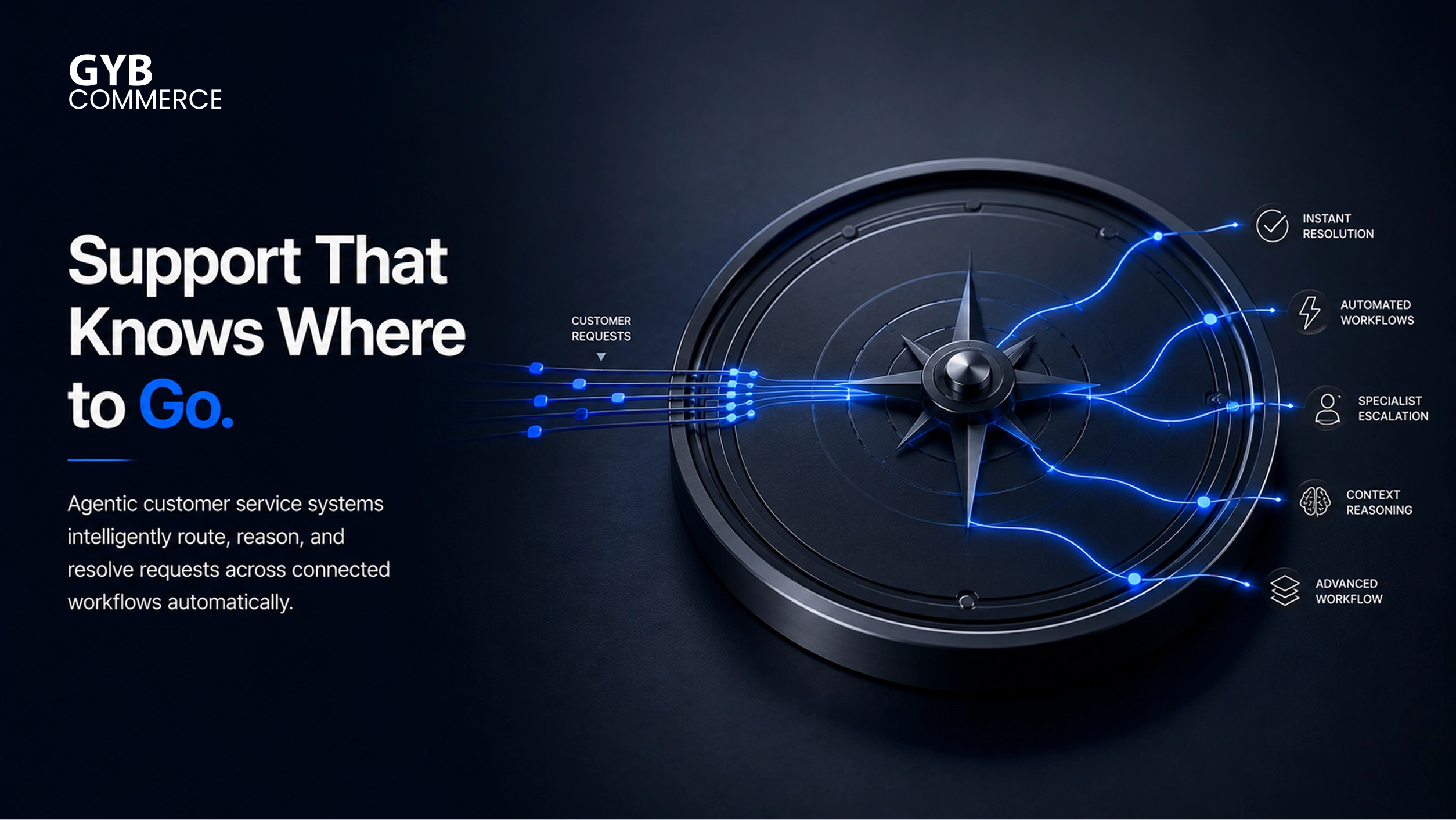
Agentic RAG extends this by introducing AI agents that can plan, reason, and execute tasks. Instead of a linear flow, the system operates as a loop. It interprets the query, retrieves context, decides next steps, calls tools if needed, and validates the outcome before responding.
This shift changes the role of automation. The system is no longer a response generator. It becomes a workflow engine capable of resolving complete customer requests.
Core Components of an Agentic RAG Architecture
Agentic RAG systems rely on multiple layers working together. Each layer plays a distinct role in delivering accurate and actionable responses.
- Large Language Models act as the reasoning engine that understands intent and generates responses
- Retrieval Layer uses vector databases and semantic search to fetch relevant information
- Agent Orchestration Layer manages planning, task decomposition, and workflow execution
- Tool and API Layer enables real-world actions such as updating records or triggering processes
These components must be tightly integrated. Weakness in any layer directly affects system performance and reliability.
Why Agentic RAG Outperforms Traditional Customer Service Automation
Traditional automation systems rely on predefined rules and static workflows. They can handle repetitive queries but fail when complexity increases.
Agentic RAG introduces adaptability. It understands context, retrieves dynamic information, and executes actions. This allows it to handle multi-step queries without rigid scripting.
In practice, this leads to higher resolution rates and fewer escalations. It also reduces dependency on manual intervention, which lowers operational costs over time.
Common Mistakes When Deploying Agentic RAG
Many implementations fail due to architectural gaps rather than technology limitations. One common issue is treating RAG as a plug-and-play solution. Without proper data structuring, retrieval accuracy drops significantly.
Another mistake is over-automation in early stages. Deploying agentic systems on high-risk workflows without validation leads to poor user experiences.
Ignoring evaluation metrics is also critical. Without tracking performance, it becomes difficult to identify weaknesses or optimize the system.
Business Impact of Agentic RAG for Customer Service Automation
Organizations deploying agentic RAG systems report measurable improvements. These include reduced response times, higher customer satisfaction, and lower support costs.
This setup shows you how to reduce customer service costs with automation.
Ticket deflection rates often increase significantly because the system resolves queries before reaching human agents. This allows teams to focus on complex issues instead of repetitive tasks.
Over time, the system becomes a strategic asset. It not only improves efficiency but also enhances the overall customer experience.
Frequently Asked Questions
What is agentic RAG for customer service automation?
Agentic RAG for customer service automation combines retrieval systems with AI agents that can reason and take actions. It goes beyond answering queries and enables full workflow execution.
How is agentic RAG different from traditional RAG systems?
Traditional RAG retrieves information and generates responses. Agentic RAG adds planning, decision-making, and tool usage, allowing it to complete tasks instead of only providing answers.
How long does it take to deploy agentic RAG for customer service automation?
Deployment timelines vary based on system complexity and data readiness. A basic implementation can take weeks, while enterprise systems may require several months.
What are the key components of agentic RAG systems?
Agentic RAG systems include language models, retrieval pipelines, orchestration layers, and API integrations. Each component contributes to reasoning, retrieval, and execution.
Can agentic RAG replace human customer service agents completely?
Agentic RAG can automate a large portion of repetitive tasks. However, human agents are still required for complex, sensitive, or high-risk interactions.
What metrics should be tracked in agentic RAG deployments?
Key metrics include response time, first contact resolution, customer satisfaction, and hallucination rate. These metrics help evaluate system performance and reliability.
Is agentic RAG suitable for small businesses?
Agentic RAG can be adapted for small businesses with focused use cases. Starting with limited workflows allows gradual scaling without heavy investment.
Final Takeaways
Agentic RAG represents a shift from static automation to intelligent systems that can reason and act. The real value lies in its architecture, not just the models used.
A successful deployment depends on structured data, strong retrieval pipelines, and controlled orchestration. Without these foundations, even advanced AI models will fail to deliver consistent results.
Businesses that approach this with an architecture-first mindset will build systems that scale efficiently. Those that treat it as a simple chatbot upgrade will struggle to achieve meaningful impact.