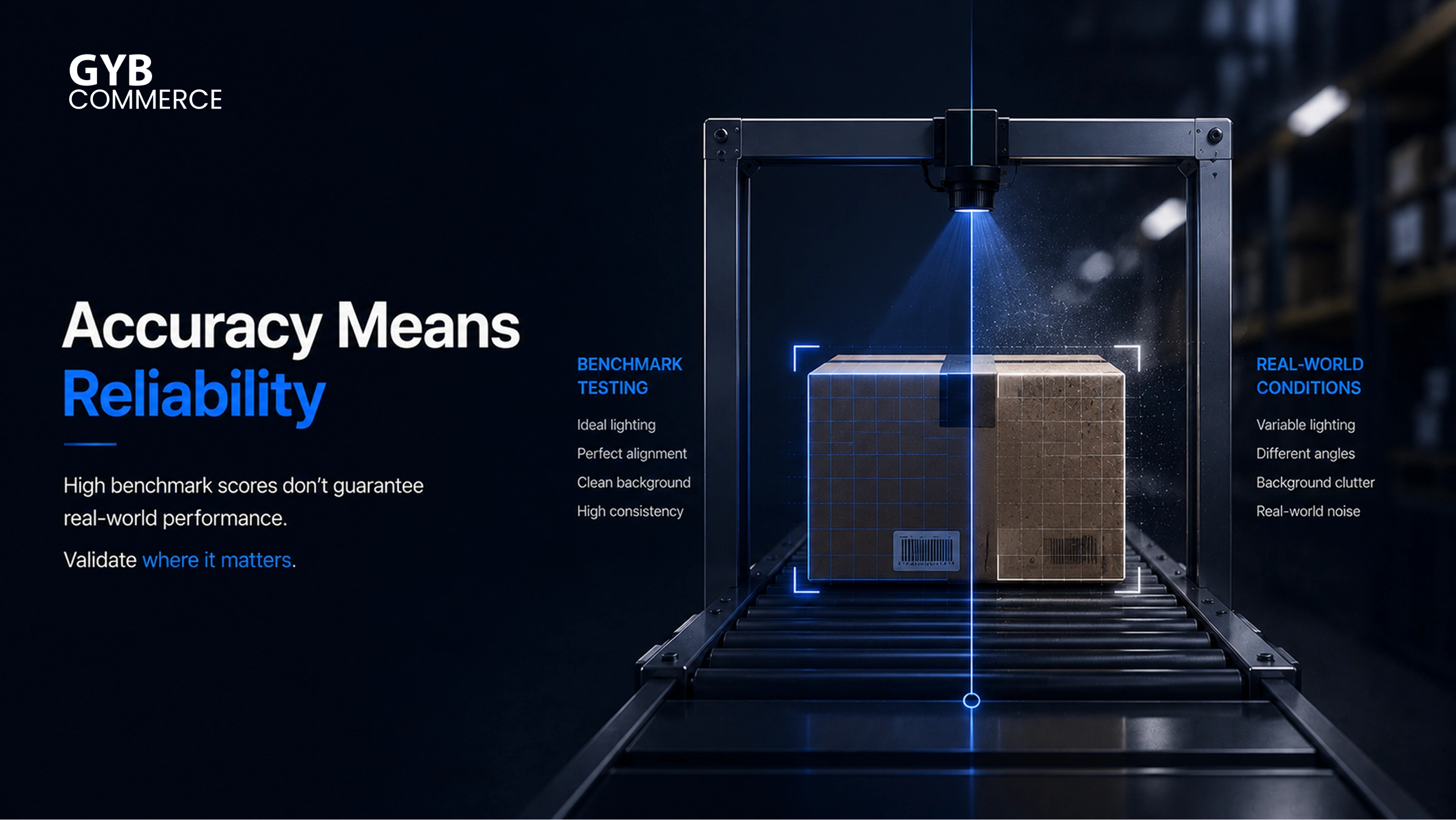
Organizations rarely struggle with adopting computer vision. The real challenge begins after deployment, when models start making decisions that affect operations, revenue, and customer experience. A system that performs well in testing can still fail in production. This gap creates confusion, especially when accuracy reports look strong but real outcomes do not match expectations.
Because of this, organizations treat accuracy as a business-critical factor, not just a technical metric. They evaluate computer vision solutions across multiple layers, including data quality, model performance, and real-world behavior. Instead of relying on a single number, teams break down accuracy into measurable components. This approach helps them understand where systems succeed, where they fail, and how improvements can be made over time.
Table of Contents
What Does Accuracy Mean in Computer Vision Solutions?
Why Accuracy Is More Than a Single Metric
Accuracy in computer vision is often misunderstood as a single percentage score. In reality, it reflects how well a system performs across different scenarios. Organizations go beyond basic accuracy and analyze deeper performance indicators to understand system reliability.
They focus on metrics such as precision, recall, and F1 score. Precision measures how many detected objects are correct. Recall measures how many actual objects were detected. The F1 score balances both, giving a clearer view of performance.
This becomes important when errors have different consequences. For example:
- A false positive may trigger unnecessary actions
- A false negative may cause missed detections
- Both can impact operations differently depending on the use case
Because of this, organizations evaluate accuracy in context rather than isolation.
Types of Computer Vision Tasks That Affect Evaluation
Different computer vision tasks require different evaluation methods. Accuracy in image classification is not measured the same way as in object detection or segmentation.
Common tasks include:
- Image classification, where the model assigns a label to an image
- Object detection, where the model identifies and locates objects
- Image segmentation, where the model separates objects at pixel level
Each task introduces unique challenges. For instance, object detection must correctly identify both the object and its position. Segmentation requires pixel-level precision, which increases complexity.
Modern systems often rely on technologies like convolutional neural networks and vision transformers. These models process images differently, which affects how accuracy is evaluated. As a result, organizations align evaluation methods with the specific task and model architecture.
How Organizations Define Evaluation Criteria Before Testing
Mapping Business Goals to Technical Metrics
Before testing begins, organizations define what accuracy means for their specific use case. This step connects technical evaluation with business outcomes.
For example, in healthcare applications such as analyzing chest X-rays for pneumonia, missing a case can have serious consequences. Therefore, recall becomes more important than precision. In contrast, in retail environments, false positives in object detection may lead to incorrect inventory updates.
Teams translate these needs into measurable goals. They define acceptable error rates and align them with operational impact. This ensures that evaluation reflects real-world priorities rather than abstract performance.
Setting Performance Benchmarks and Success Thresholds
Organizations rely on standard datasets and benchmarks to establish baseline performance. Datasets like COCO, ImageNet, and Open Images are commonly used for this purpose.
These benchmarks help teams compare models under controlled conditions. However, organizations do not stop at benchmark scores. They define their own success thresholds based on use-case requirements.
For instance, a model may need:
- High precision for fraud detection systems.
- High recall for safety-critical applications.
- Balanced performance for general-purpose systems.
By setting these thresholds early, organizations create a clear evaluation framework. This reduces ambiguity during testing and helps teams make informed decisions.
Request a Free Computer Vision Flow
How Organizations Evaluate Training Data Quality
Why Dataset Quality Directly Impacts Accuracy
Data quality is one of the most important factors in computer vision accuracy. Even advanced models cannot perform well if the training data is flawed.
Organizations analyze datasets for:
- Bias, which can cause models to perform poorly on certain groups
- Imbalance, where some classes are underrepresented
- Noise, including incorrect or inconsistent labels
To address these issues, teams use techniques such as data augmentation and synthetic data generation. These methods increase diversity and improve model generalization.
As a result, better data leads to more reliable performance across different scenarios.
How Teams Validate Annotation and Ground Truth Data
Accurate annotations are essential for training and evaluation. Organizations invest significant effort in validating ground truth data.
They use annotation tools and structured workflows to ensure consistency. Human reviewers often verify labeled data to reduce errors. In some cases, multiple annotators label the same data to measure agreement.
This process helps identify inconsistencies and improve labeling quality. It also ensures that evaluation results are based on reliable ground truth.
Without proper validation, accuracy metrics can be misleading. Therefore, organizations treat annotation quality as a core part of the evaluation process.
How Model Performance Is Tested Using Technical Metrics
Core Metrics Used to Measure Accuracy
Once data quality is ensured, organizations evaluate model performance using technical metrics. These metrics provide a detailed view of how the system behaves.
Commonly used metrics include:
- Precision, which measures correct positive predictions
- Recall, which measures how many actual positives are detected
- F1 score, which balances precision and recall
- Intersection over Union, used for segmentation tasks
Each metric highlights a different aspect of performance. Together, they provide a complete evaluation.
Teams analyze these metrics across different datasets and scenarios. This helps identify strengths and weaknesses in the model.
Evaluating Edge Cases and Failure Scenarios
Real-world environments introduce conditions that are not always present in training data. Organizations test models against edge cases to ensure robustness.
These include situations such as:
- Poor lighting or low image quality
- Occluded or partially visible objects
- Unusual angles or backgrounds
Testing these scenarios helps teams understand how the model behaves under stress. It also reveals failure patterns that may not appear in standard evaluations.
By addressing these issues early, organizations improve reliability before deployment.
How Organizations Test Computer Vision in Real-World Conditions
From Controlled Testing to Live Environments
After technical evaluation, organizations move to real-world testing. This step often reveals gaps that controlled environments cannot capture. A model that performs well on curated datasets may struggle with unpredictable inputs.
Therefore, teams simulate real operating conditions before full deployment. They introduce variations such as lighting changes, motion blur, and background noise. This helps them understand how the system behaves outside ideal scenarios.
In many cases, organizations run pilot deployments. These limited rollouts allow teams to observe performance without risking full-scale impact. Feedback collected during this phase becomes critical for refinement.
As a result, evaluation shifts from theoretical accuracy to real-world performance. This transition is essential for building production-ready systems.
Measuring Inference Speed and Latency
Accuracy alone is not enough in production environments. Organizations also measure how quickly a model processes data. This is where inference speed and latency become important.
For example, real-time systems such as surveillance or autonomous operations require instant responses. Even a slight delay can affect outcomes. On the other hand, batch processing systems can tolerate slower speeds.
Teams evaluate trade-offs between accuracy and performance. They compare deployment options such as edge devices and cloud-based processing. Edge AI reduces latency but may limit computational power. Cloud systems offer higher processing capacity but introduce delays.
By analyzing these factors, organizations ensure that models meet both accuracy and performance requirements.
How Organizations Compare Vendors and Solutions
Evaluating Model Architectures and Capabilities
When selecting vendors, organizations look beyond surface-level claims. They analyze the underlying model architectures and capabilities.
Different approaches, such as convolutional neural networks and transformer-based models, offer varying strengths. Some models perform better in structured environments, while others handle complex visual data more effectively.
Teams also evaluate whether solutions are pre-trained or custom-built. Pre-trained models offer faster deployment, but they may lack domain-specific accuracy. Custom models require more effort but can deliver better results for specialized use cases.
This comparison helps organizations identify solutions that align with their requirements.
Assessing Integration and Deployment Readiness
Accuracy evaluation does not stop at the model level. Organizations also assess how easily a solution integrates into existing systems.
They examine factors such as:
- API integration and compatibility with current workflows
- Deployment environments, including edge and cloud setups
- Scalability and ability to handle increasing data volumes
A highly accurate model is not useful if it cannot be deployed effectively. Therefore, integration and scalability play a key role in evaluation.
Organizations prioritize solutions that fit seamlessly into their infrastructure. This reduces implementation friction and accelerates time to value.
What Common Mistakes Organizations Make When Evaluating Accuracy
Over-Reliance on Benchmark Scores
One of the most common mistakes is relying too heavily on benchmark results. While datasets like COCO and ImageNet provide useful comparisons, they do not reflect real-world complexity.
A model that achieves high scores on benchmarks may still fail in production. This happens because benchmarks often use clean and structured data.
Organizations that focus only on these scores risk overestimating performance. Instead, they combine benchmark evaluation with real-world testing.
Ignoring Data Drift and Model Degradation
Another critical issue is ignoring how models change over time. Data drift occurs when real-world inputs differ from training data. This can reduce accuracy without immediate detection.
Organizations monitor model performance continuously. They track changes in input patterns and evaluate outputs regularly. When performance drops, they retrain models using updated data.
Without this process, even high-performing systems can degrade over time. Therefore, ongoing evaluation is essential for maintaining accuracy.
Best Practices to Improve Accuracy Evaluation Outcomes
Continuous Monitoring and Feedback Loops
Organizations treat evaluation as an ongoing process rather than a one-time activity. Continuous monitoring allows them to detect issues early and respond quickly.
They implement feedback loops that collect real-world data and feed it back into training pipelines. This helps models adapt to changing conditions.
Over time, this iterative approach improves both accuracy and reliability. It also ensures that systems remain aligned with evolving requirements.
Aligning Technical Accuracy with Business Outcomes
Finally, organizations focus on aligning technical metrics with business impact. Accuracy is only valuable if it leads to better decisions and outcomes.
Teams evaluate how model performance affects operations, costs, and customer experience. They prioritize improvements that deliver measurable value.
This approach shifts the focus from abstract metrics to practical results. It ensures that evaluation efforts contribute directly to organizational goals.
Frequently Asked Questions
How do organizations evaluate accuracy of computer vision solutions in real-world conditions?
Organizations evaluate accuracy of computer vision solutions by combining benchmark testing with real-world validation. They test models using live data, edge cases, and production environments. This approach ensures that performance reflects actual operating conditions rather than controlled scenarios.
What metrics are most important when evaluating computer vision accuracy?
The most important metrics include precision, recall, and F1 score. These metrics provide a balanced view of performance. For tasks like segmentation, Intersection over Union is also used to measure accuracy at a detailed level.
Why does dataset quality affect computer vision accuracy?
Dataset quality directly impacts how well models learn patterns. Poor labeling, bias, or imbalance can lead to inaccurate predictions. Organizations improve accuracy by validating annotations and increasing dataset diversity.
How do organizations test computer vision models before deployment?
Organizations test models through controlled experiments and pilot deployments. They simulate real-world conditions and evaluate performance across different scenarios. This helps identify issues before full-scale implementation.
What is the difference between benchmark accuracy and real-world accuracy?
Benchmark accuracy is measured using standardized datasets in controlled environments. Real-world accuracy reflects performance in dynamic and unpredictable conditions. Organizations prioritize real-world evaluation to ensure reliability.
How often should computer vision models be re-evaluated?
Models should be re-evaluated continuously. Changes in data and environment can affect performance over time. Regular monitoring and retraining help maintain accuracy and prevent degradation.
Can a highly accurate model still fail in production?
Yes, a highly accurate model can fail in production. This often happens when real-world conditions differ from training data. Organizations address this by testing edge cases and monitoring performance after deployment.
Final Takeaways
Organizations evaluate accuracy of computer vision solutions through a structured and multi-layered approach. They move beyond single metrics and focus on data quality, model performance, and real-world validation. Benchmark scores provide a starting point, but real-world testing determines true reliability. Continuous monitoring ensures that systems remain effective over time. Ultimately, accuracy must align with business outcomes to deliver meaningful value.