



Flutter App Development Company

Flutter App Development Company Focused on Structured Cross-Platform Engineering

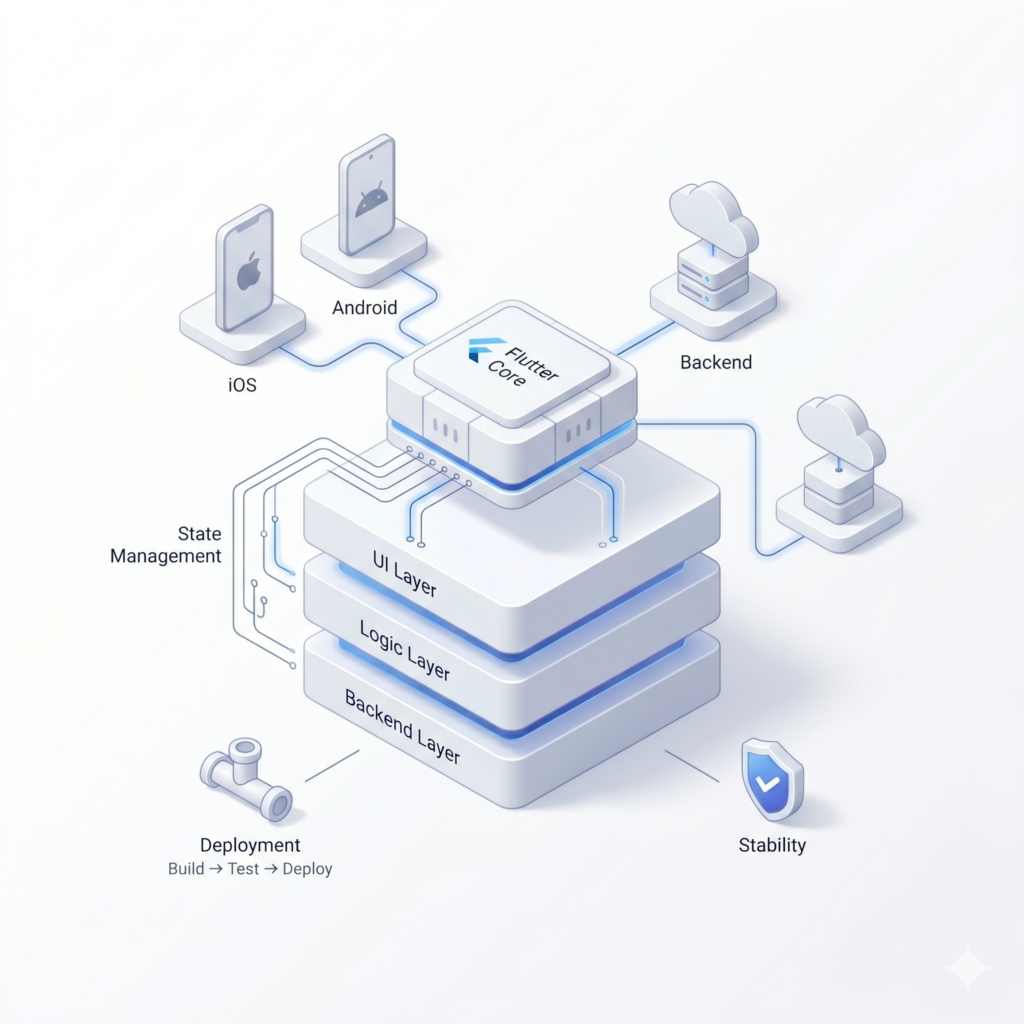
Most cross-platform initiatives fail when teams prioritize rapid UI assembly over structured application architecture. Poor state control, inconsistent backend integration, and unmanaged deployment cycles create instability as complexity increases. GYB Commerce operates as a Flutter app development company that engineers scalable cross-platform systems using Flutter and the Dart programming language to deliver controlled performance across iOS and Android. We build production-ready applications supported by disciplined backend integration, governed release workflows, and long-term maintainability planning.

Create Business Growth Through Structured Android App Development

Android app development is not only about building interfaces. It is about designing android app solutions that integrate seamlessly into the broader Android ecosystem and enterprise backend infrastructure.

When businesses invest in android app programming services without architectural validation, they often face:

Fragmented mobile UI/UX design across devices

Unstable API and backend integration layers

Performance bottlenecks under real-world load

Rework cycles during Play Store launch

Escalating maintenance overhead

Our android app development service prevents those risks by aligning every Android developer with system architecture before feature execution begins.

We focus on end-to-end development across the entire mobile app lifecycle, ensuring scalability, security, and predictable delivery outcomes.

Flutter Mobile App Development Services Across the Full Product Lifecycle

Strategic Product Discovery and Technical Evaluation

Every successful Flutter engagement begins with structured product discovery and technical scoping. We analyze integration requirements, workload expectations, data synchronization complexity, and long-term maintenance considerations before development begins. This evaluation ensures Flutter aligns with performance goals and operational constraints rather than being selected purely for cross-platform appeal.

Custom Flutter Application Engineering

We develop custom Flutter applications structured around modular Dart architecture and reusable widget systems. Instead of compressing features into a fragile single codebase, we engineer cross-platform applications that preserve clarity across UI, business logic, and backend integration layers.

Our engineering model includes:

This structure ensures that the single codebase advantage remains sustainable as application complexity grows.

UI Systems Built with Material Design and Cupertino Widgets

User interfaces must reflect platform expectations without fragmenting the shared architecture. We design interactive components using Material Design patterns for Android and Cupertino widgets for iOS while maintaining a unified design system. This approach preserves visual consistency while respecting native behavioral standards across devices.

Backend Integration and Data Synchronization

Cross-platform delivery is only stable when backend orchestration remains disciplined. Our flutter mobile app development services integrate structured REST API layers and GraphQL endpoints to ensure consistent data exchange across platforms.

Our integration methodology includes:

This prevents race conditions, redundant calls, and synchronization drift between mobile clients and backend services.

Cloud Deployment and App Store Deployment Governance

Deployment requires more than build compilation. We implement structured Cloud Integration frameworks and automated release workflows supported by CI/CD pipelines. Each release is validated through controlled QA Testing cycles before App Store Deployment, ensuring predictable version control and rollout stability.

Migration, Modernization, and Code Refactoring

Organizations often require modernization of outdated native applications or unstable cross-platform builds. We migrate legacy systems into structured Flutter environments by reviewing architecture constraints, isolating reusable logic, and rebuilding performance-sensitive modules without disrupting operational continuity.

Post-Launch Maintenance and Application Evolution

Flutter application development services extend beyond launch. We maintain runtime stability, monitor performance metrics, and optimize release cycles to support ongoing growth. Structured maintenance ensures that feature expansion does not compromise architectural clarity or system stability.

Dart and the Flutter SDK Rendering Model

Flutter uses the Flutter SDK and Dart to control rendering directly rather than relying on native UI bridges. This model enables consistent visual output across devices while reducing fragmentation between platforms. Direct rendering improves performance predictability and simplifies UI consistency management.

Single Codebase Efficiency Without Platform Drift

A single codebase reduces duplication only when governed by modular architecture and clear state separation. Flutter enables cross-platform development while maintaining structured control over reusable components. When engineered properly, this reduces long-term maintenance overhead without introducing platform-specific instability.

Hot Reload and Development Velocity Control

Flutter’s hot reload capability accelerates development cycles by allowing real-time UI iteration. This improves prototyping speed and reduces debugging friction during feature refinement. Development velocity increases without sacrificing architectural integrity when supported by disciplined code management.

Performance Characteristics Compared to Traditional Native Builds

Flutter compiles to native ARM code, enabling competitive runtime performance for most commercial use cases. Performance optimization still depends on architectural planning, efficient state management, and structured backend integration. Framework capability supports scale, but disciplined engineering ensures sustainability.

Application Architecture Planning

Every Flutter engagement begins with structured application architecture planning. We define modular boundaries, state management layers, backend interaction models, and deployment workflows before development begins. This planning phase ensures the cross-platform solution remains maintainable as feature complexity increases.

Reusable Widget Strategy and Code Maintainability

Flutter’s widget system enables reusable UI components when structured properly. We design reusable widget libraries that separate presentation logic from business rules, reducing duplication across the single codebase. This approach supports long-term maintainability and controlled feature expansion.

CI/CD Automation and QA Testing Discipline

Release stability depends on disciplined automation. We implement structured CI/CD pipelines and automated QA Testing frameworks to validate builds before deployment. This ensures regression control, predictable versioning, and stable rollouts across mobile ecosystems.

Security Controls and Compliance Validation

Security must be embedded within the architecture rather than added later. We implement secure API communication layers, encrypted data handling, authentication controls, and compliance validation workflows. These controls protect application integrity during runtime and deployment cycles.

Performance Optimization and Runtime Efficiency

Performance optimization requires structured state control and memory management planning. We evaluate rendering efficiency, animation behavior, and backend response patterns to prevent latency under load. Continuous runtime monitoring ensures the application scales without degrading user experience.

Core Language and Framework Layer

Our flutter mobile app development services are built on the Flutter SDK and the Dart programming language, enabling direct rendering control and predictable performance. This foundation supports modular architecture and cross-platform consistency across mobile devices.

Design Systems and UI Libraries

We implement Material Design standards for Android interfaces and Cupertino widgets for iOS experiences while preserving a unified visual system. This ensures design clarity without fragmenting the shared codebase.

Backend and Integration Stack

Backend alignment is achieved through structured REST API and GraphQL integration models. We also integrate services such as Google Firebase when real-time synchronization and cloud-backed data services are required.

DevOps and Release Automation

Deployment workflows are managed through controlled CI/CD pipelines, automated validation checks, and version governance frameworks. This ensures builds are securely deployed and efficiently managed across staging and production environments.

Cloud Infrastructure and Deployment Channels

Our cloud deployment strategy supports scalable infrastructure, secure configuration management, and reliable App Store Deployment processes. Controlled rollout management prevents release instability and preserves operational continuity.

Flutter vs Native Development: Architectural Trade-Offs

Evaluation Factor

Code Structure

Development Velocity

UI Consistency

Hardware Access

Maintenance Model

Release Governance

Scaling Complexity

Flutter

Single Dart-based codebase with modular widgets

Unified cross-platform rollout

Controlled rendering through Flutter SDK

Requires platform channels for advanced features

Centralized updates through shared architecture

Unified deployment workflows

Managed through modular architecture discipline

Native Development

Separate platform-specific codebases

Independent iOS and Android timelines

Platform-dependent UI rendering

Direct device-level access

Parallel maintenance efforts

Platform-specific release cycles

Platform scaling handled independently

Investment Considerations for Flutter Application Development Services

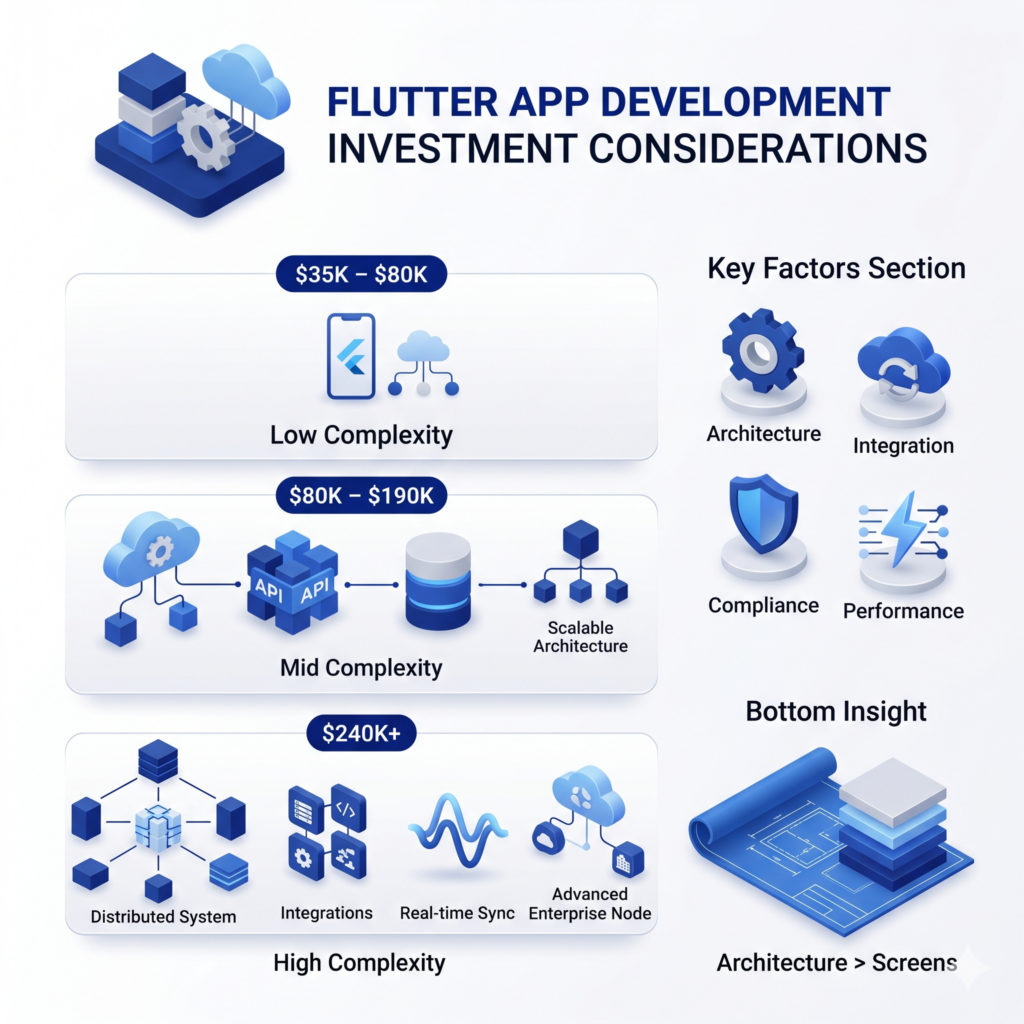
Cost modeling depends on integration depth, performance requirements, backend complexity, and compliance validation needs.

Cost modeling depends on integration depth, Low-complexity applications with limited backend integration typically range from $35,000 to $80,000. Mid-level systems requiring structured cloud integration and scalable architecture range between $80,000 and $190,000. High-complexity cross-platform systems involving advanced integrations and real-time updates may exceed $240,000 depending on scope.performance requirements, backend complexity, and compliance validation needs.

Total investment is influenced more by architectural planning than by interface size or screen count.

Case Studies

Operational Management Platform Rebuilt Using Flutter

Business Context

A multi-location logistics organization operated fragmented mobile applications across iOS and Android platforms. Independent codebases caused inconsistent functionality, delayed updates, and backend synchronization issues.

Technical Constraints

The organization required real-time updates, scalable cloud deployment, and unified UI consistency without increasing maintenance overhead. Existing native builds lacked structured integration discipline and version control clarity.

Architecture Implementation

We rebuilt the platform using a modular Flutter architecture supported by structured backend integration and disciplined CI/CD automation. Reusable widget systems reduced duplication while preserving platform-specific visual consistency.

Integration Strategy

The solution integrated operational dashboards, inventory systems, and reporting services through controlled REST API orchestration and cloud integration workflows. Deployment pipelines ensured predictable rollout management.

Measured Outcomes

Within six months, release cycles accelerated by 34 percent and defect rates declined by 39 percent. Maintenance overhead decreased through unified codebase governance and structured deployment control.

arrow

Why GYB Commerce Stands Out Among Flutter App Development Companies

System-Level Planning Before Interface Execution

GYB Commerce begins with application architecture planning rather than immediate UI construction. This prevents structural instability that often emerges from feature-first development approaches.

Disciplined Single Codebase Governance

We treat the single codebase advantage as a governance responsibility rather than a shortcut. Modular architecture and structured state separation prevent platform drift as systems scale.

Deep Backend and Cloud Integration Expertise

Our flutter development agency prioritizes backend integration and cloud deployment discipline to ensure synchronization consistency and predictable scaling behavior.

Lifecycle-Oriented Cost Forecasting

We evaluate maintenance implications, deployment workflows, and integration scope before development begins. This ensures long-term investment clarity rather than reactive budgeting.

Release Governance and Long-Term Maintainability

Controlled CI/CD automation, structured QA validation, and documented architecture practices ensure predictable evolution across product lifecycles.

What Clients Say About Working With Us

Rated 5 out of 5
4.9
Rated 4.5 out of 5

Frequently Asked Questions

Quick answers to the most common questions

A flutter app development company provides structured application architecture, cross-platform engineering, backend integration planning, and lifecycle governance. The focus extends beyond interface creation into long-term system stability.

Flutter mobile app development services vary based on integration depth, scalability requirements, and compliance needs. Architectural planning and backend complexity influence total investment more than screen count.

Flutter supports business-critical systems when engineered with modular architecture and disciplined integration models. Stability depends on structured state control and governed deployment workflows.

Flutter applications integrate with existing backend systems through REST API and GraphQL orchestration layers. Structured middleware ensures consistent data synchronization across platforms.

Security depends on encrypted communication, controlled authentication layers, and structured cloud deployment practices. When engineered correctly, Flutter applications support secure production environments.

Migration begins with architecture review and codebase evaluation to identify reusable logic. Structured refactoring ensures operational continuity during transition.

Development timelines depend on complexity and integration requirements. MVP builds may require three months, while large-scale cross-platform systems can require six to eight months.

Post-launch support includes performance monitoring, CI/CD management, feature enhancements, and stability optimization. Structured maintenance ensures predictable long-term evolution.

Contact us

Partner with Us for Comprehensive IT

We’re happy to answer any questions you may have and help you determine which of our services best fit your needs.

Your benefits:
What happens next?
1

We Schedule a call at your convenience 

2

We do a discovery and consulting meting 

3

We prepare a proposal 

Schedule a Free Consultation

Technologies that we use.

OpenAI
Anthropic Claude
LangChain
Amazon Web Services
WhatsApp Business API
LlamaIndex
n8n
FastAPI

Ready to reduce your technology cost?

Our success stories

GYB Commerce blogs

Cross-Platform Applications Built for Sustainable Growth

Flutter delivers value when supported by disciplined architecture, integration governance, and structured lifecycle management. As a flutter app development company, GYB Commerce engineers cross-platform systems designed for long-term operational clarity rather than short-term acceleration.

top
Simplifying IT
for a complex world.
Platform partnerships