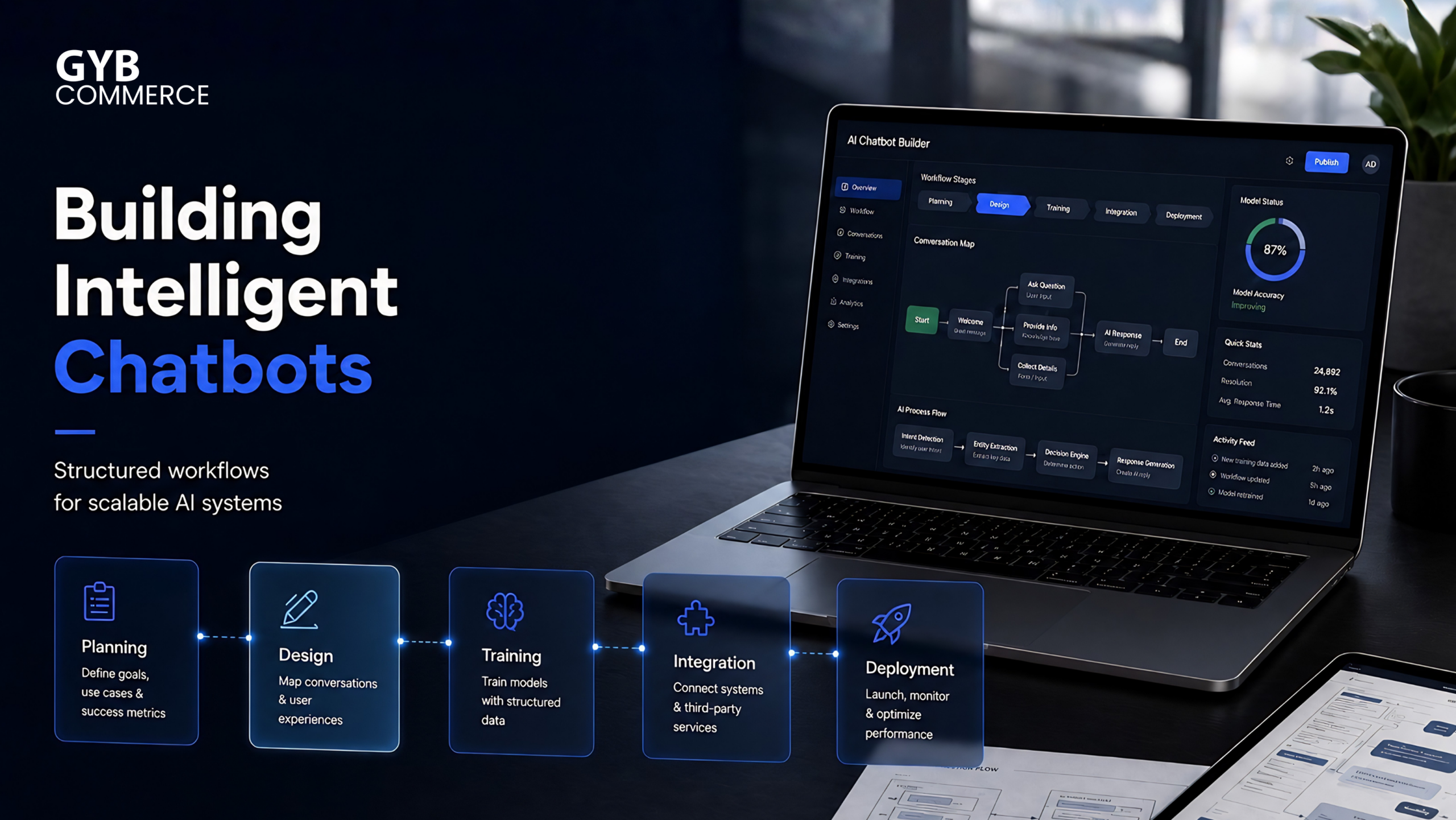
Building an AI chatbot is not just a technical task. It is a structured process that combines planning, design, data, and continuous improvement. Many businesses assume it starts with coding, but the real work begins much earlier.
This guide explains the AI chatbot development process step by step. It focuses on how businesses can approach it in a practical and structured way. By understanding each stage, it becomes easier to build a chatbot that actually delivers value.
Table of Contents
Understanding AI Chatbot Development Process
What is AI chatbot development process?
The AI chatbot development process refers to the complete lifecycle of building a chatbot, from idea to deployment and beyond. It includes planning, designing conversations, training models, integrating systems, and continuous optimization.
This process ensures that the chatbot is not just functional, but also aligned with business goals. Without structure, chatbot development often leads to poor performance and user frustration.
How AI chatbots differ from rule-based systems?
Rule-based chatbots follow predefined scripts. They respond only when user input matches specific conditions. This makes them limited in handling real conversations.
AI chatbots, on the other hand, understand intent and context. They can interpret different ways of asking the same question. This makes them more flexible and useful in real scenarios.
Core technologies behind chatbot development
AI chatbots rely on multiple technologies working together. These technologies enable them to understand language, process data, and respond accurately.
- Natural Language Processing helps interpret user input
- Machine Learning improves responses over time
- Natural Language Understanding identifies intent and meaning
Together, these technologies allow chatbots to move beyond simple automation and handle complex interactions.
Request Free AI Chatbot Development Consultation
Why Businesses Need a Structured Chatbot Development Process
How structured development improves outcomes
A structured approach reduces confusion during development. It ensures that every stage has a clear purpose. This leads to better planning and execution.
Without structure, chatbots often fail to meet expectations. They may respond incorrectly or fail to handle real queries. A defined process helps avoid these issues.
Impact on customer support and engagement
AI chatbots play a major role in customer communication. They provide instant responses and handle repetitive queries efficiently. This improves support quality.
A well-developed chatbot also improves engagement. It guides users through interactions and provides relevant responses. This creates a smoother experience.
Role in automation and scalability
Automation is one of the main reasons businesses invest in chatbots. They reduce manual workload and handle large volumes of queries.
Scalability is another key advantage. A chatbot can serve multiple users at the same time. This allows businesses to grow without increasing support costs.
Before you kick off any of these stages, make sure your budget is aligned with the scope. Our AI chatbot development cost breakdown covers what each phase typically costs.
Key Stages in AI Chatbot Development Process
Stage 1: Defining goals and use cases
Every chatbot should start with a clear purpose. Without defined goals, development becomes unfocused. The chatbot may fail to deliver meaningful results.
Common use cases include customer support, lead generation, and internal assistance. Starting with a focused use case makes the process easier to manage.
Stage 2: Understanding users and conversation intent
Understanding users is essential for building effective chatbots. This involves identifying common queries, user behavior, and expectations.
Intent recognition plays a key role here. It helps the chatbot understand what the user wants. This improves response accuracy and relevance.
Stage 3: Choosing chatbot platform or framework
The choice of platform affects how the chatbot is built and scaled. Some tools are designed for simplicity, while others offer deeper control.
Platforms like Dialogflow and Rasa provide different levels of flexibility. The right choice depends on technical expertise and project requirements.
Stage 4: Designing conversation flow and logic
Conversation design determines how users interact with the chatbot. A clear flow ensures that conversations remain structured and easy to follow.
Poor design can confuse users and reduce engagement. A well-planned dialogue flow improves usability and overall experience.
Stage 5: Training the chatbot model
Training is where the chatbot learns how to respond. It involves defining intents, entities, and providing relevant data.
The quality of training data directly affects performance. Well-structured data leads to more accurate and meaningful responses.
Stage 6: Integrating APIs and backend systems
A chatbot becomes more useful when it connects with external systems. API integration allows it to retrieve and update data in real time.
For example, it can fetch order details or update customer records. This turns the chatbot into a functional tool rather than just a conversational interface.
Stage 7: Testing and deployment
Testing ensures that the chatbot works correctly before launch. It involves checking responses, identifying errors, and improving accuracy.
Deployment makes the chatbot available to users. This is usually done through websites, apps, or messaging platforms.
One step that businesses often underestimate is training the chatbot on their actual domain data. Our guide on training an AI chatbot for industry-specific questions covers this in full.
Stage 8: Continuous monitoring and improvement
The development process does not end after deployment. Continuous monitoring is required to track performance and identify gaps.
Updating training data and improving responses helps the chatbot evolve. Over time, it becomes more accurate and effective.
One step that businesses often underestimate is training the chatbot on their actual domain data. Our guide on training an AI chatbot for industry-specific questions covers this in full.
How AI Chatbots Work Within the Development Process
From user input to response generation
Every interaction starts with user input. The chatbot processes this input and generates a response based on its training.
This process happens in real time. It involves multiple steps that work together to deliver accurate responses.
Role of NLP and intent recognition
Natural Language Processing helps the chatbot understand user input. It breaks down the message and identifies key elements.
Intent recognition determines what the user wants. This allows the chatbot to respond appropriately.
How integrations make chatbots functional
Integrations allow chatbots to perform actions. Without them, the chatbot is limited to answering questions.
Connecting with systems like CRMs and databases improves functionality. It enables the chatbot to provide real-time information.
Choosing the Right Tools and Technologies
Popular chatbot frameworks and platforms
There are many tools available for chatbot development. Each tool offers different features and capabilities.
Some platforms focus on ease of use, while others provide advanced customization. Choosing the right tool depends on project needs.
When to use no-code vs custom development
No-code platforms are suitable for simple projects. They allow quick setup without technical knowledge.
Custom development offers more flexibility. It is better suited for complex use cases and long-term scalability.
Balancing flexibility and scalability
Choosing the right approach requires balance. A simple tool may not support future growth. A complex solution may require more resources.
It is important to consider both current needs and future expansion. This helps avoid limitations later.
Common Challenges in AI Chatbot Development Process
Building a chatbot is not always straightforward. Even with the right tools, many projects fail due to avoidable mistakes. Understanding these challenges helps create a more reliable system.
Poor planning and unclear objectives
Many chatbot projects start without clear goals. This leads to confusion during development and weak outcomes. The chatbot may exist, but it does not solve a real problem.
Clear objectives guide the entire process. They help define use cases, data requirements, and success metrics. Without them, development becomes inefficient.
Lack of quality training data
Training data plays a major role in chatbot performance. If the data is incomplete or poorly structured, the chatbot will struggle. It may give incorrect or irrelevant responses.
High-quality data improves understanding and accuracy. It ensures the chatbot responds in a meaningful way. Investing in data preparation is essential.
Weak conversation design
A chatbot is only as good as its conversation flow. Poor design can confuse users and reduce engagement. Users may not know what to ask or how to proceed.
A structured dialogue flow improves usability. It guides users and keeps interactions clear. Good design makes the chatbot easier to use.
Integration limitations
Many chatbots fail because they are not connected to the right systems. Without integrations, they cannot perform actions or fetch real data. This limits their usefulness.
Integrating with CRMs, databases, and APIs makes chatbots more functional. It allows them to provide real-time responses and complete tasks.
Ignoring continuous improvement
Some businesses treat chatbot deployment as the final step. In reality, it is just the beginning. Without updates, the chatbot becomes outdated.
Continuous improvement ensures long-term performance. Regular updates and monitoring keep the chatbot relevant and effective.
Best Practices for a Successful AI Chatbot Development Process
Building an effective chatbot requires more than following steps. It involves applying the right practices throughout the process. These practices improve performance and reduce risks.
Start with a focused use case
Trying to solve too many problems at once increases complexity. It makes development difficult and reduces effectiveness. Starting with one clear use case is more practical.
A focused approach allows better testing and faster improvement. Once the chatbot performs well, additional features can be added.
Use real data for training
Real data reflects actual user behavior. It includes variations, errors, and natural language patterns. This makes training more effective.
Using real conversations improves accuracy. It prepares the chatbot for real-world interactions.
Design for user experience
User experience should always be a priority. If the chatbot is difficult to use, users will stop interacting with it. Clear communication improves engagement.
Simple language and structured responses make interactions easier. This leads to better outcomes.
Plan for scalability early
A chatbot should be able to grow with the business. Planning for scalability ensures that it can handle increased usage. This avoids future limitations.
Choosing the right architecture and tools supports long-term growth. It reduces the need for major changes later.
If you’re handling the technical build internally, our hands-on guide on how to build an AI chatbot from scratch covers the implementation details this process overview leaves out.
Combine automation with human fallback
Automation is useful, but it cannot handle every situation. Some queries require human assistance. Ignoring this can lead to poor user experience.
Providing a fallback option ensures that users can get help when needed. This creates a balanced system.
How Long Does the AI Chatbot Development Process Take?
The timeline for chatbot development depends on several factors. These include complexity, data availability, and integration requirements. Understanding timelines helps set realistic expectations.
Timeline for simple vs complex chatbots
Simple chatbots can be developed in a few days or weeks. These are usually built using no-code platforms and handle basic tasks.
More advanced chatbots require several weeks or months. They involve custom development, integrations, and detailed training. The complexity of features affects development time.
Factors that affect development time
Several factors influence how long it takes to build a chatbot. Data preparation, testing, and integrations are some of the most important.
Projects with complex requirements take longer. Proper planning helps reduce delays and improve efficiency.
Frequently Asked Questions
What is the AI chatbot development process?
The AI chatbot development process includes planning, designing, training, integrating, and deploying a chatbot. It also involves continuous monitoring and improvement. Each stage plays an important role in ensuring performance.
A structured process helps build chatbots that are accurate and reliable. It ensures alignment with business goals.
How long does it take to develop an AI chatbot?
The development timeline depends on the chatbot’s complexity. Simple chatbots can be built quickly, while advanced systems require more time. Integrations and data preparation also affect timelines.
Proper planning helps manage development time effectively. It reduces delays and improves outcomes.
What are the main stages in chatbot development?
The main stages include defining goals, designing conversations, training the model, integrating systems, testing, and deployment. Continuous improvement is also an important stage.
Each stage contributes to overall performance. Skipping steps can lead to poor results.
How do AI chatbots improve business operations?
AI chatbots automate repetitive tasks and provide instant responses. This improves efficiency and reduces workload for support teams. They also enhance customer engagement.
By handling multiple users simultaneously, chatbots improve scalability. This supports business growth.
What are common mistakes in chatbot development?
Common mistakes include poor planning, weak training data, and lack of integration. Ignoring user experience and continuous improvement also affects performance.
Avoiding these mistakes improves chatbot reliability. It leads to better outcomes.
Final Takeaways
The AI chatbot development process is more than just building a tool. It is a structured approach that combines planning, data, design, and continuous improvement. Each stage contributes to the overall success of the chatbot.
Businesses that follow a clear process achieve better results. They build chatbots that are accurate, scalable, and aligned with user needs. Over time, continuous improvement ensures long-term effectiveness.